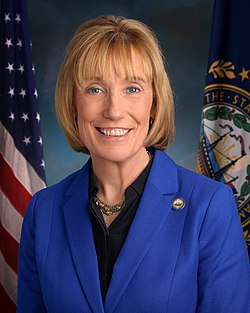
Maggie Hassen , née Margaret Wood ( born Maggie Hassan , February 27, 1958 , Boston , Mass. ) Is an American politician representing the Democratic Party . A senator from the state of New Hampshire from January 3, 2017 , from 2013 to 2016, served as governor of this state . In 2005 - 2010, a member of the Senate of New Hampshire .
| Maggie Hassen | |||||||
|---|---|---|---|---|---|---|---|
| English Maggie hassan | |||||||
 | |||||||
| Predecessor | Kelly ayott | ||||||
| |||||||
| Predecessor | John Lynch | ||||||
| Successor | Chris Sununu | ||||||
| Birth | February 27, 1958 (61 years old) Boston , Massachusetts | ||||||
| Father | |||||||
| Spouse | |||||||
| The consignment | Democratic Party | ||||||
| Education | Brown University School of Law, Northeastern University | ||||||
| Website | |||||||


Biography
Maggie Wood was born in Boston in 1958 and grew up in the suburbs of this city of Lincoln. Her mother was a teacher, and her father was a professor at the Massachusetts Institute of Technology , and later Deputy Minister of Housing and Urban Development in Lyndon Johnson’s office [1] . Maggie received her first academic degree at Brown University (Rhode Island), and in 1985 she became a doctor of law at Northeastern University [2] . At Brown University, she met her future husband, Thomas Hassen. Hassen is a native of the so-called “black Irish”, whose ancestors probably immigrated to Ireland from Arab countries [3] .
After completing her professional education, Hassen began her legal career, becoming the legal adviser at the in the 1990s. In a marriage with Tom Hassen, she had two children - Ben and Maggie. The health status of Ben, suffering from cerebral palsy , first brought his mother to politics when, in the early 1990s, she became an activist in campaigns to protect the rights of people with disabilities and their families in New Hampshire, where she lived with her husband, the administrator of the Phillips Academy in Exeter . In 1999, Maggie Hassen was included by the then Governor of New Hampshire, Djinn Shahin, as part of the Commission on the Quality of Education [1] .
In 2002, the leadership of the Democratic Party of New Hampshire nominated Hassen as a candidate for an empty seat in the state Senate. She lost the election to Republican Russell Prescott, but in 2004 she ran again and this time went to the Senate. There, Hassen played an important role in the creation of a commission to monitor health facilities, including advocating for the commission to have the right to regulate tariffs for hospital services. As the leader of the Senate Democratic Majority, she was also a central player in legitimizing gay marriage in New Hampshire , including overcoming resistance in her own faction. Hassen retained her seat in the New Hampshire Senate until 2010, when she again lost the election to Prescott [1] .
In 2012, Hassen became a candidate for governor of New Hampshire. Her program balanced between the state’s libertarian traditions and the ideology of the Democratic Party, which was gaining popularity in New Hampshire at that time, and emphasized the creation of new jobs and an increase in educational allocations, while rejecting the possibility of tax increases. Hassen was elected governor for a two-year term, and in the next election she won re-election [3] , remaining in this post until 2016 [2] . For a certain period, she remained the only female governor representing the Democratic Party (four more female governors represented Republicans at the same time) [3] .
As a governor, she proved herself to be a supporter of cooperation between political camps, which, in particular, showed the state budget for 2014, which the New Hampshire Legislative Assembly, numbering about 400 deputies, approved almost unanimously. Some of the Hassen projects received the support of the Republicans and were simultaneously rejected by the Democrats - in particular, the project of opening the first legal casino in the state, which was twice approved by the Republican majority in the Senate, but did not go through the House of Representatives, where Hassen had his own party [3] . During Hassen's tenure as governor, state unemployment was one of the lowest in the United States; tuition at public universities was frozen for the first time in 25 years, and tuition at district colleges was reduced. In the same years, the state government faced a severe crisis related to the massive use of opioids , and was forced to organize a fight against this phenomenon [4] .
At the end of 2015, Hassen, while continuing to act as governor of the state, nominated herself for the US Senate , becoming in this campaign a rival to the incumbent Republican Senator Kelly Eyott [5] . The fight turned out to be equal, and in the 2016 elections, a preliminary count of ballots in the state gave Hassen victory with a difference of only 1023 votes. The Ayotte headquarters refused to demand a recount, and the victory of Hassen became official [6] . In the US Senate, Hassen joined the internal security committees; on health care, education, labor law and pensions; and business, science, and transportation. She also became a member of the Joint Economic Committee of Congress [4] .
Notes
- ↑ 1 2 3 Emily Corwin. Childhood Experiences And Parenthood Led Maggie Hassan To Politics . New Hampshire Public Radio. Date of treatment June 30, 2018.
- ↑ 1 2 Hassan, Margaret Wood (Maggie), (1958 - ) . Biographical Directory of the United States Congress . Date of treatment July 1, 2018.
- ↑ 1 2 3 4 Molly Ball. How She Does It . The Atlantic (April 11, 2014). Date of treatment July 1, 2018.
- ↑ 1 2 hassan.senate.gov - official site of Maggie Hassen (English)
- ↑ Emily Cahn. Maggie Hassan Will Run for Senate in New Hampshire . Roll Call (October 5, 2015). Date of treatment July 1, 2018.
- ↑ Beth Germano. Hassan Declared Winner In NH Senate Race; Ayotte Concedes Neopr . CBS Boston (November 9, 2016). Date of treatment July 1, 2018.
Links
- hassan.senate.gov - official site of Maggie Hassen (English)