Junior Wells ( English Junior Wells , full name - Eimos Wells Blackmore Jr. , Amos Wells Blakemore Jr .; born December 9, 1934 , Memphis , Tennessee , USA - January 15, 1998 , Chicago , Illinois ) - American blues singer, master of percussion harmonics , as well as one of the founders of the Chicago Blues style.
| Junior Wells Junior wells | |
|---|---|
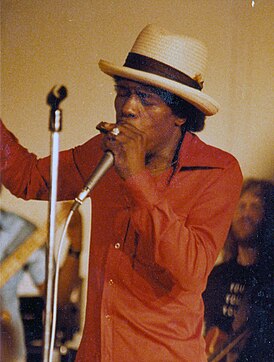 Junior Wells at a concert in Illinois, 1983 | |
| basic information | |
| Full name | Amos Wells Blackmore Jr |
| Date of Birth | December 9, 1934 |
| Place of Birth | Memphis , Tennessee , USA |
| Date of death | January 15, 1998 (63 years old) |
| A place of death | Chicago , Illinois , USA |
| Buried | |
| A country |  USA USA |
| Professions | Singer , musician |
| Years of activity | 1950 - 1998 |
| Instruments | Harmonica |
| Genres | Blues Chicago blues |
| Collectives | The aces |
| Labels | States, Chief, Telarc, Vanguard, Chess |
Recorded with many blues and rock and roll musicians, including Buddy Guy , The Rolling Stones , Van Morrison , Muddy Waters and others.
Junior Wells was posthumously inducted into the Blues Hall of Fame in 1998 [1] .
Content
- 1 Biography
- 2 Discography
- 2.1 Solo albums
- 2.2 In collaboration with Buddy Guy
- 3 notes
- 4 Literature
- 5 Links
Biography
Junior Wells was born on December 9, 1934 in Memphis , Tennessee , the childhood of the future musician passed in the city of Marion , Arkansas . He began to play the harmonica from an early age, gained playing skills thanks to his enthusiasm for the work of Junior Parker and Sunny Boy Williamson II. The story that happened to Wells at the age of 12 became famous: he stole a two-dollar harmonica from a local pawnshop, but when the juvenile judge heard what skill Wells was playing the instrument, he personally paid for the harmonica [2] . In 1948, after the divorce of his parents, Junior moved with his mother to Chicago , where he, along with local musicians, became a regular at clubs and pubs. In 1950, he went through an impromptu audition with guitarists Luis and David Myers, as a result of which the band The Deuces ( Rus. Devils ) was formed. Later they were joined by drummer Fred Below, and the group changed its name to The Aces ( Russian Aces ) [3] . During his time in the band, Wells' performance style and his mastery of harmonica were strongly influenced by another famous bluesman, Little Walter .
After Little Walter left the Muddy Waters band in 1952, Wells took his place. Their first joint recording took place at Chess Records. In addition to participating in Waters 'band, Wells continued to play The Aces, and in 1953, at the States Records studio, musicians under the guidance of Wells recorded their first hits, including Messin' with the Kid, Come on in This House, Hoodoo Man ”,“ Cut That Out ”,“ It Hurts Me Too ”and the instrumental“ Eagle Rock ”and“ Junior's Wail ” [3] .
In 1957, Wells began collaborating with music producer Mel London. The collaboration has resulted in numerous hits, including "I Could Cry" and "Lovey Dovey Lovely One." Wells's first single to hit the charts was “Little by Little,” also produced by London. The composition took 23rd place in the Billboard charts in June 1960 [4] . Wells's harmonica was relegated to the background in the late 1950s, giving way to live vocals.
The early 1960s marked a period of long and fruitful collaboration between Junior Wells and guitarist Buddy Guy , with whom in 1965 they recorded the first Wells album, Hoodoo Man Blues , at Delmark Records Studios [5] [6] . The record was entered into the Blues Hall of Fame in 1984 [7] . Together with Guy, they also performed on the same stage with The Rolling Stones during their tour in 1970, at the same time they recorded together with Eric Clapton at the Atlantic studio, and in 1974 Wells and Guy opened the performance of Muddy Waters at the Montreux festival [8 ] .
A notable change in the Wells style occurred in 1968 with the release of the album You're Tuff Enough - it was a funky record, it traced the strong influence of James Brown [3] . But, despite the fact that the albums South Side Blues Jam (1971) and On Tap (1975) received positive feedback, the subsequent work of the 1980s provoked conflicting opinions. Moreover, Wells began to record less and less solo songs every year.
In 1991, Wells and Buddy Guy recorded the joint acoustic album Alone and Acoustic in Paris, which was coldly received by critics. However, the recording of a new disc was interesting to musicians primarily as an experience of acoustic music making, captured in studio conditions.
The 1997 album Come on in This House received encouraging reviews and also brought Wells the Bluesman William Christopher Handy Award. Junior Wells continued to perform and give concerts until in the summer of 1997 he was diagnosed with lymphoma . In the fall of the same year, he suffered a heart attack during treatment, and as a result fell into a coma [9] . Wells remained in this state until his death on January 15, 1998 [10] . He was buried in in Chicago [11] .
After the death of the musician, a number of records from live performances ( Last Time Around - Live at Legends , Live at Theresa's 1975 ), as well as a compilation of Wells' best songs, were released. In addition, in 1998 the film “ The Blues Brothers 2000 ” was released, in which Junior Wells played a cameo while he was still alive [12] .
Discography
Solo albums
|
Issued posthumously:
|
In collaboration with Buddy Guy
|
|
Notes
- ↑ 1998 Blues Hall of Fame Inductees . Blues.org.
- ↑ Junior Wells (inaccessible link) . Centerstagechicago.com. Date of treatment November 12, 2012. Archived October 17, 2011.
- ↑ 1 2 3 Dahl, Bill. Junior Wells . Allmusic.com. Archived December 30, 2012.
- ↑ Joel, 1988 , p. 438.
- ↑ Russell, 1997 , p. 183-184.
- ↑ Junior Wells . Allaboutjazz.com. Archived December 30, 2012.
- ↑ 1984 Blues Hall of Fame Inductees . Blues.org.
- ↑ Verkhovsky, Ilya. Buddy Guy & Junior Wells “Last Time Around - Live At Legends” 1998 . Bluesnews.ru. Archived December 30, 2012.
- ↑ Bendersky, Ari. Blues Legend Junior Wells In Coma; Near Death . Rolling Stone (11 September 1997). Archived January 13, 2013.
- ↑ Ratliff, Ben. Junior Wells, Central Player in Chicago Blues, Is Dead at 63 . New York Times (January 17, 1998). Archived January 13, 2013.
- ↑ Junior Wells . Findagrave.com. Archived January 13, 2013.
- ↑ IMDB: Blues Brothers 2000 . IMDB.com. Archived January 7, 2013.
Literature
- Russell, Tony. The Blues - From Robert Johnson to Robert Cray. - Dubai: Carlton Books Limited, 1997. - ISBN 1-85868-255-X .
- Whitburn, Joel. Top R&B Singles 1942-1988. - Record Research, 1988. - ISBN 0-89820-068-7 .
- Wilcock, Donald; Guy, Buddy. Damn Right I Got the Blues. - Woodford Press, 1993 .-- ISBN 094262713X .
- Schumacher, Michael. Crossroads - The Life and Music of Eric Clapton. - Hyperion, 1995. - ISBN 0-7868-8166-6 .
Links
- Junior Wells official Myspace page
- Junior Wells on Discogs
- "Messin 'With the Kid" performed by Wells, 1974