
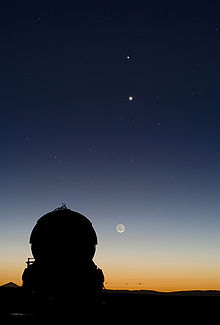
Compound (in astronomy) is a configuration of celestial bodies in which their ecliptic longitudes are equal [1] [2] [3] . Sometimes the concept of a connection is used in right ascension , and not in ecliptic longitude [4] . Thus, during the connection of two bodies, they are relatively close to each other in the celestial sphere (but the moment of connection does not necessarily coincide with the moment of maximum approximation). In astrology, the term conjunction can be used [5] .
In conjunction there can be two objects of the Solar system or an object of the Solar system and some more distant object.
There is an astronomical symbol for the compound:  ( Unicode code is U + 260C). In modern science, it is not used.
A similar, but less clearly defined phenomenon is known as the parade of planets . This is a more or less close rapprochement on the celestial sphere of some of them. This term has no clear definition and is used mainly in the media and popular literature.
Content
Connection to the Sun
The connection of a celestial body with the Sun can occur in two cases: either when this body is between the Earth and the Sun, or when the Sun is between the Earth and this body. For outer planets (located farther from the Sun than the Earth), only the second situation is possible. For inner planets (i.e. Mercury and Venus ) both are possible. Accordingly, they distinguish between the lower and upper conjunctions : in the lower conjunction the planet is between the Earth and the Sun, and in the upper conjunction beyond the Sun [2] .
The opposite situation (when the ecliptic longitudes of a given celestial body and the Sun are opposite) is called the opposition of this body.
The time interval between two compounds (of the same name) of any celestial body with the Sun is called the synodic period of revolution of this body.
In the lower connection to the Earth, the night side of the planet is turned, and in the upper - the day side. The angular size of the planet, visible from the Earth, is the largest in the lower junction, and the smallest in the upper junction.
If the ecliptic latitude of the planet in the lower conjunction is small enough, this planet passes along the solar disk. They happen both at Mercury , and at Venus .
The conjunction of the moon with the sun is called the new moon . If at this time the moon has a sufficiently small ecliptic latitude, a solar eclipse occurs .
Influence on communications with spacecraft
During the connection of the planets with the Sun, communication with the devices that study them is very difficult. When the Sun is between the spacecraft and the Earth, there is a risk that an antenna equipped with an automatic navigation system will begin to monitor the Sun. This is because the Sun acts as a strong generator of electromagnetic noise, creating a much more powerful signal than a signal from an earth station. In particular, the connection of Mars with the Sun makes it impossible to communicate with Mars rovers for about two weeks. For example, one of such periods lasted from November 29, 2008 to December 13, 2008 (15 days).
The passage of Mercury on the disk of the Sun (November 8, 2006).
Passage of Venus on the disk of the Sun (June 8, 2004).
Io passes over the surface of Jupiter (image from the Cassini spacecraft ).
A computer simulation of the passage of Venus visible from Earth before Jupiter , which occurred during their connection on January 3, 1818.
See also
- Passage of Venus on the disk of the Sun
- The passage of Mercury on the disk of the Sun
- Coverage (Astronomy)
- Planet confrontation
- Eclipse
- en: List of conjunctions (astronomy)
- Parade of planets
- Syzygy
Notes
- ↑ Kononovich E.V., Moroz V.I. General course of astronomy: a training manual. - Moscow: URSS editorial, 2004. - P. 56-57. - 544 p. - ISBN 5-354-00866-2 .
- ↑ 1 2 Planet configurations // Great Soviet Encyclopedia : [in 30 vol.] / Ch. ed. A.M. Prokhorov . - 3rd ed. - M .: Soviet Encyclopedia, 1969-1978.
- ↑ Surdin V.G. Compound . Astronet. Date of treatment January 5, 2013. Archived January 13, 2013.
- ↑ Her Majesty's Nautical Almanac Office and United States Naval Observatory. Conjunction (inaccessible link) . Glossary, The Astronomical Almanac Online (2012). Date of treatment January 9, 2013. Archived June 15, 2013.
- ↑ wikt: conjunction
Literature
- Planet configurations // Great Soviet Encyclopedia : [in 30 vol.] / Ch. ed. A.M. Prokhorov . - 3rd ed. - M .: Soviet Encyclopedia, 1969-1978.
- Kononovich E.V., Moroz V.I. General course of astronomy: a training manual. - Moscow: URSS editorial, 2004. - P. 56-57. - 544 p. - ISBN 5-354-00866-2 .
- Upper connection // Great Soviet Encyclopedia : in 66 volumes (65 volumes and 1 additional) / Ch. ed. O. Yu. Schmidt . - M .: Soviet Encyclopedia , 1926-1947.