The battle for Battle Mountain took place between the UN forces and North Korean forces ( KPA ) in the initial period of the Korean War , lasting from August 15 to September 19, 1950 around Mount Sobuk-san of South Korea. The battle became one of a series of several battles that took place simultaneously during the battles for the Busan perimeter . American and South Korean forces managed to defend the mountain from the capture of the North Korean division.
| Battle of Battle Mountain | |||
|---|---|---|---|
| Main Conflict: Part of the Busan Perimeter Defense , Korean War | |||
 US mortars of the combat team of the 5th regiment of the 25th infantry division fire at Masan | |||
| date | August 15 - September 15, 1950 | ||
| A place | Sobuk-san Mountain, South Korea | ||
| Total | UN forces victory | ||
| Opponents | |||
| |||
| Commanders | |||
| |||
| Forces of the parties | |||
| |||
| Losses | |||
| |||


The command of the 25th Infantry Division of the U.S. Army defending Masan deployed the 24th Infantry and 5th Infantry Regiments of this division on Mount Sobuk-san with the goal of holding two mountain peaks: Peel Bong and a height of 665 (later called Battle Mountain). During the one-month battle with the 6th division of the People’s Army of North Korea, the height of Battle Mountain changed hands 20 times.
In the course of the stalemate, neither side managed to stay on top of the mountain, however, the American forces managed to disrupt the North Korean offensive in the direction of Battle Mountain, which ultimately created the prerequisites for the subsequent defeat and retreat of the North Korean forces after the UN forces landed in Incheon .
Background
The beginning of the war
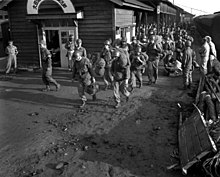
After the outbreak of the Korean War on June 25, 1950, as a result of the North Korean invasion of the Republic of Korea (South Korea), the UN decided to send troops to support South Korea. Subsequently, the United States, as a member of the United Nations, sent ground forces to push back the invading North Korean forces and prevent the collapse of South Korea. However, the number of US troops in the Far East was greatly reduced after the end of World War II five years earlier. At this point, the 24th Infantry Division stationed in Japan was closest to the scene of the conflict. However, the division was not in full force; most of its equipment was outdated due to a reduction in military spending. Nevertheless, the command of the 24th division was ordered to go to South Korea [1] .
The 24th Infantry Division was the first US unit sent to Korea with the goal of stopping the North Korean advance, delaying as many North Korean units as possible in order to gain time for reinforcements to arrive [2] . For several weeks, the division fought alone, while the first cavalry division , the 7th and 25th infantry divisions, along with other parts of the support of the Eighth Army, advanced to the position [2] . The first month after the defeat at Osan (the first clash of American and North Korean forces) [3] the 24th Infantry Division periodically suffered defeats and retreated south under the pressure of North Korean troops outnumbered and equipped [4] [5] . In the battles of Jochewon, Cheonan and Pyeongtaek, the regiments of the 24th Infantry Division were systematically thrown south [4] . The 24th Infantry Division died in the Battle of Daejeon and was almost completely destroyed, but, nevertheless, delayed the North Korean offensive until July 20 [6] . By this time, the number of combat units of the Eighth Army was approximately equal to the number of North Korean forces advancing in the region, while fresh UN units arrived daily [7] .
North Korean offensive
After the capture of Daejeon, North Korean troops began encircling the Busan perimeter. The 4th and 6th North Korean infantry divisions advanced south with a wide flanking maneuver, during the movement they had to stretch out into a thin line, nevertheless they made attempts to break through the left flank of the Americans, having superior numbers and with the support of armored vehicles. American and South Korean forces were periodically thrown back [8] until they managed to finally stop the North Korean offensive in a series of battles in the southern part of the country. On July 27, the 3rd battalion of the 29th Infantry Regiment, who had recently arrived at the front, fell into a coordinated ambush of the North Koreans near the village of Hadon and suffered heavy losses, which opened up a passage to the North Koreans in the Busan area [9] [10] . Soon after, North Korean forces took Chinja in the west, dropping the 19th American Infantry Regiment and paving the way for a further offensive in Busan [11] . The American units subsequently succeeded in defeating the North Koreans on the flank and pushing them back during the battle for the night of August 2. Suffering from increasing losses, the forces of the North Korean army retreated west to re-form and receive reinforcements. Both sides used respite to prepare for new battles for the Busan perimeter [12] [13] .
25th Infantry Division position
The commander of the Eighth Army, Lieutenant General Walton Walker , ordered the 25th American Infantry Division, under the command of Major General William B. Keane, to take up defense on the southern flank of the Busan perimeter west of Masan . On August 15, the 25th Infantry Division advanced to the line [14] , but the rugged terrain west of Masan delimited the choice of positions. The mountain range west of Masan was the first light-shielded ground position east of the Chinju Pass. The spurs of Mount Sobuk-san 610 m high dominated the area and covered the road from Komam-ni to Haman and Chindong-ni the only way to the south and north of Masan [15] .
To the north-west of Komam-ni was the spur Pil-bong, Mount Sibidang-san, towering 270 meters along the river Nam provided an excellent observation post so that American artillery located in Koman-ni could stop the enemy’s movement along the road near Chungam-ni [16] . The 25th American Infantry Regiment took up positions at Sibidang-Komam-ni on the north side of the defensive line of the 25th Infantry Division. The defensive line of the 35th Infantry Regiment stretched from a point 3.2 km west of Komam-ni to the Nam River and then turned east along the river to the place of its confluence with the Naktong River . This regimental line was too long (24 km) two times longer than the usual line intended for the regiment [16] .
The 1st battalion of the 35th Infantry Regiment kept the left flank of the regiment west of Komamni, the 2nd battalion kept the regiment line along the Nam River, the 3rd battalion, renamed the 1st battalion of the 29th Infantry Division, stood in reserve on the road south of Chirvon and could immediately come to the rescue anywhere in the regimental line [16] . In the south stood the American 24th Infantry Regiment, to the west of Chindog-ni on the left flank of the division was a combat team of the 5th Infantry Regiment. According to the order of the division’s command, the combat team of the 5th Infantry Regiment kept its position along the Chindong-ni coastal road to Yaban-san [14] , but soon Kin ordered the regimental command to close the gap north of the 24th Infantry Regiment. But when the fighting team of the 5th Infantry Regiment sent a hundred South Korean units under the command of American officers, the North Korean forces had already thrown them back. Then Kin ordered the combat team of the 5th Infantry Regiment to capture this area, but it was already too late, the North Korean troops managed to gain a foothold there [16] .
Prelude
The 6th and 7th North Korean divisions located near Masan attacked the 25th American infantry division in many sectors of the front, the main blow fell on the 24th and 35th infantry regiments [17] . At the same time, the 7th North Korean division tried to seep through the positions of the 35th Infantry Regiment around Sibidang and Komam-ni. Reinforced patrols of the 6th North Korean division also conducted reconnaissance in battle of the middle mountainous part of the line of the 25th Infantry Regiment. While the division commanders ordered their units to take up defensive positions west of Masan, the 2nd battalion of the 24th Infantry Regiment was still trying to capture Obong-san (a mountain range west of Battle Mountain and Peel-bong) and through the narrow the gorge come to their aid [18] . At dawn on August 15, the second battalion broke away from the North Koreans and retreated to the Souk-san mountains and to the ridge west of Haman [17] . The 3rd battalion of the 24th Infantry Division advanced into the Haman region to support the regiment's forces defending in this sector [18] .
Battle Mountain
The mountain range to the west of Haman, where the 24th American Infantry Regiment occupied the defensive line, is part of the Sobuk-san mountain range [19] . 13 km northwest of Chindong-ni and 4.8 km southwest of Haman is the Pil-bong height (also known as height 743) of the Sobuk-san massif [14] . From a height of 743, the ridge of the ridge turns to the northwest and 1.6 km from the Pil-bong altitude soars up again forming the Battle Mountain height (also known as height 665) devoid of vegetation [19] . The US military also called it “Napalm Height”, “Old Bald Head” and “Blood Hill” [14] . Between Peel Bong and Battle Mountain, the ridge line forms a narrow rocky ledge, which the troops called the "Rocky Cliffs." To the north of Battle Mountain, the terrain rises sharply, forming two long spurs. The Americans who fought here called the northern spur Green Peak [19] .
2 km west of the heights of Battle Mountain and Peel Bong are the villages of Ogok and Tundok. Through the mountains from north to south, there is a trail that passes through a high pass north of the villages and rises to the western slope halfway from Battle Mountain. Thanks to the road, the North Koreans had an advantage in raising and supplying the attacking troops. From the villages of Ogok and Tungdok to the ranges of Battle Mountain and Pil Bong, a network of roads was built [19] . From the summit of Battle Mountain, the observer could directly look at the valley held by the North Koreans and the command post of the 24th Infantry Regiment, the supply route, artillery positions and suitable road heights [14] . The side that captured the crest could survey the entire rear of the enemy. Recognizing these advantages, the rivals in the course of the six-week battle constantly tried to capture the ranges of Battle Mountain [19] .
Procurement
The approaches to Battle Mountain and Pin-bong are more difficult from the eastern side (held by the Americans) than from the western (North Korean side) [20] . On the east side there are no roads for climbing from the middle of the mountain to its top, from the bottom to the edge of the Haman Valley there is only a hiking trail. Climbers need two to three hours to climb the Pil Dong from the vicinity of the mountain, three to four hours to climb the Battle Mountain from the valley. It takes six hours to reach the top of Battle Mountain. Often, messenger runners took eight hours to get to Battle Mountain Peak and go down. In some places, the slope becomes so steep that climbing requires ropes to move along the trail. North Korean night patrols constantly cut telephone lines. Telephone operators had to carry out heavy and dangerous work on drawing communication lines with the top [19] . For parts holding the top, rations, water, and ammunition were often reduced [21] .
Both sides encountered difficulties when lowering the dead and seriously wounded. The UN rescue teams, consisting of six people, had to lower every wounded man on a special stretcher from the mountain. To transport down the critically injured, the help of a physician was also required, groups often accompanied by riflemen armed to protect against North Korean snipers. The wounded, in critical condition, often died before they could be brought to the bottom of the mountain, where they could be given full medical assistance [22] . North Korean troops also did not have enough time to evacuate all the wounded and killed from the peak, both sides had to bury the dead in shallow graves along the peak [17] .
Support artillery of the 24th Infantry Regiment (159th Field Artillery Battalion) was deployed in a valley south of Haman. On August 19, the artillery was moved further to the rear, with the exception of battery C, which remained in the channel of the stream north of Haman [17] . Regimental engineers worked to improve the road going down from Haman to the north-east to the main road Koman-ni - Masan. The sappers intended to use this road to evacuate artillery, if it became necessary to improve the road network of the regimental sector to facilitate the movement of troops and supplies. This road has become known as the "Minesweeper Road" [22] .
On August 15, in the south, between the 24th Infantry Regiment and the combat team of the 5th Infantry Regiment, there was a gap of 3,700 m wide in the vicinity of Pil-bong [17] . Since the 24th Infantry Regiment did not show good results in previous battles, the next day, Kin sent 432 South Korean police officers to fill the gap, now the North Koreans had a solid front without gaps [22] .
Battle
Against the 24th American Infantry Regiment, Battle Mountain had the 6th North Korean Division, which, starting on August 5, fought with the Kin battle group. The division initially totaled 10 thousand people, but suffered 4 thousand losses during the battles for the Busan perimeter. However, the North Korean command was able to replenish the ranks of the division, mobilizing 3,100 South Koreans from nearby cities. The South Koreans fought as they were ordered, however, behind them were rear North Korean barriers that shot anyone who tried to desert, retreat, or surrender [14] .
24th US Infantry Regiment knocked down
The first attack against the mountain line of the 24th Infantry Regiment began on the morning of August 18th. The North Koreans captured a number of positions of company E on the northern spur of Battle Mountain and killed the company commander [23] . On this day, Lieutenant Colonel Paul F. Roberts replaced Lieutenant Colonel George R. Cole as commander of the 2nd Battalion of the 24th Infantry Regiment [22] . The next day, the North Koreans attacked Company C, which occupied Battle Mountain, and took it to flight [23] . The officers managed to gather only 40 people to return them to their positions. Most of the South Korean police defending Pil Bong also joined the battle, only 56 people remained in their defensive positions. US officers threatened and used physical force to send the rest back to their positions. An undetermined number of North Koreans leaked through a 1.6 km gap north of the Pil Bong that existed during the day [22] .
On August 20, the 6th North Korean division stepped up pressure on Battle Mountain and launched increasingly powerful attacks to capture both peaks [24] . During the offensive of the North Koreans, the entire company C, with the exception of the company commander and 25 people, left their positions on Battle Mountain. Before reaching the bottom of the mountain, the fugitives mistakenly reported that the company commander had been killed and that the North Koreans had first surrounded and then captured the company’s positions. Relying on this information, American artillery and mortars exposed the company to concentrated fire, fighter-bombers, after making 38 sorties, attacked with napalm , fragmentation bombs, rockets and machine-gun fire at the crest of the Battle Mountain peak where there were 26 of its defenders that held the height for 20 hours [ 25] . At this time, they rejected the proposal of the North Koreans for surrender [24] . A platoon of company E, with the exception of 10 people, also left its positions on the mountain with the development of an enemy attack. On the left flank of the regiment, a South Korean patrol from the position of company K on Sobuk-san captured the commander of the 15th North Korean regiment but a few minutes later he was killed while trying to escape. Patrolmen found several intelligence reports on his body. During the day of the battle for Battle Mountain and Pil-bong, the North Koreans knocked down South Korean police from the left flank of the 24th Infantry Regiment on Mount Sobuk-san [25] . The soldiers of the 24th Infantry Regiment continued to leave their positions in scattered groups, ignoring the orders of the officers to remain in place. The situation became so difficult that those who remained in positions often received bronze stars with the letter V for the fact that they continued to fight being in such a small number [26] .
Fifth Regiment Combat Team
Keen understood from the alarm of the commander of the combat team of the 5th regiment, Colonel John L. Trogmorton, ordering him to allocate part of the 5th regiment to attack and take back Mount Sobuk-san. On the morning of August 21, the 1st battalion of the 5th Regiment's combat team attacked from the edge of the 24th Infantry Regiment and, overcoming the weak North Korean resistance, cleared the southern ridges of the mountain. That evening, a strong North Korean detachment launched a counterattack and knocked out the 1st battalion of the 5th Infantry Regiment from the mountain. On August 22, at 12:00 the 1st battalion of the 5th Infantry Regiment again attacked the heights. After 5 hours, company B captured the heights. Now Keane has changed the location of the 5th Regiment and the 24th Infantry Regiment, giving southern ranges to the 5th Regiment's battle team and Battle Mountain and Peel Bong to the 24th Infantry Regiment. At night, the North Koreans counterattacked the 1st battalion of the 5th Regiment’s combat team and prevented them from consolidating their positions. On the morning of August 23rd, Company A attempted to clear a height of 910 m south-west of the peak and provide communication with Company B but did not succeed. The North Korean command considered the Sobuk-san ranges so important that they detached significant forces to defend them and daily attacked a nearby fighting team of the 5th regiment [25] .
A similar combat situation arose north of company B’s position on Mount Sobuk-san. North Korean troops on the Rocky Cliffs stretching from Sobuk-san to Pil-bong were hiding there from air raids. Napalm bombing, 230 kg bombs and machine-gun fire had little effect. Departments of the 24th Infantry Regiment could not break through to the south and join the company. In the combat team of the 5th Regiment, they came across the stubborn defense of the North Koreans [25] .
Attacks of August 21-26
Further north along a ridge in the Battle Mountain area, the battle went badly for the 24th Infantry Regiment. After company C lost its height of Battle Mountain, the UN artillery and aircraft subjected the ridge to intense blows according to the plan of the forthcoming infantry counterattack to capture altitude. Hot and sweltering weather complicated climbing to a steep slope, however, on August 21 at 12:00 pm, company L climbed to the top. The North Koreans left her, having been bombarded by American aircraft, artillery and mortars. However, they concentrated the fire of their own mortars at the top and did not allow the company L to consolidate its positions [27] . This situation persisted until noon until a North Korean platoon penetrated the trenches on the eastern slope and attacked a platoon of company L from the rear, catching the Americans by surprise. Hearing the shots, the other two platoons of company L began to leave their positions and descend from the mountain. North Koreans immediately regained high ground while American officers tried to assemble companies I and L on the eastern slope [28] . During the day of the separation of company E also left their positions [27] .
Now, at the height of Battle Mountain, concentrated air strikes by American aircraft, artillery and mortar fire. Companies I and L were preparing for a new counterattack to capture altitude. Soon the attack followed, with little success, the offensive was stopped at midnight in anticipation of the dawn [27] . Shortly after dawn on August 22nd, companies I and L completed the offensive. Company L climbed the mountain, company I provided fire support. Three grenades thrown by the North Koreans injured six people, the rest retreated without the command of their disappointed commander [28] . As a result, after some coercion, they were able to return to the mountain. A few hours later, after a small detachment of North Koreans attacked their right flank, the company again without orders retreated from the mountain to the position of company I [27] .
The next day, August 23, battles for Battle Mountain continued, with new South Korean police units arriving to strengthen companies I and L. The American and South Korean units eventually managed to gain a foothold on Battle Mountain mainly thanks to the American mortar bombers, who bombarded the North Korean approaches to the western slope of the mountain. During the day, the North Koreans counterattacked the mountain six times, but each time they were driven back. Parts of the 3rd battalion of the 24th Infantry Regiment continued to retreat when they were under enemy fire and the battalion commander complained to Keen that he needed more officers to keep people in line [29] . The situation in the Haman region forced Walker to raise the first temporary marines brigade, which was in reserve for advancement to the front line, on alert. However, the team was never sent there [27] . On August 24, so many soldiers deserted from the mouths of I and L that they had to retreat from the mountain. During the fighting, they lost 120 people. Rota C, together with the South Korean police, kept its height [30] .
North Korean troops continued to attack the 24th Infantry Regiment on the entire front, probing weaknesses [30] . On August 25 and 26, Company C repelled several North Korean attacks on Battle Mountain, which began along a long ridge stretching from Tundok. At one point in the battle, American aircraft found about a hundred North Koreans in the open and immediately covered them with napalm, bombs and machine-gun fire. The North Korean squad was completely destroyed, only a few were fortunate enough to survive. Error in the footnotes ? : Invalid call: invalid keys, for example, too many keys were specified or the key was incorrect . To organize the command, a special command group was created due to the isolation of Battle Mountain and the expansion of the regiment’s combat front [27] . Over the next two days, UN forces continued to harass North Koreans with air raids, preventing them from forming for any major attack on Battle Mountain [30] .
Attacks on August 28-29
On August 27, the 1st battalion in the Battle Mountain area was replaced by the 3rd battalion of the 24th Infantry Regiment. The 1st battalion was assigned to the reserve, with the exception of company C, which remained on Battle Mountain as part of the Baker battle group [30] . The next day, August 28, the North Koreans again went on the attack. Before dawn, a North Korean company was struck between orders C and I by a North Korean company. At night, the North Koreans fired mortars at mortar C at an altitude of Battle Mountain [31] . After midnight, the North Korean infantry appeared behind the Americans and seized the command post. The next morning, on August 29th at 02.45 a new attack began, several people from Company C left their positions at Battle Mountain without firing a single shot [30] . The North Koreans moved the attack to the positions of company E and seized part of the positions of the company. After dawn, the Americans managed to drop ammunition for the company E from airplanes and create an artillery curtain to prevent the North Koreans from introducing more or less significant reinforcements from the main position. All day on August 29th, with the help of artillery and aircraft, the Americans harassed the North Koreans, who occupied the old positions of company E. In the evening, company E launched a counterattack and seized the lost positions [31] .
On August 19th at 23.00 the North Koreans again attacked S. Company. The soldiers on the left flank quickly left their positions and soon the whole company retreated, leaving the North Koreans on the mountain. The company commander, Captain Lawrence M. Corcoran, remained at the command post with 17 soldiers (some of whom were injured). All remaining later were awarded bronze stars [21] . After the dawn of August 30, American air raids again began, artillery, mortar tanks located in the valley concentrated fire on the peak held by the North Koreans. A wounded American soldier, who, being cut off from his hideout for several hours on the mountain, went downstairs and reported that the main part of the North Koreans had retreated from the top to find the best shelter from air strikes and only a small detachment remained for cover [32] . At 11.00 the company B, which was previously in reserve [21] with the support of the 3rd battalion, attacked the heights at 13.00 it captured the heights [32] . Weak defensive positions were restored, but the American troops at the top continued to have difficulties with supplies [21] .
Acting in this way, the 24th Infantry Regiment sequentially captured Battle Mountain. The Americans worked the crest of the ridge with artillery fire, mortars and tanks, the aircraft covered the summit with napalm. Then the infantry attacked, rising along the eastern slope with the support of mortars, which kept the shelling at a height until the infantry arrived there [33] . Then the mortar men carried the fire, and the infantry rapidly rose to the very peak, usually abandoned by the North Koreans [32] .
Pat
During August, Battle Mountain changed hands so often that there was no agreement on the exact number of times. An intelligence sergeant of the 1st battalion of the 24th infantry regiment estimated that the peak passed from hand to hand 19 times [34] . Subsequent studies suggested a 20-fold figure [33] . Every night from August 18 to the end of the month, North Koreans attacked the mountain. It often happened that in a day the height changed owners 2-3 times [33] . The usual course of events went like this: the North Koreans captured the height, and the next day it was captured by the 24th American Infantry Regiment. This type of staggering battle led to relatively high casualties among advanced artillery observers and damage to their equipment. In the period from August 15 to August 31, 7 observers and 8 other employees of the Observation and Communications Unit of the 159th Field Artillery Battalion were lost, eight radio stations, 11 telephones, and 2 vehicles were also lost [34] .
South of Battle Mountain and Peel Bong, the 1st Battalion and the 5th Regiment's combat team also held the defenses of their units of Sobuk-san for two weeks. For actions in the battles of August 25 and 26, Master Sergeant Melvin O. Hendrich from the company On the 5th Regiment's combat team was posthumously awarded the Medal of Honor . He adjusted the artillery fire from the front line and at one moment he personally stopped the company’s withdrawal from the position. Wounded, Hendrich returned to his front line, where he continued to adjust the fire and single-handedly entered the battle with the advancing North Koreans until he was killed. When the fighting team of the 5th regiment again seized positions, near the position of Hendrich, 70 bodies of North Koreans, apparently killed by Hendrich, were counted [34] . By the end of August, the fighting situation in the mountains west of Masan continued to remain stalemate [35] . Neither side succeeded in achieving a decisive advantage [34] .
September Offensive
Although the 6th 7th North Korean divisions concentrated their forces for the planned breakthrough of the positions of the 25th American infantry division along the Nam and Naktong rivers during the September offensive, the forces of the 6th division continued to attack the area [36] [37] . North Koreans fired at Battle Mountain, Peel Bong and Sobuk-san from guns and mortars. In the period from September 1 to September 6, several strong attacks followed locally [38] . The 1st battalion of the 5th Infantry Regiment never succeeded in completely capturing the southern parts of Sobuk-san, which would give observation of the valley and the rear of the North Koreans. The instability of the position of the 24th Infantry Regiment prompted Keen to order Trogmorton to send company E (the only remaining regimental reserve) north of the regimental sector along the road to Haman to cover the right flank of the combat team of the 5th Infantry Regiment. While in position, company E soldiers picked up the lagging soldiers from the 24th Infantry Regiment every night and sent them back to the units the next morning. The American fleet took part in the battle, destroyers standing on the south coast illuminated Mount Sobuk-san, covered with clouds, with their searchlights. One destroyer almost constantly remained at the post, supporting ground operations with the fire of 5-inch guns. An aerial artillery observer corrected ship fire through a fire adjustment center [39] .
On September 7, North Koreans continued their attacks on Battle Mountain, occupied by American and South Korean forces [40] . The command of the 25th Infantry Division ordered the 3rd battalion of the 27th American Infantry Regiment, under the command of Lieutenant Colonel George H. de Shaw, to seize the high ground. De Shaw had already taken part in a counterattack through the rear of the 24th Infantry Regiment near Haman. Companies K and B of the 24th Infantry Regiment were supposed to support the offensive and clean the crest when de Shaw captured it [41] . From September 7th to 9th, the 3rd Battalion counterattacked Battle Mountain. On September 9, company I reached the summit, and engaged in hand-to-hand combat with the North Koreans [42] . Company L reached the crest, but the North Koreans jumped out of the dugout and threw both companies down. About two North Korean companies held the Battle Mountain ridge, more than two companies protected their flanks. During the three-day battles, the 3rd Battalion de Shaw suffered heavy losses. At noon on September 9th, the Americans counterattacked and captured a height of 910 meters east of Battle Mountain. Again, a stalemate arose. The command of the 25th division ordered the 3rd battalion of the 27th infantry regiment to advance in the vicinity of Masan along the front of the Busan perimeter [41] .
Containment Actions
After the failure of the attacks of September 8 and 9, the 3rd battalion of the 27th infantry regiment on Battle Mountain, the command of the 24th regiment decided to suspend the attack at this height. Company K of the 24th Infantry Regiment and Company From the 65th Combat Engineering Battalion, they dug in a lower elevation east of Battle Mountain, strengthened their positions with wire fences and minefields, shot all approaches to the positions from guns and mortars. The regiment commander decided to restrain the North Koreans who occupied Battle Mountain with artillery and mortar fire. Over the following nights, North Koreans from Battle Mountain repeatedly attacked the U.S. defensive position below, but all of their attacks were repelled. After a month of fighting, the North Koreans managed to stay on the crest of Battle Mountain. The defensive fire of the 24th infantry regiment and artillery attached to the regiment held North Koreans at a height and they could not develop a further offensive [41] .
After capturing the height of Battle Mountain, the North Korean command decided to take control of the Pil Bong altitude in the southeast. In the predawn hours of September 14th, 400-500 North Koreans attacked the companies of the I and L of the 24th Infantry Regiment, defending the Pil Bong [41] . Several attacks were repelled, but after some people left their positions, the number of company L decreased from one hundred to forty people [43] . The remaining soldiers of the company L moved to the position of company I on the crest of the Pil-bong where they found that after a relatively weak attack, the company left its height. With so many fighters, they could not keep their height and also retreated [41] .
After the 25th division resisted one of the most powerful attacks on September 7th, Walker ordered the combat team of the 5th Infantry Regiment to advance to the site of the remaining battles around the Busan perimeter. In view of the ongoing battle north of Daegu, reserves were required to be advanced. That evening, the 1st and 2nd battalions of the 27th Infantry Regiment moved from the battlefield near the Nam River to support the combat team of the 5th Infantry Regiment on the Masansky Front. At 15:00 on September 9th, command over the regimental zone was taken by the commander of the 27th Infantry Regiment, John H. Michaelis. The 3rd battalion of the 27th Infantry Regiment on the same day stopped its counterattacks to the height of Battle Mountain, joined the regiment and on September 11th took its place on the southern edge of the line. At this time, the combat team of the 5th Infantry Regiment began moving towards Samnadzhin and, having arrived there, became part of the reserve of the 8th Army [44] .
In mid-September, the Eighth Army and the South Korean Army continued to conduct battles at almost all points of the Busan perimeter. After two weeks of heavy fighting, they barely managed to repel a large North Korean offensive near the Naktang River, the main axis of the attack was on the approaches to Masan [44] .
Incheon landing
The landing of the UN forces in Incheon led to the collapse of the North Korean front and led to their retreat along the entire front. However, on September 16, the 25th Infantry Division was still fighting with North Korean troops, and North Korean strong points stood at the tops of Battle Mountain, Pil-Bong and Sobuk-san [45] . Kin understood that the division would be able to launch an offensive along the road to Chinja only after clearing the mountainous center of the front. Therefore, he believed that the key to the advance of the 25th division lay in the center where the North Koreans held their heights and attacked the 24th Infantry Regiment daily [46] . The 27th infantry regiment on the left and the 35th infantry regiment on the right straddled the road from Masan to Chinja and could not go on the offensive until the situation on the front of the 24th infantry regiment changed for the better [47] .
To fulfill his plan, Keen created a battalion-sized combat group on September 16 under the command of Major Robert L. Woolfock, commander of the 3rd Battalion, and ordered the group to attack the next Battle Mountain and Peel Bong to restore the previous positions there on the 24th infantry regiment [46] . On September 17-18, the battle group periodically attacked the heights with the strong support of artillery of the 8th and 90th field artillery battalions and numerous air raids, but the North Koreans each time repelled all attacks with automatic fire, causing heavy losses to the Americans. One day, Company A of the 27th Infantry Regiment lost 57 people [47] . The 24th Regiment was bogged down in front of Battle Mountain. After the failure of the next attack on September 18th, Wulfock’s detachment abandoned the efforts to capture the peaks and the next day the group was disbanded [47] .
North Korean Retreat
On September 19, UN forces determined that North Koreans left Battle Mountain at night, the 1st battalion of the 24th Infantry Regiment advanced and captured it. On the right, the 35th Infantry Regiment began to move forward [48] and reached an elevation near Chungam-ni, having met only weak resistance when hiding in the so-called. the North Koreans began to shell the soldiers of the 1st battalion from the rear with spider holes. The next day, the 1st battalion captured Chungam-ni, the 2nd battalion captured a long ridge northwest of the Nam River. At this time, the North Koreans continued to offer stubborn resistance on the left flank of the division, preventing the 27th Infantry Regiment from advancing [49] .
On the night of September 18-19, North Koreans retreated from the vicinity of Masan. The 7th North Korean division withdrew from a position south of the Nam River, while the stretched parts of the 6th Division covered the entire front. Under cover of the 6th Division, the 7th Division on September 19th crossed to the northern bank of the Nam River. After that, the 6th division withdrew from the positions of Sobuk-san [49] . The American units immediately began to pursue the North Korean units retreating to the north, having left the positions at Battle Mountain, which had lost their strategic importance [50] .
Afterword
The combat team of the 5th regiment lost 269 people killed, 573 wounded, 4 missing during the battles for the Busan perimeter (the team spent most of the battles at Masan) [51] . The 24th Infantry Regiment lost 267 killed, 796 wounded, one was captured, two were missing during the battles for the Busan perimeter. In the battles for Battle Mountain, the regiment lost 150 killed and 450 wounded, the remaining losses were during the battles for Haman after August 31st. The 65th Engineer Battalion, supporting the 24th Infantry Regiment, lost 27 killed and 75 wounded [52] .
North Korean troops suffered heavy casualties, most during the offensive. By mid-September, the number of the 7th North Korean division was reduced to 4 thousand people., 6 thousand people were lost in the battles for the perimeter. [53] Only 2 thousand people from the 6th North Korean division returned to North Korea, the division lost 80% of its strength. 3 thousand people were captured in large groups trying to return to North Korea. By the end of the battles for Masan, the number of attacking forces decreased from 20 thousand to 6 thousand people [54] .
Desertion continued to be a problem for the 24th Infantry Regiment (after the segregated unit). According to statistics from the Eighth Army, in August, 116 people deserted from the 25th division, compared with 15 from the 27th infantry regiment and 12 from the 35th infantry regiment [23] . The regiment’s command was already criticized for the poor performance shown at the Battle of Sanju a few weeks earlier [55] . In late August, Keen began to investigate the behavior of the units and revealed their poor effectiveness, and also criticized the rest of the division [56] . Keen looked at the regiment as a weak link in the chain and, after the regiment's ineffective operations during the battles for Battle Mountain and under Haman, suggested that Walker disband the regiment and use its composition for replacements in other field units. Virtually all officers and soldiers of the regiment supported this idea, but Walker rejected the offer, feeling that he could not afford to lose the regiment [57] .
Notes
- ↑ Varhola, 2000 , p. 3
- ↑ 1 2 Alexander, 2003 , p. 52
- ↑ Catchpole, 2001 , p. 15
- ↑ 1 2 Varhola, 2000 , p. four
- ↑ Alexander, 2003 , p. 90
- ↑ Alexander, 2003 , p. 105
- ↑ Fehrenbach, 2001 , p. 103
- ↑ Appleman, 1998 , p. 222
- ↑ Appleman, 1998 , p. 221
- ↑ Alexander, 2003 , p. 114
- ↑ Catchpole, 2001 , p. 24
- ↑ Catchpole, 2001 , p. 25
- ↑ Appleman, 1998 , p. 247
- ↑ 1 2 3 4 5 6 Bowers, Hammong & Mac Garrigle, 2005 , p. 145
- ↑ Appleman, 1998 , p. 365
- ↑ 1 2 3 4 Appleman, 1998 , p. 366
- ↑ 1 2 3 4 5 Bowers, Hammong & Mac Garrigle, 2005 , p. 147
- ↑ 1 2 Appleman, 1998 , p. 368
- ↑ 1 2 3 4 5 6 Appleman, 1998 , p. 369
- ↑ Bowers, Hammong & MacGarrigle, 2005 , p. 146
- ↑ 1 2 3 4 Bowers, Hammong & MacGarrigle, 2005 , p. 154
- ↑ 1 2 3 4 5 Appleman, 1998 , p. 370
- ↑ 1 2 3 Bowers, Hammong & MacGarrigle, 2005 , p. 148
- ↑ 1 2 Bowers, Hammong & MacGarrigle, 2005 , p. 149
- ↑ 1 2 3 4 Appleman, 1998 , p. 371
- ↑ Bowers, Hammong & MacGarrigle, 2005 , p. 150
- ↑ 1 2 3 4 5 6 Appleman, 1998 , p. 372
- ↑ 1 2 Bowers, Hammong & MacGarrigle, 2005 , p. 151
- ↑ Bowers, Hammong & MacGarrigle, 2005 , p. 152
- ↑ 1 2 3 4 5 Bowers, Hammong & Mac Garrigle, 2005 , p. 153
- ↑ 1 2 Appleman, 1998 , p. 373
- ↑ 1 2 3 Appleman, 1998 , p. 374
- ↑ 1 2 3 Alexander, 2003 , p. 132
- ↑ 1 2 3 4 Appleman, 1998 , p. 375
- ↑ Bowers, Hammong & MacGarrigle, 2005 , p. 161
- ↑ Bowers, Hammong & MacGarrigle, 2005 , p. 163
- ↑ Alexander, 2003 , p. 181
- ↑ Alexander, 2003 , p. 183
- ↑ Appleman, 1998 , p. 483
- ↑ Bowers, Hammong & MacGarrigle, 2005 , p. 174
- ↑ 1 2 3 4 5 Appleman, 1998 , p. 484
- ↑ Bowers, Hammong & MacGarrigle, 2005 , p. 175
- ↑ Bowers, Hammong & MacGarrigle, 2005 , p. 176
- ↑ 1 2 Appleman, 1998 , p. 485
- ↑ Appleman, 1998 , p. 568
- ↑ 1 2 Bowers, Hammong & MacGarrigle, 2005 , p. 177
- ↑ 1 2 3 Appleman, 1998 , p. 569
- ↑ Bowers, Hammong & MacGarrigle, 2005 , p. 179
- ↑ 1 2 Appleman, 1998 , p. 570
- ↑ Bowers, Hammong & MacGarrigle, 2005 , p. 180
- ↑ Ecker, 2004 , p. 31
- ↑ Ecker, 2004 , p. 29th
- ↑ Appleman, 1998 , p. 546
- ↑ Appleman, 1998 , p. 603
- ↑ Bowers, Hammong & MacGarrigle, 2005 , p. 113
- ↑ Bowers, Hammong & MacGarrigle, 2005 , p. 155
- ↑ Appleman, 1998 , p. 572
Literature
- Alexander, Bevin (2003), Korea: The First War we Lost , New York City, New York : Hippocrene Books , ISBN 978-0-7818-1019-7
- Appleman, Roy E. (1998), South to the Naktong, North to the Yalu: United States Army in the Korean War , Washington, DC : Department of the Army , ISBN 978-0-16-001918-0 , < http: //www.history.army.mil/books/korea/20-2-1/toc.htm >
- Bowers, William T .; Hammong, William M. & MacGarrigle, George L. (2005), Black Soldier, White Army: The 24th Infantry Regiment in Korea , Honolulu, Hawaii : University Press of the Pacific, ISBN 978-1-4102-2467-5
- Catchpole, Brian (2001), The Korean War , London, England : Robinson Publishing , ISBN 978-1-84119-413-4
- Ecker, Richard E. (2004), Battles of the Korean War: A Chronology, with Unit-by-Unit United States Causality Figures & Medal of Honor Citations , Jefferson, North Carolina : McFarland & Company , ISBN 978-0-7864- 1980-7
- Fehrenbach, TR (2001), This Kind of War: The Classic Korean War History - Fiftieth Anniversary Edition , Washington, DC : Potomac Books Inc., ISBN 978-1-57488-334-3
- Varhola, Michael J. (2000), Fire and Ice: The Korean War, 1950–1953 , Mason City, Iowa : Da Capo Press , ISBN 978-1-882810-44-4