Edward Vincent (Ed) Sallivan ( English Edward Vincent "Ed" Sullivan ; September 28, 1901 , New York , USA - October 13, 1974 , ibid.) - American journalist and TV host, best known for the " Ed Sullivan Show " program, in which Ed discovered musical talents. The show was broadcast from 1948 to 1971, becoming one of the most long-lived projects of American television [1] .
| Ed sullivan | |
|---|---|
| Ed sullivan | |
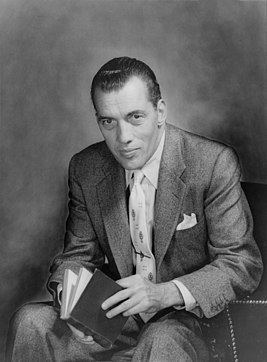 | |
| Birth name | Edward Vincent Sullivan |
| Date of Birth | September 28, 1901 |
| Place of Birth | Harlem , Manhattan , New York , USA |
| Date of death | October 13, 1974 (73 years) |
| Place of death | Upper East Side , Manhattan , New York, USA |
| Citizenship |  USA USA |
| Occupation | TV host , writer |
| Father | Peter Arthur Sullivan |
| Mother | Elizabeth F. Sullivan (nee Smith) |
| Spouse | Silvia Sullivan (1930–1973) |
| Awards and prizes | Golden Globe ( 1959 ) [d] ( 2012 ) |
| Site | www.edsullivan.com |
In 1996, Sullivan took the 50th place in the rating of the 50 Greatest Stars of Television of All Time according to the American weekly TV Guide [2] .
Content
Childhood and adolescence
Ed Sullivan was born on September 28, 1901 in Harlem (New York), in the family of customs officers Elizabeth F. Smith and Peter Arthur Sullivan [3] , both came from Ireland [4] [5] . Ed had a twin brother, Daniel, who died at a very early age, after which the family decided to move to Port Chester ( Westchester , New York ) [6] . There, young Sullivan attended St. Mary’s Catholic School, then Port Chester High School. During his studies, he managed to achieve high rates in youth sports and later became interested in boxing . In 1917 he arrived in Chicago to enlist in the fleet, but was refused because of his age. After graduation, he began to try himself in journalism and work in the tabloid as a newspaper sports columnist [7] . Later, Sullivan began to write about the cultural life of New York and to keep his own column called “Little Old New York” in the newspaper The New York Daily News [8] [9] , and also to make broadcasts on the radio. Gradually, thanks to his growing popularity, he began to compete with one of the most sought-after journalists and columnists of the time - Walter Winchell .
More and more interested in entertainment television and cinema, in 1933, Sullivan took part in the creation of the comedy film "Mr. Broadway." Despite the fact that television began to occupy most of his time, he continued to write in The News throughout his career.
Work on television
In 1948, the American television and radio network CBS invited Sullivan as the host for the Sunday show Toast of the Town , which later grew into the Ed Sullivan Show . For the first time the program was broadcast in June 1948 from CBS Studio 50 at the address: New York, Broadway , 1697. In 1967, the building was renamed Ed Ed Sullivan Theater. Currently there is a transfer of David Letterman Late Show with David Letterman [10] .
The first assessments of television critics were disappointing [11] . Sullivan did not possess outstanding skills of entertainer or entertainer, and in 1967, 20 years after the debut program, in Time magazine in one of the articles the question was asked: what exactly is Sullivan's talent, if he is so popular? [12] His mannerisms in front of the camera were so unusual for viewers that some seriously believed that he had Bell's paralysis [12] . In 1955, Time described Sullivan as:
| He is like an Indian near a cigar store, a giant from Cardiff , a stone-faced idol as if he had just arrived from Easter Island . He moves like a lunatic, he smiles as if he ate a lemon, and he builds sentences with great difficulty [11] . |
But, despite the abundance of criticism, the publications noted that “instead of scaring children, he nonetheless entertains the whole family” [11] . Ed Sullivan appeared before the public as the most ordinary person who, through television broadcasting, reveals great talents to the same ordinary people. The actor, comedian and frequent guest of the show, , said of Sullivan:
| Ed doesn't do anything special, and he succeeds better than anyone on television [12] . |
Sullivan had an understanding of what exactly the public wanted to see on television and how to maintain balance in his television show. In one program, he combined a variety show (which could include acrobats, jugglers, artists and illusionists), performances by popular comedians and athletes, vocal numbers, and there was time for young viewers - the Italian puppet became one of the symbols of the program. In addition, the show was not limited to American artists - talented people from all over the world came to the show to Sullivan [13] .
Ed Sullivan always adequately perceived himself and his style of conducting the program, he had a healthy sense of humor and therefore never forbade, but even encouraged parodies of his own person. Among his parodists were , Frank Gorshin , , and especially . The latter also played the role of Sullivan in the films “ I want to hold your hand ”, “ Dorz ”, “ Mr. Saturday night ”, “ To hell with love! ", As well as in the television movie" Elvis "in 1979 [14] .
In 1963, Ed Sullivan played himself in the movie Bye Bye Bird.
Talent discoverer
In the 1950s, Sullivan established himself as a discoverer of talent. He sought to attract as many promising artists, musicians and actors as possible to the transfer, thus giving them a start in show business.
When Elvis Presley achieved a certain popularity at the beginning of his career, Sullivan said that he would never invite him to his show because of his image of the “bad guy.” However, later, when Presley became so famous and loved by the public that his performances could not be ignored, Ed Sullivan agreed that he should take part in the program. Moreover, Sullivan could not help but notice that during the broadcast of with the participation of Presley, the audience gathered twice as many people in front of TV screens as usual. In the end, after negotiations with the manager Presley, the management of the show Ed Sullivan pledged to pay the musician 50 thousand dollars for participating in three programs. The first broadcast with Presley was scheduled for September 9, 1956 [15] , but Sullivan himself was unable to attend the recording, as he had a car accident. Instead, the transfer was led by Charles Lawton . After that, having already personally met Presley, Sullivan stated in his program that Elvis was “a very decent and good guy” [16] [17] .
Having missed the opportunity to be the first to present Elvis Presley in his show, Sullivan decided not to repeat the mistake and in 1964 recorded a sensational program: The Beatles came on the air. The first broadcast was conducted on February 9. According to the agency Nielsen, the show was watched by over 73 million viewers - it was an absolute broadcasting record of that time [18] [13] . After that, The Beatles appeared on a visit to Sullivan three more times and, following the results of the American tour, they released a live album and video , which included Sullivan episodes. The presenter became so friendly with the group that he even announced their appearance at Shea Stadium on August 15, 1965. Also, another British band, The Dave Clark Five , took part in Ed Sullivan’s show, unlike The Beatles, which had no reputation as rebels and bad guys, thanks to which the band appeared on the show 12 times [19] .
During the period of the development of television art, the artists mostly sang live at various shows, and not to soundtracks . This was also true for the transfer of Ed Sullivan [20] . Exceptions were made only in special cases, such as, for example, was broadcast with the speech of Billie Joe Thomas. During the performance of the song “Raindrops Keep Falling On My Head”, the artist and the dancers were poured with real water, and therefore they had to use the soundtrack [21] [22] .
Ed Sullivan was also known for his attempts to show African American artists on television, for which he was often criticized. One of his favorite black teams was The Supremes women's group, which took part in the show 17 times. In addition, African American musicians such as The Temptations , The Four Tops and Martha and the Vandellas participated in the program.
It is worth noting that in times when country music had not yet gained great popularity, Ed Sullivan had already invited musicians and singers from Nashville , USA to attend. Among them were the later world stars Johnny Cash and Glenn Campbell . In the future, it helped create a program about country culture “Hee Haw”.
In addition to his own show, Ed Sullivan also participated in other television projects. In 1958, he starred in the CBS Mr. Sitcom . Adams and Eve , the game show What's My Line? and in 1961 he took part in The Red Skelton Show - the program, which ranked third after the “Ed Sullivan Show” and the TV series Gunsmoke .
February 8, 1960 at the " Walk of Fame " in Hollywood , Ed Sullivan star was opened at 6101 Hollywood Blvd [23] .
Character
In addition to the ability to conduct shows and entertain the audience, Sullivan had some drawbacks: thus, he could get angry and offended by the artists who displeased him. The performances of Buddy Holly , The Doors , Jackie Mason and Bo Diddley contributed to the negative side of Sullivan’s personality.
On November 20, 1955, Sullivan asked Bo Diddley to sing Ernest Ford's song " Sixteen Tons ". Diddley considered that the performance of this song would ruin his career, and instead sang his main hit “Bo Diddley”, after which he was barred from further participation in the show [24] .
Buddy Holly and the group The Crickets first performed on the program in 1957, performing two songs and making a good impression on Sullivan. The next performance took place in 1958, but before the air Sullivan insistently asked Buddy Holly not to perform the song “Oh, Boy!”, As she, in his opinion, was too noisy. Buddy Holly replied that he had already promised his friends from Texas to perform this song for them and would not change his choice, there was a skirmish in the dressing room between the musician and the TV presenter, and as a result, Sullivan incorrectly pronounced the name Buddy Holly during the broadcast, and did not react when it turned out that the microphone of the soloist is off. Buddy Holly had to get out of the situation due to her very loud singing. The audience accepted the group with a bang, and Sullivan was forced to again invite musicians, which was followed by a refusal, and Buddy Holly said that the TV presenter simply did not have enough money to pay him and the group a third time [25] [26] .
In 1963, Ed Sullivan planned to participate in the Bob Dylan show, but the television censors refused to broadcast his song “Talkin 'John Birch Paranoid Blues” as potentially offensive to the John Birch Society [27] [28] .
The comedian Jackie Mason was barred from participating in the show after October 8, 1964, during one of the performances, Sullivan showed the guest two fingers behind the camera, meaning that he had two more minutes to complete - the broadcast was broadcast live , and from minute to minute the appeal of President Lyndon Johnson was to begin. A common version is that the comedian did not want to shorten the speech, responded with indignation and showed the middle finger in retaliation [29] . However, according to other sources, he simply said “So we’re talking with fingers now”, picked up Sullivan’s gesture and began to improvise with various hand and finger movements [30] . Anyway, Mason received permission to return to television only after the trial [31] .
On January 15, 1967, the group The Rolling Stones was asked to change the words in the chorus of the song “Let's spend the night together” ( let's start the night together ) to “let's spend some time together”. Mick Jagger complied with the request, but during the performance he defiantly rolled his eyes, thus showing his true attitude to the censored version of the song. When Sullivan asked the band to wear more appropriate costumes for the next performance, the musicians came to the show in the uniforms of the Nazi army soldiers, for which the presenter became even more angry, and The Rolling Stones were forced to change into stage clothes. After this incident, the group participated in the show only once, on November 23, 1969 [32] [33] .
A scandalous incident occurred with the group The Doors on September 17, 1967, when the lead singer Jim Morrison , contrary to the demands of the censors, replaced the line “girl, we couldn't get much higher ” (my Russian girl, we’re not getting more buzz ) with “girl, we couldn't get much better ”( Russian, my girl, we’ll no longer be better ) in the song“ Light my fire ”(due to an obvious hint of narcotic intoxication), nevertheless performed the original version. The group was also excluded from participating in the program [34] [35] .
Mo Howard from comedy trio in 1975 recalled that Sullivan often forgot who was to be announced on the air:
| Ed was a very nice man, but for the showman and the presenter was extremely forgetful. During our first appearance, he announced that the Ritz Brothers will now appear before the audience, but he wriggled out, adding that “we look more like The Three Stooges” [36] . |
Ed Sullivan Show and Political Undertones
Sullivan, like many TV presenters of the time, was involved in the ideological struggle associated with the Cold War , because of which the artists he declared did not always fall into the show. For example, in 1950, the American choreographer and stepist was to perform the program, but this fact met with resistance from the American public figure Hester McCullough, who accused the dancer of anti-government activities and communist sentiments [37 ] . McCullough demanded that the management of the show exclude Draper from the program, but the performance still took place, causing a flurry of indignation from the American public. As a result, Ed Sullivan had to publicly apologize to the main sponsor of the program - the Ford Motor Company - and promise not to involve guests with controversial political views in the future.
Another musician who never attended the Sullivan show was the legendary African-American singer Paul Robson , known for his sympathy for the communist system.
After the incident with Draper, Ed Sullivan, together with Theodore Kirkpatrick, began talking with future participants of the show and checking them for potential anti-capitalist convictions [38] . In addition, Sullivan continued to write in The New York Daily News, where communism and McCarthyism were often mentioned in his articles [39] .
Personal life
As a young man, Sullivan was engaged to Olympic swimming champion , but she died of cancer in 1927 at the age of 23 [40] .
On April 28, 1930, Ed Sullivan married Sylvia Weinstein ( born Sylvia Weinstein ) and lived with her until her death in 1973. On December 22, 1930, the couple had a daughter, Elizabeth, who later married Bob Precht ( born Bob Precht ) - the producer of her father's show [41] [42] .
Last years of life and death
In the fall of 1965, CBS began television broadcasting in color. In the central and eastern parts of the Americas, the show was broadcast live, but, in addition, all issues were recorded for further display in the western, Pacific, zone of the United States.
By 1971, Ed Sullivan’s program, like many other perennial shows, began to lose popularity, and CBS had to close the program. Ed Sullivan was so unhappy with this fact that he refused to even record his farewell. Nevertheless, in 1973, he held a special edition of the show, dedicated to the 25th anniversary of the project.
In September 1974, an X-ray showed Sullivan’s esophageal cancer , but the doctors, along with their TV host relatives, preferred to hide the diagnosis from Sullivan. Ed, being convinced that the unhealthy condition was caused by an aggravation of the ulcer, died five weeks later, on October 13, 1974 , in New York at Lenox Hill Hospital ( Lenox Hill ) [43] . At the farewell ceremony in New York's St. Patrick's Cathedral was attended by about three thousand people. Sullivan was buried in the family crypt at Ferncliffe Cemetery near his wife's grave [6] .
Notes
- ↑ Hinckley, David. Ed Sullivan Sunday night story (English) . New Yor Daily News (30 April 1999). The date of circulation is November 2, 2012. Archived December 29, 2012.
- ↑ Special Collectors' Issue: 50 Greatest TV Stars Of All Time // TV Guide . - 1996, December 14–20.
- ↑ Leonard, John. The Ed Sullivan Age (English) . American Heritage (May – June 1997). The date of circulation is November 1, 2012. Archived December 29, 2012.
- ↑ Nachman, Gerald. His TV show helped start a national viewing habit (English) (inaccessible link) . TheColumnists.com (18 January 2006). The date of circulation is November 1, 2012. Archived December 29, 2012.
- ↑ Harris, 1968 .
- ↑ 1 2 Di Giacomo, Donna. Ed Sullivan (English) . Findagrave.com. Archived December 29, 2012.
- ↑ Yagoda, Ben. The True Story of Bernard Macfadden (English) . American Heritage (December 1981). The date of circulation is November 1, 2012. Archived December 29, 2012.
- ↑ Ed Sullivan's 110th Birthday (English) . Edsulivan.com. The appeal date is February 2, 2013. Archived on February 7, 2013.
- ↑ Ed Sullivan: Biography (English) . TVguide.com. The appeal date is February 2, 2013. Archived on February 7, 2013.
- ↑ Ed Sullivan Theater (English) . Edsullivan.com. The date of circulation is November 1, 2012. Archived December 29, 2012.
- 2 1 2 3 Radio: Big As All Outdoors . Time.com (17 October 1955). The date of circulation is November 1, 2012. Archived December 29, 2012.
- ↑ 1 2 3 Variety Shows: Plenty of Nothing (eng.) . Time.com (13 October 1967). The date of circulation is November 1, 2012. Archived December 29, 2012.
- ↑ 1 2 Hinckley, David. 'Sundays with Sullivan' explores scope of Ed Sullivan's epic television show (Eng.) . New York Daily News (September 5, 2009). The date of circulation is November 2, 2012. Archived December 29, 2012.
- ↑ Will Jordan (Eng.) On the Internet Movie Database
- ↑ Rosenberg, Jennifer. 1956 - Elvis Gyrates on Ed Sullivan's Show (English) . About.com. The date of circulation is November 2, 2012. Archived December 29, 2012.
- ↑ Elvis on the Ed Sullivan Show (English) . Edsullivan.com. The date of circulation is November 2, 2012. Archived December 29, 2012.
- ↑ Merwin, Gregory. Fifty Million People Can't Be Wrong (English) (inaccessible link) . TV Radio Mirror (25 May 1957). The date of circulation is November 2, 2012. Archived December 29, 2012.
- ↑ Bondarovsky, 1991 , p. 29.
- ↑ The Dave Clark Show on the Ed Sullivan Show (Eng.) . Edsullivan.com. The appeal date is November 19, 2012. Archived December 29, 2012.
- ↑ Great Moments in Lip Sincing (English) (inaccessible link) . Thedaleyplanet.net. The appeal date is December 13, 2012. Archived December 29, 2012.
- ↑ Sklar, Ronald. The Ed Sullivan Show Rock'n'Roll Classics (Rhino-2002) (English) . Popentertainment.com (16 December 2003). The appeal date is December 13, 2012. Archived December 29, 2012.
- ↑ Billie Joe Thomas with "Raindrops Keep Falling On My Head" on Ed Sullivan Show
- ↑ Ed Sullivan (English) . Walkoffame.com. The date of circulation is November 2, 2012. Archived December 29, 2012.
- ↑ Bo Diddley on Ed Sullivan show (English) . Edsullivan.com. The date of circulation is November 2, 2012. Archived December 29, 2012.
- ↑ Buddy Holly's Final Ed Sullivan Appearance (English) . Performingsongwriter.com. The date of circulation is November 2, 2012. Archived December 29, 2012.
- ↑ Buddy Holly on Ed Sullivan show (English) . Edsullivan.com. The date of circulation is November 2, 2012. Archived December 29, 2012.
- ↑ Bob Dylan Walks Out on The Ed Sullivan Show (Eng.) . History.com. The date of circulation is November 2, 2012. Archived December 29, 2012.
- ↑ Bob Dylan on Ed Sullivan show (English) . Edsullivan.com. The date of circulation is November 2, 2012. Archived December 29, 2012.
- ↑ Top 5 Most Controversial Performances From The Ed Sullivan Show (Eng.) . Edsullivan.com. The date of circulation is January 29, 2013. Archived on February 4, 2013.
- ↑ TV Urban Legends Revealed # 31 (English) (inaccessible link) . Legendsrevealed.com. The date of circulation is January 29, 2013. Archived on February 4, 2013.
- ↑ Denisov, Ivan. Jackie Mason: Stand-up from the Rabbi (February 23, 2011). The date of circulation is November 2, 2012. Archived December 29, 2012.
- ↑ Uslan, Michael; Solomon, Bruce. Dick Clark's The First 25 Years of Rock and Roll. - N. Y. , 1981. - P. 181.
- ↑ The Rolling Stones on Ed Sullivan show (English) . Edsullivan.com. The date of circulation is November 2, 2012. Archived December 29, 2012.
- ↑ The Doors on Ed Sullivan show (English) . Edsullivan.com. The date of circulation is November 2, 2012. Archived December 29, 2012.
- ↑ When the Doors went on Sullivan (English) . CNN.com (3 October 2002). The date of circulation is November 2, 2012. Archived December 29, 2012.
- ↑ Howard, 1977 , p. 165.
- ↑ Thompson, D. Claudia; Hayes, Shaun A. AMERICAN HERITAGE CENTER GUIDE TO ENTERTAINMENT INDUSTRY RESOURCES (English) (p. 5) (2009). The date of circulation is November 2, 2012. Archived December 29, 2012.
- ↑ Barnouw, 1990 .
- ↑ Sullivan, Ed. Little Old New York (eng.) . The New York Daily News (7 May 1953). The appeal date is June 5, 2019. Archived on February 7, 2013.
- ↑ The American Midwest: An Interpretive Encyclopedia, 2007 , p. 901.
- ↑ ED SULLIVAN (1902-1974) "Master of Variety" (Eng.) . Edsullivan.com. The date of circulation is January 22, 2013. Archived February 4, 2013.
- ↑ Television Host Ed Sullivan Dies At 73 (Eng.) // The Palm Beach Post. - 1974. - No. 176 .
- ↑ Ed Sullivan Dies of Cancer at Age 72 . Associated Press (October 14, 1974).
Literature
- Barnouw, Erik. Tube of Plenty: The Evolution of American Television. - Paperback, 1990. - ISBN 9780195064841 .
- Harris, Michael David. Always on Sunday: Ed Sullivan, An Inside View. - N. Y .: Meredith Press, 1968. - ISBN 68-19031.
- Howard, Moe. “Moe Howard and the Three Stooges”. - Bloomington, Ind .: Citadel Press, 1977. - ISBN 978-0-8065-0723-1 .
- Sisson, Richard; Zacher, Christian K .; Cayton, Andrew RL The American Midwest: An Interpretive Encyclopedia. - Bloomington, Ind .: Indiana University Press, 2007. - ISBN 0-253-34886-2 .
- Bondarovsky, Pavel. The Beatles // Student Meridian : Special Edition. - 1991. - № 8 . - ISSN 0321-3803 .
Links
- edsullivan.com - the official site of the show Ed Sullivan
- The Ed Sullivan Show: Top 10 Musical Performances