Arab invasion of Afghanistan - military campaigns of Arab troops in Afghanistan during the Arab conquests of the 7th-8th centuries.
| Arab invasion of Afghanistan | |||
|---|---|---|---|
| Main Conflict: Arab Conquest | |||
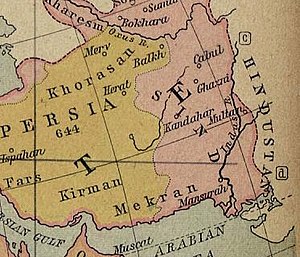 Names of territories during the Caliphate | |||
| date | VII century - VIII century | ||
| A place | Afghanistan | ||
| Total | Arabs' capture of western Afghanistan. Preservation of independence of Kabulistan and many Afghan principalities. | ||
| Opponents | |||
| |||

Content
Arabs conquering western Afghanistan
By the time of the Arab conquests, most principalities of Afghanistan contained small principalities and tribes of Ephthalite origin. The western regions of Afghanistan ( Herat , eastern Sidzhistan ) were in the sphere of influence of the Sassanid Iran , and with its fall around 650 became virtually independent.
The first Arabs invaded Afghanistan date back to the early 650s. After the conquest of Nishapur and Merv in 652, the Arab commander Abdullah ibn Amir sent troops to conquer other cities that were part of Khorasan - Herat and Bushenj. They submitted to the Arabs without resistance, agreeing to pay tribute. To conquer the northwestern lands of modern Afghanistan, a detachment of al-Akhnaf ibn Qais was sent, who captured the upper reaches of the Murghab River , defeating the Turkic-Ephtalite army of the ruler of the city of Mervurud. After this, al-Ahnaf took possession of the Dzhuzjan region and went to Balkh . Balkh surrendered to the Arabs by agreement.
In 653, an uprising began in the lands conquered by the Arabs, but the swift actions of the new governor Abdullah ibn Hazim led to the early defeat of the rebels.
660s Campaigns
The advance of the Arabs stopped due to internal conflicts, the civil war of 656–661. After the establishment of the power of the Umayyads , the campaigns of Arabs into the inner regions of Afghanistan began again. In 662–663, Abdarrahman Ibn Samur made a trip to the east of Afghanistan from Sijistan. He reached Kabul , but could not subjugate these areas. Then, around 664, the Arabs made another trip to Kabul under the leadership of al-Muhallaba ibn Abu Sufra, who brought great booty. In 665–666, a campaign into the depths of Afghanistan was made by Abdallah ibn al-Savwar, who obtained horses of the valuable al-Kikani breed.
In 667, the Shah of Kabul expelled the Arab garrisons from Zabulistan and Rukhhaj and tried to expel Muslims from other areas. The viceroy of Sidzhistan ar-Rabi ibn Ziyad al-Harisi stopped the Kabul people at Bust and returned Rukhhaj and Daver. But the Kabul state retained independence from the Caliphate. In subsequent years, the Arabs undertook constant campaigns against the rulers of Kabul and other Afghan principalities, but all these campaigns ended in defeat and heavy losses for the Arabs.
Hikes of the 670s - 690s
In 671, Balkh rebelled against the Arabs, but soon obeyed the governor of al-Rabi ibn Ziyad al-Harisi. In 673, Abbad from Sijistan made a trip to Kandahar , capturing a rich pagan temple there.
The campaign of the Arabs under the command of the governor of Sijistan, Abu Ubaida ibn Ziyad against Kabul, about 681 ended with the defeat of the Arabs and the capture of the governor himself. Yazid ibn Ziyad hastened to his rescue and died in a battle unsuccessful for the Arabs.
In the 680-690s, the Kabuli retaliated against the Arab rulers of Sijistan, since the Caliphate at that time was involved in a new civil war, distracting most of the military forces from the borders.
The defeat of the army of Ubaidallah and the rebellion of Ibn al-Ashas
In 698, the new governor of Sijistan, Ubaidallah ibn Abu Bakr, decided to take a major campaign against the ruler (root beat) of Kabulistan . He gathered a 20-thousand army of Basrians and Kufis and went on a campaign. Ubaidallah’s army went along mountain roads in the direction of Kabul for a long time, but 100 km from the city it was blocked in the mountains by Kabul troops. The Afghans cut off all the ways in which fodder and food were received by the Arab army, in which the famine began. Ubaidallah went into negotiations with the root beat, paid tribute to him, handed over the hostages and promised not to attack Kabulistan. Part of the Arab commanders did not accept a humiliating peace and attacked the Kabul, but was killed. After the agreement, Ubaidallah with the remnants of the army began to retreat to Sijistan, but only about 5 thousand Arab soldiers reached the house. Ubaidallah soon died, thus escaping punishment for the shameful defeat for the Arabs.
The governor of the eastern provinces of the Caliphate al-Hajjaj ibn Yusuf wanted to avenge Kabulistan for the defeat of the army of Ubaidallah and appointed ibn al-Ashas as governor of Sijistan, ordered him to destroy the state of Kabul Shahs. But Ibn al-Ashas acted cautiously and gradually seized the possessions of Kabul Shah. This aroused the anger of al-Hajjaj, who demanded vigorous action from Ibn al-Ahasa under the threat of his removal. In response, Ibn al-Asah rebelled and entered into an alliance with the ruler of Kabul. After the defeat of the rebellion in 701, Ibn al-Ashas fled to Kabulistan, but his ruler soon made peace with the Caliphate and issued a rebel.
Summary
After the defeat of the army of Ubaidallah ibn Abu Bakr and the rebellion of Abdarrahman ibn al-Ashaas, the attempts of the Arabs to completely conquer Afghanistan were almost completed. Kabulistan actually defended independence, and a number of mountain principalities and tribes of central and eastern Afghanistan remained outside the borders of the Caliphate. The western and northern regions of Afghanistan entrenched in the composition of Arab possessions, Islam spread in them, Arabs settled in cities. The unconquered lands of Afghanistan retained their traditional beliefs; Islam began to establish itself here only in the 9th-12th centuries. The independence of Kabulistan was eliminated in the 870s by Yakub ibn Leys from the Saffarid dynasty , then Afghanistan was completely included in the system of states of the Islamic world.