Chilean Kunya shark or Japanese Kunya shark [1] ( Mustelus mento ) is a species of cartilaginous fish of the genus common marten sharks of the family marten sharks of the order Karhariniformes . It lives in the eastern part of the Pacific Ocean . Propagated by live birth . The maximum fixed length is 130 cm. There is no danger to humans. The meat of these sharks is eaten. The species was first scientifically described in 1877 [2] .
| Chilean Kunya Shark | |||||||||||||||||||||||||||||||||||
 | |||||||||||||||||||||||||||||||||||
| Scientific classification | |||||||||||||||||||||||||||||||||||
|---|---|---|---|---|---|---|---|---|---|---|---|---|---|---|---|---|---|---|---|---|---|---|---|---|---|---|---|---|---|---|---|---|---|---|---|
| |||||||||||||||||||||||||||||||||||
| International scientific name | |||||||||||||||||||||||||||||||||||
Mustelus mento ( Cope , 1877) | |||||||||||||||||||||||||||||||||||
| Area | |||||||||||||||||||||||||||||||||||
| |||||||||||||||||||||||||||||||||||
| Security status | |||||||||||||||||||||||||||||||||||

Content
Range
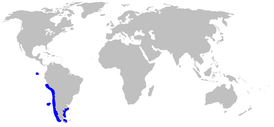
Chilean canyon sharks live in the temperate waters of the eastern Pacific from Lobos de Tierra ( Peru ) to the southern tip of Chile , as well as the Galapagos Islands and the Juan Fernandez Islands [3] [4] . These bottom sharks are found on the continental and island shelf, at a depth of 16 to 50 m.
Description
Chilean marten sharks have a short head and a rather dense body. The distance from the tip of the muzzle to the base of the pectoral fins is from 18% to 23% of the total body length. The muzzle is slightly elongated and blunt. Oval small eyes are elongated horizontally. At the corners of the mouth there are labial grooves. The upper furrows are slightly longer than the lower. The mouth is rather short, almost equal to the eye, its length is 2.5-3.5% of the body length. Dull and flat teeth are asymmetrical, with a small central tip. The inner surface of the mouth is covered with buccal-pharyngeal teeth. The distance between the dorsal fins is 17-22% of the body length. The pectoral fins are large, the anterior margin is 12-17%, and the posterior margin is 8.5-14% of the total length, respectively. The length of the anterior margin of the ventral fins is 7.6–9.7% of the total body length. The height of the anal fin is 2.8-3.9% of the total length. The first dorsal fin is larger than the second dorsal fin. Its base is located between the bases of the pectoral and ventral fins. The base of the second dorsal fin is located in front of the base of the anal fin. Anal fin smaller than both dorsal fins. There is a ventral recess at the edge of the upper lobe of the caudal fin. The caudal fin is elongated almost horizontally. Color is gray or taupe. White spots cover the back. The belly is light [5] [6] [7] .
Biology
Chilean marten sharks breed live birth. There are up to 7 newborns in the litter [4] . Males and females reach puberty with a length of 65–76 cm and 86–90 cm, respectively. The length of the newborn is about 30 cm [4] .
Human Interaction
It is not dangerous to humans. The meat is eaten. In Chile, these sharks are caught most in the south by artisanal methods [8] . In Peru, a ban has been imposed on sharks less than 60 cm long. The International Union for Conservation of Nature has assigned this species the status of “Close to Vulnerability” [9] .
Notes
- ↑ Reshetnikov Yu.S. , Kotlyar A.N. , Russ T.S. , Shatunovsky M.I. The Bilingual Dictionary of Animal Names. Fish. Latin, Russian, English, German, French. / edited by Acad. V. E. Sokolova . - M .: Rus. Yaz., 1989 .-- S. 29 .-- 12,500 copies. - ISBN 5-200-00237-0 .
- ↑ Cope ED 1877 Synopsis of the cold blooded vertebrata, procured by Prof. James Orton during his exploration of Peru in 1876-77. Report of the British Association for the Advancement of Science v. 17: 33-49
- ↑ Chirichigno, N. and Cornejo, M. 2001. Catalogo Comentado de los peces marinos del Perú. Publicación Especial. Instituto del Mar del Perú.
- ↑ 1 2 3 Compagno, Leonard JV Sharks of the World: An Annotated and Illustrated Catalog of Shark Species Known to Date. - Rome: Food and Agricultural Organization, 1984. - S. 455–457. - ISBN 92-5-101384-5 .
- ↑ Bigelow, HB and WC Schroeder, 1948. Sharks. Mem.Sears Found.Mar.Res., (1): 53-576
- ↑ Hildebrand, SF, 1946. A descriptive catalog of the shore fishes of Peru. Bull.USNatl.Mus., (189): 95 p.
- ↑ Kato, S., S. Springer and MH Wagner, 1967. Field guide to eastern Pacific and Hawaiian sharks. Circ.USFish Wildl. Serv., (271): 47 p.
- ↑ Lamilla, J., Acuna, E., Araya, M., Bustamente, C., Concha, F., Hernandez, S., Kong, I., Muschke, E., Oliva, M., Pequeno, G. , Villarroel, JC and Vogler, R. 2005a. "Lineamientos básicos para desarrollar el Plan de Acción de Tiburones" Informes Tecnicos FIP. FIP / IT N * 2004-18. Volumen 1: Antecedentes para desarrollar el Plan de Acción de Tiburones.
- ↑ Romero, M., Leandro, L. & Lamilla, J 2007. Mustelus mento. In: IUCN 2012. IUCN Red List of Threatened Species. Version 2012.2. <www.iucnredlist.org>. Downloaded on 26 October 2012.
Links
Chilean Cunya shark in the FishBase database.