
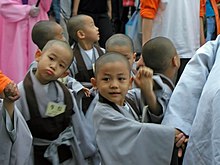


Shramanera ( Sanskrit ; Pali : sāmaṇera ; Chinese; 沙彌 cor. 사미 ; Burm. . A girl or a woman in the same status is called shramneri or shramanerika (Sanskrit: śrāmaṇerī or śrāmaṇerikā, Pali sāmaṇerī , Chinese trad. 沙彌 尼 , pinyin : Shāmíní , Sinhala. )
Content
Etymology
The literal meaning of the word ārāmaṇera is “little shramana ,” that is, “little”, meaning “child” and “shramana”, in the sense of “monk, ascetic”.
Vows
According to Vinaya , those who are not twenty cannot take the bhikkhu vows, but can take the vowel shramaners. Schramaners are obliged to observe ten vows of moral behavior:
- Refrain from killing living beings.
- Refrain from stealing.
- Refrain from lust (sex, lust).
- Refrain from lying.
- Refrain from intoxicant use.
- Refrain from eating at the wrong time (after noon).
- Refrain from amusements.
- Refrain from using perfume, cosmetics, jewelry.
- Refrain from sitting in a high, upholstered, luxurious seat.
- Refrain from owning money.
Dedication of shramanera and shramaneri is different.
In Tibetan Buddhism
Tibetan monasticism follows the tradition of Mulasarvastivada , through Tibet this tradition was also transferred to Mongolia and Buryatia.
In the Buddhist Traditional Sangha of Russia
Higher religious Buddhist education in Russia can be obtained at datsans . Buddhist schools are divided into male and female. There is only one female datsan in Russia - “ Zungon Darzhaling ” in Ulan-Ude .
The largest male educational institution in Russia, in which the huvaraki comprehend the basics of Buddhist philosophy, is the Damba Choinhorlin University named after Damba-Darj Zayayeva . It was created in 1991 to the south-west of the city of Ulan-Ude during the Ivolginsk datsan .
At the university, under the guidance of teachers and spiritual mentors from Mongolia , Tibet , India and Buryatia, more than a hundred khuvaraks from different countries are studying. Each year, a Buddhist university recruits 25 people aged 15 years. Education in datsan only full-time and free. The term of study, as in the usual secular university, is five years.
Twice a year, the huwaraki go on holidays: summer (from June to September) and winter - in the days of the Buddhist New Year of Sagaalgan .
The Huwaraki study Buddhist philosophy, Eastern medicine, ethnography, Tibetan, Old Mongolian and Buryat languages, as well as iconography, the basics of tantrism and meditation . In the curriculum there are also general educational subjects: law, mathematics, logic, psychology, economic theory, sociology, political science, Western European philosophy, English and history.
Upon graduation from university, the khuvarak receives a diploma of higher education and the title of lama ( kandamy - for women). The most capable huvaraks continue their studies in India, in the Buddhist monastery of Drepung - Goman Datsan. After a traditional 16-year course of study, lamas get the title of Geshe - the equivalent of a candidate of philosophical sciences. Those who wish have the opportunity to defend to higher degrees - Geshe-doramba, Geshe-gabju (doctor) and Geshe-lharamba (professor).
Graduates of Buddhist universities can realize themselves not only in serving in datsans , but can work as translators, orientalists , Tibetan medicine specialists, ethnographers , astrologers , masters of tank-painting , as well as teach in Buddhist schools.
Life Huvarak
After admission to the university, the huvarak takes a novice vow, which mainly involves taming the mind, body, speech and consciousness.
Huwaraki live in the territory of the datsan, in the homes of priests. Spartan life equip themselves. The day begins with an early rise (at five or six in the morning) and morning hural (prayer). Two large breaks in classes last for an hour. During this time, novices have time to cook their own food, eat, put in order the room in which they live. From five to seven in the evening do homework, for which they have dinner.
In addition to studying, the khuvaraks are involved in the economic affairs of the datsan. For example, they prepare its buildings and territory for large temple holidays: they paint, make minor repairs, and even build. During the summer holidays it is allowed to work outside the datsan.
Notes
Sources
- Galdanova G.R. The Dolamaist Buryat Beliefs. - Novosibirsk, 1987
- A.M. Pozdneev. Essays on the life of Buddhist monasteries and Buddhist clergy in Mongolia, 1887. - Стр. 156
- Tumunov Zh. T. Aga and Agints. - Ulan-Ude, 1993
Links
- Irina Ruzhnikova. There are many people willing to become Huvaraks in Oriole // Okruzhnaya Pravda, No. 27, July 14, 2005
- Photo report from Tartaria Magna magazine about the life of the Buryat Huvaraks in the Indian monastery of Drepung
- Mile Small. Huwaraki in the Land of Happy Teaching // BBC Russia, February 2, 2004
- Andrew Yang. Datsans of Buryatia began recruiting novices // Inform Policy, September 7, 2011