Not to be confused with Oguzes .
Not to be confused with Uyghurs .
Not to be confused with acne .

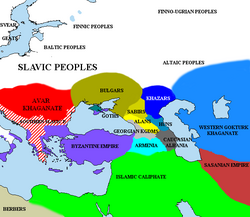
Ogurs [1] (the Ogur massif of tribes) is a part of the Praturk tribes, which originally lived in Central Asia, but which separated itself early and migrated to Europe.
Content
History
It is assumed that the ogurs emerged very early from the general array of Praturk tribes. The selection of ogres came from a larger association at that time - Oguzes , presumably in the middle of the first millennium BC. [one]
With the allocation of ogres, the beginning of the disintegration of the Praturk language into the Turkic group of languages proper and the Ogur ("Bulgarian") group of languages is also associated [2] .
Ogurs were the first of the ancestors to carry out several migration waves to the west.
In the first half of the 5th century, ogurs led by the Hun tribe conquered almost all of Europe and created a huge multi-ethnic power. After its collapse, the tribes of ogres for many centuries in Europe were called "Huns."
In the VI century , Avars ( obras ) appeared in Europe and created the Avar Haganate .
In the 7th century , the Bulgars spread widely, which in turn were squeezed to the west and north by the Khazars , who created the Khazar Khaganate .
In the end, the predominantly nomadic Praturks-ogurs gradually assimilated with the local population and settled in modern eastern Europe (the Sub-Donets, Don, Black Sea, Volga).
Classification
The following historical tribes and peoples can be attributed to cucumbers:
- Huns ?
- Bulgars
- Onogurs
- Saragurs
- Kutrigurs
- Utigurs
- Urogs
- Highlangurs
- Altziagira ?
- Akatsirs ?
- Savirs ?
- Avars ( mods )?
- Khazars
Ogurs and Ugres
There is an assumption that it was the ogurs through the Magyars who transferred their name to the Ugrians not belonging to the Turkic peoples [3] .