Isaac Taylor (August 17, 1787 - June 28, 1865) - English writer, specializing in history and philosophy, artist, inventor.
| Isaac Taylor | |
|---|---|
| Isaac taylor | |
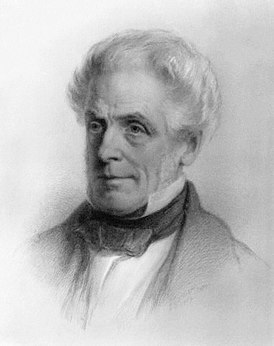 Isaac Taylor, portrait by Joseph Gilbert | |
| Date of Birth | August 17 |
| Place of Birth | Lavenham |
| Date of death | June 28 |
| A place of death | Stanford Rivers |
| Citizenship (citizenship) | |
| Occupation | prose writer, translator |
| Years of creativity | 1822-1864 |
| Direction | history, philosophy |
| Genre | novels |
| Language of Works | English |
| Debut | "Elements of thought" |
| Awards | "Civil List Pension" |
Content
- 1 life
- 2 Works
- 3 Inventions
- 4 family
- 5 notes
Life
He was the eldest surviving son of Isaac Taylor of Ongar. He was born in Lavenham (Suffolk County) on August 17, 1787. Later, he and his family moved to Colchester , and then, at the end of 1810, to Ongar. According to family tradition, Isaac studied as a draftsman and engraver . After several years of work as a designer of book illustrations, he felt a craving for literature [1] .
From 1812 to 1816, he wintered in the west of England, spending most of his time in Ilfrackum and Marazion with his sister Jane. Around 1815, thanks to the work of Sulpicius of the North , Taylor began to collect patristic literature. Soon after, Francis Bacon 's De augmentis aroused his interest in inductive philosophy. In 1818, a family friend Josiah Conder, later the editor of Eclectic Review, persuaded Taylor to join the existing staff, which already included Robert Hall, John Foster, and Olinfus Gregory [1] .
In 1825, Taylor settled in the village of Stanford Rivers (about two miles from Ongar) in an old farmhouse. Here, August 17, 1825, he marries Elizabeth, the second daughter of James Madland, the girlfriend of his sister Jane. In 1836, Taylor disputed the Department of Logic at the University of Edinburgh with Sir William Hamilton, and was almost defeated. In March 1841, in Hanover Square, he gave 4 lectures on "Spiritual Christianity." Although he joined the association of Anglican churches at the beginning of his career, he still remained in good relations with friends from the English Dissenters [1] .
In 1862, Taylor was awarded a £ 200 Civil List Pension Grant in recognition of his merit in literature. After 3 years, on June 28, 1865, he died in the village of Stanford Rivers [1] .
Works
In his youth, Isaac performed projects for his father and for books published by his sister Jane Taylor. He made anatomical drawings for the surgeon and painted miniatures, a portrait of his sister and himself in 1817. Some of his projects for John Boydell in “Illustrations from the Holy Scriptures” (1820) delighted Dante Gabriel Rossetti and were compared by Alexander Gilchrist to some of William Blake 's plates (Blake's Life, 1863) [1] .
In 1822, Taylor ’s first book, Elements of Thought (London, 1822), was later renamed “The World of Mind” (London, 1857). Following this, in 1824, a new translation of “Characters of Theophrastus” (Francis Howell, London) followed. The translator added picturesque images of characters drawn on wood by himself. In 1825, Jane Taylor's memoirs, correspondence, and literary essays were published (London, 1825, 2 volumes; Included in Taylors from Ongar , 1867) [1] .
“History of the Transmission of Ancient Books to Modern Times” (London, 1827) and “The Process of Historical Evidence” (London, 1828) were then combined into one work (1859), in which he tried to prove that literary documents such as The Bible can be taken as the basis for history. Then came the translation of Herodotus (London, 1829), whose work seems to have been proposed by an anonymous novel, “The Temple of Melekartha” (London, 1831), telling about the prehistoric migration of the inhabitants of Tire from the Persian Gulf to Levan. Taylor said he portrayed his wife as a heroine. His next and most famous work was The Natural History of Enthusiasm (London, Boston, 1829) [2] , which appeared anonymously in May 1829. It was a kind of historical and philosophical discussion of religious imagination that corresponded to fashion. Taylor developed this theme in Fanaticism (London, 1833) and Spiritual Despotism (London, 1835; three editions) [2] . Three more volumes about skepticism and gullibility were included in the author’s plan of the “pathological anatomy of a false religion,” but these additional works were never completed. Those works that were published were praised by John Wilson in Blackwood's Magazine , and the last three were noted by Sir James Stephen in the Edinburgh Review (April, 1840) [1] .
At the same time, Taylor published Saturday Night (London, 1832; many publications in England and America) [2] . Subsequently, he developed part of this book in The Physical Theory of Another Life (London, 1836) [1] .
His next book was Home Learning (London, 1838) [2] , in which he insisted on the beneficial effects of the country's life, the educational value of children's pleasures, and the natural, rather than stimulated, growth of the child’s mental abilities. He then completed and edited the translation of the Jewish Wars by Josephus Robert Trail (1793–1847) [3] ; she appeared in two illustrated editions (1847 and 1851), but did not raise a lot of money [1] .
In his 1839–40 publication, “Ancient Christianity and the teachings of the Oxford Tract” (in 8 parts, London; 4th edition of 1844, in 2 volumes), Taylor argued as a polemicist against the “Tract at times” , his conviction about that the Christian church in the fourth century had already grown out of superstition and error. This view has been disputed. Loyola and the beginnings of Jesuitism (London, 1849; several editions) and Wesley and Methodism (London, 1851; 1863, 1865, New York, 1852) were followed by the popular work on Christian argumentation , Restoring Faith (London, 1855). .; several American publications) - anonymous publication. The Logic of Theology and The Ultimate Civilization were volumes of essays printed in parts in the Eclectic Review during 1859 and 1860; then, in turn, followed by the “Spirit of Poetry” in Hebrew (London, 1861; numerous editions) - lectures originally delivered to Edinburgh . After “Considerations of the Pentateuch” (London, 1863; two editions) [2] , in which he opposed the conclusions of John William Colenso , and several memoirs in the Imperial Dictionary of Biographies , his last work, Personal Memoirs, was published (London, 1864), the autobiographical part of which will appear later in “Good Words” by Alexander Strahan [1] .
Inventions
Taylor was interested in mechanical devices and inventions. At the beginning of his life, he invented a beer faucet (patented November 20, 1824), which came into widespread use, and he also designed a machine for engraving on copper (12,248 pat., August 21, 1848). His goal was to use the device on a large scale with indicators for engraving patterns on copper cylinders for printing chintz in Manchester [1] .
Family
Taylor had 2 sisters who are known as poets: Anna Taylor (later Gilbert; 1782-1866) and Jane, who composed rhymes for Twinkle Twinkle Little Star . Joseph Gilbert, the son of Anna, became an artist and writer. Children of Isaac Taylor:
- Jane
- Isaac Taylor (1829-1901) - priest and writer
- Phoebe
- James Medland Taylor (1834-?) - Architect
- the Rose
- Henry Taylor (1837-?) - architect and writer
- Katerina
- Jessie
- Euphemia
Notes
- ↑ 1 2 3 4 5 6 7 8 9 10 11 Taylor, Isaac (1787-1865) in Wikisource
- ↑ 1 2 3 4 5 Author and Bookinfo.com
- ↑ Dictionary of Ulster Biography