The Portuguese conquest of Goa occurred in 1510 during the expedition of the Portuguese admiral Afonso di Albuquerque . Albuquerque was ordered to capture only Hormuz , Aden and Malacca , so he conquered Goa on his own initiative. At that time, the city formally belonged to the princes of the Dean, but there stood the army of Yusuf Adil-Shah, the future founder of the Bijapur Sultanate . Adil Shah was virtually independent. The garrison of the city in 1510 totaled 400 soldiers.
| Conquest of goa | |||
|---|---|---|---|
| Main Conflict: Portuguese-Egyptian War | |||
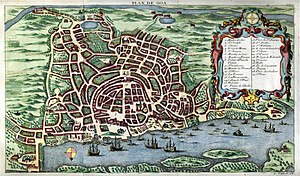 Goa in 1750 | |||
| date | December 10, 1510 | ||
| A place | Goa , India | ||
| Total | Portugal victory | ||
| Opponents | |||
| |||
| Commanders | |||
| |||
| Forces of the parties | |||
| |||
| Losses | |||
| |||


Content
Background
In 1488, the Portuguese circled the Cape of Good Hope , and in 1497 Vasco da Gama paved the way for India. Madagascar was opened in 1501, and the island of Mauritius in 1507. At the same time, Socotra and Ceylon were visited. In 1505, Francisco di Almeida was appointed first vice-king of India. The Portuguese managed to establish contacts with the Malacca Sultanate .
The penetration of the Portuguese into the Indian Ocean undermined the Arab trade in spices. Arabs united with Mameluk Egypt and in 1505 the Egyptian sultan Kansuh al-Gauri organized a sea expedition against the Portuguese. In the same year, the Seventh Portuguese Indian Armada appeared in the Indian Ocean, and in 1506 - the fleet of Admiral Albuquerque. In March 1506, at the Battle of Kannur, the Portuguese defeated the combined fleet of the Mamluks , Gujarat and Calicut . A year later, the Portuguese were defeated at the battle of Chaul , but in 1509 they again managed to win the battle of Diu . During this war, the Portuguese gained allies in the face of the Indian leaders, who were at war with the Muslim sultanates.
Albuquerque attacked Goa at the request of the local prince Timmarus , once exiled from Goa . He informed Albuquerque about the desire of the local Hindu population to free themselves from Muslim power.
The city of Goa was originally owned by Hindu dynasties, but was then captured by Muslims. In 1367, he was captured by the Vijayanagar empire , and in 1440 became independent and was moved to a new place. In 1470, he was captured by the Deccan Sultan of the Bahmani dynasty. In 1481, the Vijayanagar army made an unsuccessful attempt to recapture the city. By 1510, the city was formally under the rule of the Bahmani dynasty, but really Yusuf Adil Shah ruled the territory of Bijapur (since 1510 - the Sultanate).
On February 13, Albuquerque gathered a council of captains who decided to go to Goa. On February 28, the Portuguese fleet entered the mouth of the Mandovi River.
Goa Conquest
Adil Shah was absent at that moment, although Timmarus informed the Portuguese that he was dead. The city was surrounded by walls and had 5 gates under strong guard. The mouth of the Mandovi River was blocked by barriers. However, the garrison was greatly demoralized by rumors that Hindu yogis spread: that Goa would inevitably be captured by strangers [1] . Albuquerque sent a detachment to Fort Panjim [2] and took it without resistance. After that, the Muslims left Goa. On February 17, Albuquerque solemnly entered the city, the residents handed him the keys, and he appointed his admiral Antonio de Noronha as the ruler of the city. A lot of food, weapons, gunpowder, and many ships were captured in Goa.
Soon, Adil Shah returned with an army of 60,000. The captains offered to evacuate the city, but Albuquerque refused. Adil Shah initially entered into negotiations with the Portuguese, offering them in exchange any other city. The Portuguese refused, and on May 17 Adil Shah approached Goa. It turned out that Goa was impossible to protect, and Albuquerque took his people to the ships (May 30), burned the arsenal of the city and executed 150 Muslim prisoners. However, the fleet could not go to sea due to weather conditions and was forced to stand for almost three months in the bay, dangerously close to the guns of Fort Panjim. Gradually the food came to an end. Adil Shah proposed to supply the Portuguese with food, explaining that he wants to defeat by force of arms, and not by hunger. (At that time, there was a custom in India to help the enemy with supplies.) Albuquerque replied that he would accept help only in the future, when he and Adil Shah would be friends [3] .
Only on August 15, Albuquerque was able to leave the bay and almost immediately met 4 Portuguese ships commanded by Diogo Mendes de Vasconcellos. The Portuguese made a stop on the island of Anzedip, and then left for Hanovar, where Albuquerque met with Timmarus, whose fleet had left Goa earlier than the Portuguese. Timmarus said that Adil Shah left Goa and offered to repeat the attack. From Hanovar, Albuquerque went to Kananur, where the ships of Gonzalo di Sequeira and Juan Serran joined him, and now Albuquerque could count on 14 ships and 1,500 fighters. This fleet returned to Khanovar, where Albuquerki attended the wedding of Timmarus and the daughter of Raja Gersoppa. Timmarus again insisted on the capture of Goa, referring to the fact that Adil Shah went far inland, leaving 4,000 soldiers (Turks and Persians) in Goa and offering his help and the Rajah Gersoppa. As a result, in mid-November, Albuquerque again went to Goa.
He brought with him 34 ships [4] , 1,500 Portuguese and 300 Malabars.
November 25, the day of St. Catherine , Goa was attacked by three columns. The city was taken on the same day, after a fierce battle. Albuquerque vowed to build St. Catherine's Cathedral in the city in honor of this victory. Then he knighted several young nobles, including Frederico Fernandez, who was the first to enter the city during the assault.
Implications
The city was taken without the order of the king, and the Portuguese captains opposed it. King Manuel I was also opposed to the capture of Goa, but the Fidalgo Council approved the conquest. The victory of Albuquerque near Goa was of extremely important historical significance and became one of the main achievements in his career. He gave Portugal a new political and commercial center, he showed the Indians and Muslims that Portugal intends to settle on the Malabar coast as a ruling force, and not just in the form of a trade mission, as the Arabs earlier. The battles for Goa were the first battles of the Europeans in India, they opened the era of the presence of the European army on Hindustan.
After Albuquerque, Goa became the main trading city on the Malabar coast, it became the residence of the vice-kings and governors of Portuguese India. The beauty of Goa became a household name, it was called “Golden Goa” and “Eastern Rome” and the saying even appeared: “Whoever saw Goa does not need to see Lisbon” ( Quem viu Goa, escusa-se de ver Lisboa ).
In literature
The conquest of Goa is mentioned in Camoes ' poem " Lusiada ", which was written in Goa around 1556:
And Goa we will see the subjugation,
And the flight of the Moors, in a battle of the shameful,
And the whole East is before you
Frozen, enthusiastic about the new faith.
Winner himself in trembling excitement
He’ll fall for you, triumphantly drunk,
And the barbarian will break his idols
And the children of Luz will give peace to the world [5] .
See also
- Portuguese India
Notes
- ↑ History of the Portuguese Navigation in India, 1497–1600 Mittal Publications, 1988 p. 191
- ↑ The Portuguese called him Pangim. Now officially - Panaji, the capital of Goa. The name Panjim is still used by the Christian part of the population of Goa.
- ↑ A History of the Two Indies S. 6
- ↑ According to other sources, 28 ships
- ↑ Luis de Camoes. Lusiads
Literature
- A History of the Two Indies: A Translated Selection of Writings from Raynal's Histoire Philosophique Et Politique Des Établisments Des Européans Dans Les Des Deux Indes, Ashgate Publishing, Ltd., 2006 USBN 9780754640431
Links
- The Conquest of Goa (link not available)