Valletta [3] [4] ( Maltese. Belt Valletta , Eng. Valletta ) is the capital of the Republic of Malta , the economic and political center of the state [5] . Named in honor of the knight, naval commander, Master of the Order of St. John Jean Parisot de La Valletta , who defended the island from the Turks in 1565 and founded the city, later named in his honor. Actually, the city of Valletta has a population of 6444 (March 2014) people (which is only 0.7% of the total population of the country), while almost 394 thousand people live in the suburbs.
| City | |||||
| Valletta | |||||
|---|---|---|---|---|---|
| Belt valletta | |||||
 | |||||
| A country |  Malta Malta | ||||
| Chapter | |||||
| History and geography | |||||
| Based | middle of the XVI century | ||||
| Square | |||||
| Center height | |||||
| Timezone | UTC + 1 , in the summer UTC + 2 | ||||
| Population | |||||
| Population | ▼ 5719 [2] people ( 2012 ) | ||||
| Digital identifiers | |||||
| Telephone code | +356 356 | ||||
| Postcode | |||||
| cityofvalletta.org (eng.) | |||||

Environmental conditions
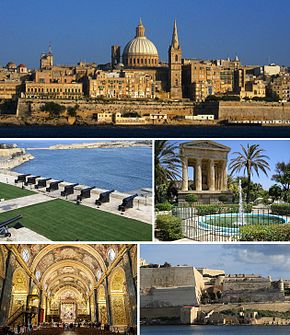
Valletta is located on the northeast coast of the island of Malta , on a rocky peninsula between two natural bays of the Mediterranean Sea : Marsamshett and Grand Harbor . Part of the streets of the city rises on the slopes of Mount Skiberras .
The capital is dominated by a Mediterranean climate with hot, dry summer (in July the temperature reaches +36 ° C) and mild rainy winter (the temperature does not fall below +4 ° C). Annual rainfall is about 550 mm. In the city, as in the whole country, there are no rivers ; groundwater is partly saline, so the population has to collect rainwater for agricultural needs and use desalination plants. The vegetation is poor, mostly shrubby . Some herbs are used in pharmaceutical and cosmetic production.
| Climate of Valletta | |||||||||||||
|---|---|---|---|---|---|---|---|---|---|---|---|---|---|
| Indicator | Jan. | Feb | March | Apr | May | June | July | Aug | Sen | Oct. | Nov. | Dec | Year |
| Absolute Maximum, ° C | 22.2 | 26.7 | 33.5 | 29.1 | 35.3 | 40.1 | 42.7 | 43.8 | 37.4 | 34.5 | 28.2 | 23.9 | 43.8 |
| Average maximum, ° C | 15.5 | 15.5 | 17.2 | 19.7 | 24.0 | 28.4 | 31.4 | 31.6 | 28.4 | 24.9 | 20.5 | 17.0 | 22,8 |
| Average temperature, ° C | 12.6 | 12.4 | 13.7 | 15.9 | 19.6 | 23.7 | 26.5 | 27.0 | 24.5 | 21.4 | 17.5 | 14.2 | 19.1 |
| Average minimum, ° C | 10.5 | 10.1 | 10.9 | 12.7 | 15.6 | 19.1 | 21.5 | 22.3 | 20.6 | 18.1 | 14.8 | 12.0 | 15.7 |
| Absolute minimum, ° C | 1.0 | 0.6 | 1.4 | 4.4 | 7.0 | 11.0 | 15.0 | 13.0 | 12.8 | 8.0 | 6.0 | 3.7 | 0.6 |
| Precipitation rate, mm | 89.0 | 61.3 | 40.9 | 22.5 | 6,6 | 3.2 | 0.4 | 7.0 | 40.4 | 89.7 | 80.0 | 112.3 | 553.3 |
| Water temperature, ° C | 14.5 | 14.5 | 14.5 | 16,1 | 18.4 | 21.1 | 24.5 | 25.6 | 25.0 | 22.2 | 19.5 | 16.7 | 19.4 |
| Source: Weather and Climate , Tourist Portal | |||||||||||||
Population, language, religion
More than 9 thousand inhabitants live in Valletta [ when? ] , which are mostly Maltese - descendants of the Phoenicians , who in ancient times colonized Malta. Residents of the city speak two languages - Maltese and English . Most citizens profess Catholicism .
Development History
The shores of the island of Malta are a winding line, carved by many convenient coves . This geographical feature explains the fact that the settlement that exists on the site of modern Valletta has been known since the 9th century BC, when the Phoenicians colonized the island. For centuries, Malta passed from hand to hand: in the VII century BC it belonged to the Greeks , from the 6th century BC to Carthage , from 218 AD to Rome , then it was seized by the Vandals , who were replaced by the Byzantines , and in 869 - Arabs . The Normans , who joined Malta to Sicily in the XI century , became its last masters, having presented the island at the beginning of the XVI century with the Order of the Johannites .
The history of Valletta begins from the moment when small groups of Maltese knights led by Jean de La Valletta repulsed the attack of the Turkish troops, who sent Suleiman the Magnificent to conquer the archipelago. The victory went to the people of Malta quite expensive, leading the master to the decision to create a well-fortified city, which in the future will help resist the onslaught of enemies.
Grand Master personally laid the first stone of the new city on March 28, 1566 . Generous donations from around the Christian world made it possible to carry out construction work very quickly. The construction was led by Italian architect Francesco Laparelli , who developed the plan of Valletta and received for the first time in the history of urban planning in Europe the opportunity to do everything in accordance with the rules and regulations of architecture . Special systems were built for the disposal of wastewater and the removal of garbage from the city, which made it possible to conduct work without accumulating construction waste. The layout of the streets was designed in such a way that the sea breeze , penetrating everywhere, cleared the air , creating the effect of air conditioning.
Immediately, a special Department of Urban Planning, which still exists, was created, which strictly regulated everything that was related to the development. The department ordered to put houses along one line, decorate them in the corners with sculptures , and to arrange a well for collecting rainwater in the yard, it was forbidden to plant gardens in front of the facades.
Simultaneously with the construction of housing and public buildings engineering defenses were built around the capital. In five years, these works were completed, including dug out a wide ditch, which separated Valletta from the main part of the island . The length of the moat was 1000 meters, depth 18 meters, and width - 20 meters.
From 1570 the pupil of Laparelli Gerolamo Kassar continued the construction of the city. Under his leadership, palaces and churches were built in Valletta. Trade, crafts and art developed in Valletta. Valletta's decoration was promoted by the fact that, having got rid of the threat of the Turkish conquerors, the Knights of Malta soon began to take care of the comfort of their own living and began building luxurious mansions and palaces.
In 1798, the knights, who lost morale and discipline, could not, and did not want to, repel the troops of Napoleon . On the contrary, many of them gave the emperor an enthusiastic welcome, since they had French roots. Such behavior of the knights helped Valletta to avoid destruction and to preserve its original appearance. In 1800, Valletta, together with the whole island, passed into the hands of the British and remained under their authority until 1974 . During World War II, the city was severely damaged by German air raids. Since 1974, Valletta has become the official capital of the Republic of Malta , which gained independence .
Cultural value
The central street of the city is the street of the Republic , which got its name in 1974 (previously it was called Strada San Giorgio, and under the English Kingzvey or Strada Real, the latter name was mentioned in Jules Verne’s novel “The Archipelago in Flames”) the city in half, ending at Fort St. Elmo, which was one of the main defensive forts of Valletta. Nowadays a military museum is located in the fort . The construction of the Republic Street is a striking example of South European style .
The city gates lead to Freedom Square, where the St. James Cavalier Tower is located to the right, followed by the knightly residence of Auberge de Castiy , which is the residence of the Prime Minister of Malta. Opposite Freedom Square is Palazzo Ferreria , one of the most beautiful palaces erected in the style of Italian classics, which previously housed the armory of knights. A little further you can see the building of the royal opera . Oberge de Provence , built in 1574 during the reign of the Knights of the Order of the Hospitallers, was the center of public life in Malta and was called the Union Club. Now it houses the National Museum of Archeology .
Republic Street crosses several squares: the Square of the Great Siege, the Republic Square and Palace Square, where the Palace of the Grand Master is located, which was built in the period from 1570 to 1580 . Currently, this building houses the residence of the President and Parliament of the Republic of Malta. Part of the palace halls is open for tourists .
Valletta is home to the only university in the whole country, founded in 1769 and received world recognition for the quality of teaching medical sciences . Also located there is the first Anglican cathedral on the island - St. Paul's Cathedral .
Among other attractions worth noting Casa Rossa Piccola , one of the last not rebuilt palaces in Malta , and the Jesuit Church , one of the oldest churches in the city.
Music Festivals
Every year in January, the International Festival of Baroque Music in Valletta .
Notes
- ↑ https://www.timesofmalta.com/articles/view/20080710/local/new-valletta-mayor.216084
- ↑ [1]
- ↑ Italy, Vatican, San Marino, Malta // Peace Atlas / comp. and prepare. to ed. PKO "Cartography" in 2009; Ch. ed. G. V. Pozdnyak . - M .: PKO "Cartography": Onyx, 2010. - p. 60-61. - ISBN 978-5-85120-295-7 (Cartography). - ISBN 978-5-488-02609-4 (Onyx).
- ↑ Valletta // Dictionary of geographical names of foreign countries / resp. ed. A.M. Komkov . - 3rd ed., Pererab. and add. - M .: Nedra , 1986. - p. 68.
- ↑ La Valletta // Brockhaus and Efron Small Encyclopedic Dictionary : 4 tons. - St. Petersburg. , 1907-1909.
Links
- Local Council of Valletta
- Malta Life History 35 min. audiovisual documentary drama in HD, about the history, culture and lifestyle of Malta and the Maltese.