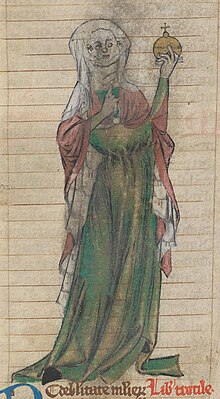
Trotula Salerno (11th – 12th centuries) is a female doctor who worked in Salerno , Italy. She is credited with several works on women's health, including women's diseases , women 's treatment, and women 's cosmetics . In medieval Europe, these texts were the main source of information on women's health [1] .
The texts Diseases of Women , Treatments for Women and Women's Cosmetics are commonly referred to collectively as “Trotula”. This is misleading because there is no evidence that Diseases of Women and Women's Cosmetics were actually written by Trotula; these two texts were distributed anonymously until they were merged with the Diseases of Women sometime in the thirteenth century, and by the end of this century they were already called collectively. Over the next several hundred years, Trotula were distributed throughout Europe, reaching the greatest popularity in the fourteenth century. Twenty-nine copies have survived to this day [2] .
In addition, only two other texts of Trotula were preserved. She was one of seven Salerno doctors who contributed to the encyclopedia of medical knowledge, On the Treatment of Illnesses . Her excerpt was later published separately: Practical Medicine According to Trota . These two texts and Diseases of Women are an exhaustive list of works marked by her name [3] .
Little is known about the life of Trotula. She is believed to have been a physician in the so-called Salerno School . The medieval scholar Caspar Wolf claimed that the texts of Trotula were written by a man freed by a Roman slave [4] . Two feminist historians, Elizabeth Mason-Hol and Kate Campbell Heard-Mid, wrote about Trotula in the 1930s and 40s. Both women made false and unconfirmed conclusions about the life of Trotula, which leads to misunderstandings to this day. It is not yet known exactly when Trotula lived, whether she was married, and whether she was one of the first feminists [5] .
Trotula
- Diseases of Women (De passionibus mulierum curandarum, Trotula Major)
In the text of twenty-seven sections, he describes various problems with the woman’s health and focuses on problems with menstruation and the birth of a child . Unlike Treatments for Women , the text provides theoretical explanations for the problem. Theoretical explanations are mainly based on Galen’s gynecological theory. Galen claims that women are colder than men and unable to “cook” their nutrients, so they must eliminate excess substances through menstruation. In Galen’s gynecology, menstruation is perceived as a healthy and important phenomenon. The author of Diseases of Women describes how to regulate the length of menstruation. The issue of uterine movement, another large section of Galen’s gynecology, is also discussed in detail. The upward movement of the uterus, or “suffocation” of the uterus, causes a number of problems. The author explains that the uterus suffocates from an excess of female sperm (another idea of Galen) and offers several possible solutions to the problem. In addition, the treatment of obstetric fistula and the appropriate regimen for the newborn were discussed. The author of this text was probably familiar with Galen’s gynecology thanks to Arabic medical texts such as Viaticum Ibn al-Jazzar [6] .
- Treatments for women
The text describes the treatment of various female (and several male) problems. The rationale for the occurrence of problems is given minimal, in the spotlight - treatment. Questions are presented ranging from tanning to infertility . Means often include mixtures of herbs and spices. The listed procedures come from the Mediterranean oral tradition , and not from the Arabic texts or Galen [7] .
- Women's Cosmetics
“De Ornatu mulierum”, also called “Trotula Minor” or “Women's cosmetics”, is a treatise that teaches women to preserve and improve their beauty and treat skin diseases with a number of prescriptions, tips and the use of natural remedies. The text gives makeup lessons, means to eliminate wrinkles , remove puffiness of the face and eyes, remove unwanted hair from the body, brighten the skin, hide spots and freckles , brush your teeth and eliminate bad breath, restore hair, treat lips and gums . Thus, the development and use of ointments and medicinal herbs for the face and hair are described, but the help of steam baths and massages is ignored. For the author, the beauty of women is associated with the philosophy of nature: beauty is a sign of a healthy body and harmony with the Universe [8] .
Notes
- ↑ Green, Monica: The Trotula , page xi. U. of PA, 2001.
- ↑ Green, pages 49-59.
- ↑ Green, page 49.
- ↑ Rowland, Beryl: Medieval Woman's Guide to Health , page 3-4. Kent State, 1981.
- ↑ Stuard, Susan Mosher. Dame Trot (neopr.) // Signs: Journal of Women in Culture and Society . - University of Chicago Press. - T. 1 , No. 2 . - S. 537-542 .
- ↑ Green, pages 17-25, 65-87.
- ↑ Green, pages 89-112.
- ↑ Paolo Cavallo , International Journal of Cosmetic Science , The First Cosmetic Treatise of History. A Female Point of View , 2008, PMID 18377616
Literature
- Rowland, Beryl. Exhuming Trotula, Sapiens Matrona of Salerno (neopr.) // Florilegium. - 1979.- T. 1 . - S. 42-57 . - ISSN 0709-5201 . - PMID 11616980 .
- The Trotula: a medieval compendium of women's medicine. - University of Pennsylvania, 2001. - ISBN 0-8122-3589-4 .
- The First Cosmetic Treatise of History. A Female Point of View. (English) // International Journal of Cosmetic Science: journal / Cavallo, Paolo. - Salerno: University of Salerno, 2008 .-- Vol. 30 , no. 2 . - P. 79-86 . - DOI : 10.1111 / j.1468-2494.2007.00414.x . - PMID 18377616 .
- reviewed at Nutton, Vivian. The Trotula: a medieval compendium of women's medicine (English) // Medical History: journal. - 2003 .-- January ( vol. 47 , no. 1 ). - P. 136-137 .