The reddish mongoose [1] ( lat. Galerella flavescens ) is a species of predatory animal from the family of mongoose ( Herpestidae ), which lives in southwestern Africa.
Reddish mongoose | ||||||||||||||
|---|---|---|---|---|---|---|---|---|---|---|---|---|---|---|
 | ||||||||||||||
| Scientific classification | ||||||||||||||
| ||||||||||||||
| Latin name | ||||||||||||||
| Galerella flavescens ( Bocage , 1889) | ||||||||||||||
| Area | ||||||||||||||
 |
Security status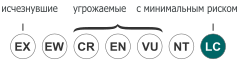 IUCN 3.1 Least Concern : 41599 |
Content
- 1 Description
- 2 Distribution
- 3 Lifestyle
- 4 notes
- 5 Literature
Description
The reddish mongoose is a relatively small mongoose with a slender physique, the size of a slender mongoose . Both species have the same weight. The body length is from 31 to 35.5 cm, while the males are slightly larger. The tail is the same length as the rest of the body. The color of the coat varies from reddish or yellowish to dark brown or black. The skull is 63 to 68 mm longer than the skull of the slender mongoose, however, is smaller than the skull of the South African mongoose [2] . In the field, the reddish mongoose can be confused with the South African mongoose, whose range is partially overlapped [3] .
Distribution
The species range is limited to southwestern Africa, where it inhabits arid regions in northwestern Namibia and southwestern Angola [3] . The reddish mongoose populates arid landscapes with sparse vegetation, while avoiding real deserts [2] .
Lifestyle
The reddish mongoose feeds primarily on small mammals, birds, reptiles and insects. Along with this, it also feeds on larvae from animal corpses and fleshy fruits. The view is active mainly during the day. Animals lead a solitary lifestyle, less commonly found in groups of 2 to 3 animals. Near the large corpse of an animal, their number reached five individuals. Sometimes animals behaved aggressively towards each other. Little is known about the size of the territory. A male, marked with a radio transmitter in the Erongo Mountains in Namibia, moved across an area of 145 hectares [2] .
Notes
- ↑ Complete Illustrated Encyclopedia. "Mammals" Prince. 2 = The New Encyclopedia of Mammals / Ed. D. MacDonald . - M .: Omega, 2007 .-- S. 468. - 3000 copies. - ISBN 978-5-465-01346-8 .
- ↑ 1 2 3 JS Gilchist, AP Jennings, G. Veron, & P. Cavallini (2009). Family Herpestidaae (Mongooses). In: Don E. Wilson, Russell A. Mittermeier (Hrsg.): Handbook of the Mammals of the World. Volume 1: Carnivores. Lynx Edicions, 2009, ISBN 978-84-96553-49-1 .
- ↑ 1 2 Herpestes flavescens in der Roten Liste gefährdeter Arten der IUCN 2011. Eingestellt von: Hoffmann, M. & Rathbun, G., 2008.
Literature
- JS Gilchist, AP Jennings, G. Veron, & P. Cavallini (2009). Family Herpestidaae (Mongooses). In: Don E. Wilson, Russell A. Mittermeier (Hrsg.): Handbook of the Mammals of the World. Volume 1: Carnivores. Lynx Edicions, 2009, ISBN 978-84-96553-49-1 .