Bratislava ( Slovak. Bratislava ), until 1919 - Presporok or Presporek ( Prešporok, Prešporek ), Presburg ( German Pressburg ), Požon ( Hungarian. Pozsony ), in the Middle Ages - Istropolis ( Latin Posonium , lat. Istropolis ) in Central Europe , the capital of Slovakia . The historical capital of the Kingdom of Hungary (from 1541 to 1684), the First Slovak Republic (from 1939 to 1945) and the Slovak Socialist Republic (from 1965 to 1990). The population of the city is 425,923 people [1] , agglomeration - about 700 thousand people [2] (unavailable link from 14-10-2017 [674 days]) . The area of the city is 368 km².
| City | |||||
| Bratislava | |||||
|---|---|---|---|---|---|
| Slovak Bratislava | |||||
 | |||||
| A country |  Slovakia Slovakia | ||||
| Edge | Bratislava region | ||||
| Chapter | |||||
| History and Geography | |||||
| First mention | 907 | ||||
| Former names | Pozhon, Presburg, Presporok | ||||
| Square | 368 km² | ||||
| NUM height | 140 m | ||||
| Timezone | UTC + 1 , in summer UTC + 2 | ||||
| Population | |||||
| Population | ▲ 425 923 [1] people ( 2017 ) | ||||
| Density | 1171 people / km² | ||||
| Agglomeration | about 700,000 | ||||
| Nationalities | Slovaks (91.4%), Hungarians (3.8%), Czechs (1.9%), Germans (0.3%), Poles , Ukrainians | ||||
| Denominations | Catholics 56.7%, atheists 29.3%, Lutherans 6%, the remaining 4.7% | ||||
| Katoykonim | brotherhood, brotherhood, brotherhood | ||||
| Digital identifiers | |||||
| Telephone code | +421 421-2 | ||||
| Postal codes | 8XX XX | ||||
| Car code | BA, BL | ||||
| bratislava.sk (words) (English) (German) | |||||


Bratislava and Vienna are the closest capitals of Europe (55 km and less than an hour of transport accessibility from each other). Bratislava directly borders Austria and Hungary , thus being the only capital in the world bordering two foreign countries. Bratislava street Kopchyanskaya goes into Alte-Nordziud-Landesstrasse street in the neighboring Austrian village of Kitsee . Until 1936, it was possible to get from Bratislava to Vienna by city tram .

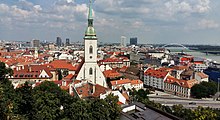

Geography and climate
Bratislava is located in the foothills of the Lesser Carpathians , on both banks of the Danube and on the left bank of the Morava River. Behind the Danube is a smaller part of the city of Petrzalka . The city is directly adjacent to the borders with Austria (until December 21, 2007 there were border crossings Petrzalka - Berg and Jarovce - Kitsee ) and Hungary (until December 21, 2007 there was a border crossing Rusovce - Raika ).
The climate is continental, bordering the temperate marine ( Dfa / Cfa ), the average annual temperature is +10.5 ° C, the average annual rainfall is 565 mm. The average January temperature is approximately −0.4 ° C, and the average July temperature is 21.3 ° C. Winter is cold and humid with snow. Summer is very warm, almost hot, often with strong winds.
| The climate of Bratislava (norm 1981-2010) | |||||||||||||
|---|---|---|---|---|---|---|---|---|---|---|---|---|---|
| Indicator | Jan | Feb | March | Apr | May | June | July | Aug | Sep | Oct | Nov | Dec | Year |
| Absolute maximum, ° C | 19.8 | 19.7 | 25.0 | 30.3 | 33,4 | 36.3 | 38,2 | 39.3 | 34.0 | 30,0 | 21.3 | 17.9 | 39.3 |
| Average maximum, ° C | 2.7 | 5.1 | 10.3 | 16.7 | 21.8 | 24.9 | 27.5 | 27.0 | 21.7 | 15.6 | 8.2 | 3.3 | 15.4 |
| Average temperature, ° C | −0.4 | 1,2 | 5.5 | 11.0 | 16,0 | 19.1 | 21.3 | 20.7 | 15.9 | 10,4 | 4.9 | 0.7 | 10.5 |
| Average minimum ° C | −3.4 | −2.3 | 1.3 | 5,4 | 10,2 | 13,4 | 15.4 | 15.0 | 11.0 | 6.1 | 1.8 | −1.9 | 6.0 |
| Absolute minimum, ° C | −24.6 | −20 | −15.1 | −4.4 | −2 | 3.0 | 7.0 | 5,0 | −2 | −8 | −12 | −20 | −24.6 |
| Precipitation rate, mm | 39 | 37 | 38 | 34 | 55 | 57 | 53 | 59 | 55 | 38 | 54 | 46 | 565 |
| Source: Weather and Climate | |||||||||||||
Population
The population of Bratislava as of December 31, 2016 is estimated at 425 923 people [1]
According to the 2001 census, Slovaks made up 91.4% of the population, Hungarians - 3.8%, Czechs - 1.9%, Germans - 0.3%, others - 2.6%.
Catholics - 56.7%, atheists - 29.3%, Lutherans - 6%, the rest - 4.7%.
Administrative Division
Administrative division - 5 districts (okres), 17 urban units (Mestská časť).
| Parts of Bratislava | |
|---|---|
| Area | Urban part |
| Bratislava I | Stare Mesto |
| Bratislava II | Ruzhinov |
| Vrakunya | |
| Podunajské Biskupice | |
| Bratislava III | Nove Mesto |
| Racha | |
| Winors | |
| Bratislava IV | Charles Weight |
| Dubravka | |
| Lamach | |
| Devin | |
| Devinska Nova Wes | |
| Zagorsk Bystrica | |
| Bratislava V | Petrzhalka |
| Jarovce | |
| Rusovce | |
| Chunovo | |
Administrative division of Bratislava | |
History
- The first permanent settlement dates back to the Neolithic ( culture of linear tape ceramics ).
- 400 BC - 50 BC e. - Celtic settlement, destroyed about 50 BC. e. Dacians led by Burebista .
- about 50 BC e. - the penetration of Germanic tribes into the territory of Bratislava.
- about 50 BC e. - The first appearance of Roman legions in Bratislava.
- about 70 years - the Roman settlement of Gerulata .
- I-V centuries of our era - the border ( limes ) of the Roman Empire runs along the Danube, many Roman and German settlements. It is traditionally believed that Bratislava was one of the strongholds of the Danube defensive line, built on the orders of the commander of the Roman emperor Tiberius , Pison. However, accurate evidence of a Roman presence in the area of modern Bratislava was not found.
- 375 year - the Romans leave the territory.
- V century - the arrival of the Slavs .
- 560 - the arrival of the Avars .
- 623 - 658 years - the principality of Samo .
- the end of the VIII century - 833 - the Principality of Nitran .
- 833 - 907 years - part of Great Moravia .
- 907 is the first mention of Bratislava in the chronicles (Brezalauspurc): the Battle of Pressburg , which ended with the victory of the Hungarians over the Bavarian army.
- 907-1918 (with small interruptions) - part of Hungary .
- 1541 - 1684 years - (after the capture of Buda by the Turks) - the provisional capital of Hungary, subordinate to the Austrian Habsburg monarchy.
- December 26, 1805 - the conclusion of a peace treaty between France and Austria in Presburg after the defeat of Austria in the Battle of Austerlitz and its complete defeat in the war of the Third Coalition ( Presburg Peace ).
- 1919 - 1939 - part of Czechoslovakia ; change of official name to Bratislava to replace Prešporek / Pressburg / Pozsony . Previously, the name Bratislava was used only by Slovak patriots, relying on a dubious reading by Pavel Joseph Safarik of the Prince of Pannonian Croatia and the Blatensky Principality of Braslav (in whose honor Brezalauspurc was named) as Bratislava. Initially, Slovak emigrants in the United States wanted to rename the city Wilson or Wilsonstadt in honor of President Woodrow Wilson as a supporter of the right of nations to self-determination.
- 1939-1945 the capital of the First Slovak Republic , the Transdanubian part (the modern district of Bratislava V ) was annexed by Germany .
- On April 4, 1945, it was liberated by the troops of the 2nd Ukrainian Front during the Bratislava-Brnovsk offensive operation .
- 1945-1992 - part of Czechoslovakia.
- 1969 - 1992 - the capital of the Slovak Socialist Republic (since 1990 - the Slovak Republic) as part of Czechoslovakia.
- since 1993 - the capital of independent Slovakia .
Transport
Since the arrival of the railway in the city in 1848, the Bratislava-Main railway station has been operating in the city center. In the Transdanubian part, the Bratislava-Petrzalka railway station operates. Railways from the city go in 6 directions. Bratislava Stefanik Ivanka Airport is located a few kilometers from the city and has been operating since 1951. The OneTwo consortium, which owns the airport, plans to combine it into a single complex with the Vienna- based Schwechat airport and the construction of the Bratislava-Schwechat-Vienna high-speed railway. To ensure navigation on the Danube, the city has a river port with a train station. The city's road network includes 5 bridges and has 3 main motorways from the city. The city has the main bus station Mlinsky Niva and bus stations.
The first public urban transport in Bratislava was in 1868 an omnibus . The tram in Bratislava was opened in 1895 and has since been the main public transport, currently having 8 lines. The Bratislava trolley bus was first launched in 1909, but was soon closed, and again began to work since 1941, having currently 14 routes. There are also bus routes in the city (about 60 regular and 20 night routes), while until 2016 the bus was the only public transport that went to the Transdanubian part of Petrzalka , now a new tram line is laid there, along which there are two routes - 1 and 3. Public transport is operated by a single company, Dopravný podnik Bratislava. In 1985, the construction of the Bratislava Metro began , which was soon stopped. Since 2002, it is planned to build a light rail , which in the future can be converted into the subway.
Science and Culture
Education
- Comenius University
- Slovak Medical University
- University of Economics in Bratislava
- Slovak Technical University in Bratislava
Museums
- Slovak National Gallery
Attractions
- Bratislava Castle
- Bratislava Zoo
- City Devin
- Grashalkovich Palace
- Istropolitan Academy
- Hatama Sofer Mausoleum
- Michal Gate
- Apollo Bridge
- National Theater of Slovakia
- New bridge
- Fishing gate
- St. Martin's Cathedral
- Old town hall
- Old bridge
- Franciscan Church
- The Church of St. Elizabeth or the “Blue Church” ( 1907 - 1913 ) in the Art Nouveau style , one of the most famous buildings of the Hungarian architect Eden Lechner
- The Church of St. Nicholas ( 1661 ) in the Baroque style , formerly Catholic, now belongs to the autocephalous Orthodox Church of the Czech lands and Slovakia
- Chapel of St. James - Ossuary and the ruins of the oldest medieval religious building in Bratislava
- Church of the Holy Spirit
- Church of the Claris
Sport
The city is based sports society "Slovan". Football club performs in the Slovak extra-league . And hockey is one of the most successful in Europe. In 2012, HC Slovan joined the KHL .
Twin Cities
- Alexandria ( Arabic: الإسكندريه ), Egypt
- Bremen ( German: Bremen ), Germany
- Vienna ( German: Wien ), Austria
- Yerevan ( Armenian ԵրԵան ), Armenia
- Kiev ( Ukrainian Kyiv ), Ukraine
- Cleveland , Ohio , USA
- Krakow ( Polish: Kraków ), Poland
- Ljubljana ( Slovenian. Ljubljana ), Slovenia
- Moscow , Russia
- Perugia ( Italian: Perugia ), Italy
- Prague ( Czech Praha ), Czech Republic
- Rotterdam ( Netherlands. Rotterdam ), Netherlands
- Ulm ( German: Ulm ), Germany
- Turku ( Fin. Turku , Swede. Åbo ), Finland
- Saratov , Russia
Notes
- ↑ 1 2 3 Slovakia: Bratislava . City Population . Date of appeal October 14, 2017.
- ↑ Districts . Statistical Office of the Slovak Republic. Date of treatment April 21, 2011. Archived August 24, 2011.