The Second Battle of Fort Wagner, also known as the Second Assault on Morris Island , or the Battle of Fort Wagner , took place on July 18, 1863 in South Carolina during the American Civil War . Units of the federal army under the command of Brigadier General Quincy Gilmore launched an unsuccessful attack on Fort Wagner, which defended Morris Island in southern Charleston Harbor. The actions of the 54th Massachusetts regiment during the assault on the fort are depicted in the feature film " Glory ."
| Second Battle of Fort Wagner | |||
|---|---|---|---|
| Main Conflict: US Civil War | |||
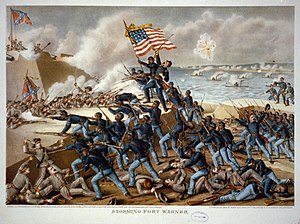 Assault on Fort Wagner | |||
| date | July 18, 1863 | ||
| A place | Morris Island, South Carolina | ||
| Total | Confederate victory | ||
| Opponents | |||
| |||
| Commanders | |||
| |||
| Forces of the parties | |||
| |||
| Losses | |||
| |||


The battle took place a week after the First Battle of Fort Wagner .
Content
Background
Fort Wagner (named in memory of the deceased Lt. Col. Thomas Wagner of South Carolina [1] ) covered the strategically important Gregg battery from the rear at the northern tip of Morris Island. In the Confederate documents, Fort Wagner is usually called a battery, but during the siege, the fortification was adapted for circular defense and became one of Charleston's strongest defense points. At 150-200 meters in front of the fort, the island narrowed to a strip of sand 55 meters wide, bounded by the ocean on the eastern side and the swampy Vincent Creek channel on the western side. Thus, it was possible to attack the fort only with a regiment column. Having overcome the narrow isthmus, the attackers found themselves in front of the southern face of the fort, 250 meters long, which covered the island across the entire width from the river to the ocean. The fort was surrounded by a shallow moat, reinforced with pointed palm trees. The bottom of the ditch from the ocean underwater was covered with boards with pointed spikes.
After the first assault on the fort , 2/3 of Morris Island was in the hands of the northerners. The southerners decided to defend Wagner Fort as long as possible in order to equip a new fortification belt around Charleston. To this end, the fort garrison received replenishment every night, which landed on the northern tip of the island, Cape Cummings, and ran under enemy fire to defend the fortifications.
On July 13, General Beauregard decided to replace Colonel Robert Graham as commandant of the fort by Brigadier General William Tagliaferro , who took command on July 14th. From July 14 to July 13, the garrison was completely changed: the fort was occupied by five companies of the Charleston battalion of Lieutenant Colonel Peter Gaillard, the 51st North Carolina Regiment of Colonel Hector Macketan, the 31st North Carolina Regiment of Colonel Knight, companies I and H from the 1st South Carolina Regiment under under the command of captains W. Tatom and Warren Adams (as an artillery servant), company B and K under the command of captains Dixon and Buckner from the 63rd Georgian regiment, a howitzer platoon from the artillery regiment De Saussure under the command of captain W. De Pass, as well as a howitzer platoon under the command of Lieutenant L. Waitis. 26 cavalrymen of the 5th South Carolina cavalry regiment served as messengers.
The general command of the artillery of the fort was assigned to Lieutenant Colonel J. Simkins. Gayllard defended the right flank, Macketan - the center, and Knight - the left flank. Two companies of Gaillard under the command of Captain Julius Blake took up positions on the extreme left flank - in the sand dunes and on the coastal rampart of the fort [2] .
The fort's armament consisted of one 10-inch coastal mortar, two 32-pound carronades , two 8-inch guns, two 32-inch howitzers, a 42-pound carronade and an 8-inch sea gun. Two light guns on the right flank, near the Vincents Creek duct, served company A of the 1st South Carolina Infantry Regiment. One 32-pound carronade , one 10-inch Columbiad, and two 12-pound howitzers were placed on the sidewalk parapet. Mortira, a 10-inch Columbiad, and one 32-pound carronade were served by Captain Tatom's company. A 42-inch carronade, an 8-inch naval cannon and a 32-inch carronade were served by Captain Adams's company.
In the evening of July 14, Major District, led by a detachment of 150 people, gathered from the 7th South Carolina Battalion, the 21st South Carolina Regiment, the 12th and 18th Georgian Regiments, and the 51st North Carolina Regiment, made an outing towards the sentinel guards. His task was to bring down the guards and pursue him until the detachment was faced with tangible resistance. The attack was so swift that the pickets of the northerners rolled back to the very positions of their brigade. After that, the Area retreated and took up positions on the ridge 200 steps ahead of the fort.
Commander of the Northerners Brigadier General Quincy Gilmore was intent on the second attempt to take the fort. From July 14 to July 17, the fort was fired daily by naval artillery and ground batteries, however, the fort garrison repaired all damage overnight. Initially, the assault was planned for July 16, but due to heavy rains the siege batteries were flooded with water, and a significant part of the gunpowder was wet. Therefore, the attack was moved to the morning of July 18. Then, the beginning of the attack was moved to the afternoon, and the first half of the day was used for shooting artillery [3] .
Battle
Artillery training
At dawn on July 18, at 8:15, four northerner land batteries erected on Morris Island opened fire:
- Reynolds advanced battery: five 8-inch siege mortars, two 30-pound and six 10-pound Parrot guns , four 3-inch cannons and two Wiard rifled guns
- Weed battery: four 10-inch siege mortars
- Hayes battery: nine 30-pound and four 20-pound Parrot guns
- O'Rourke battery: five 10-inch siege mortars
The first two batteries were commanded by Captain Loomis Langdon of the 1st United States Artillery Regiment. The rest are Lt. Col. Richard Jackson, Assistant General Inspector, and Major Bailey from the 3rd Rhode Island Artillery Regiment.
At first, the firing of land batteries was slow, but intensified with the delivery of dry powder. The main long-range firing was carried out by five wooden gunboats of Dahlgren. The artillery of the fort, the guns of the Gregg battery, the forts of Sumter and Multry, as well as the batteries of James Island fired back, but the firing of the latter was ineffective due to the long range.
At 11:30, the battleship New Ironsides , monitors Montauk (flag of Rear Admiral Dahlgren), Catskill, Nantucket, Weehawken, Patapsco and gunboats Paul Jones, Ottawa, Seneca, Chippewa and Wissahickon approached the shore. Next to the battleship in boats was a landing party of 280 sailors, led by three young lieutenants. In the afternoon, with the tide, the ships of the northerners came even closer to the coast and fired from a distance of 300 meters. One of the shells exploded in the water near the shore, and rain from stunned fish hit the fort [4] . Most defenders of the fort took refuge in a bomb shelter. Only artillerymen and most of the Charleston battalion remained in positions. It was not possible to shoot from the guns of the land front, but the coastal front was better fortified, and the Confederates tried to respond to the fire of the ships of the northerners from a 32-pound gun and a 10-inch columbiad. However, the approaching monitors managed to damage the Columbiad and lead it to silence.
The intense fire of the northerners actually proved to be ineffective: as a result of the eight-hour bombing, only 8 were killed and 20 defenders of the fort were wounded. At some point, the northerners were able to hit the Confederate flag, but Captain Robert Barnwell, engineer Captain Robert Barnwell, raised it immediately on the parapet, after which Major Ramsay, Sergeant William Shelton and Lieutenant William Ridick quickly replaced the downed banner.
In the afternoon, the chief engineer of the district, Colonel Harris, sailed from Charleston in a small boat, landed on Cummings Cape and ran into Fort Wagner under a hail of shells. There he was actively involved in the repair of damage and the dismantling of the cores and shells of the northerners, which were littered with passages and artillery sites. At 15:40, General Tagliaferro telegraphed to Charleston asking for a change, but this request was impossible to fulfill.
At 17:45, the southerners intercepted General Gilmore’s telegraph message addressed to Admiral Dahlgren and decrypted it using the code book from the sunken armadillo of the northerners Keokuk . Having learned from the text of the message that the northerners were preparing for the assault, Tagliaferro reported this to General Boregar, who ordered that the 32nd Georgian regiment of General Hagud be transferred to Morris Island immediately.
Expecting an immediate attack, Tagliaferro ordered the garrison to take places on the ramparts of the fort. Two companies of the 31st North Carolina Regiment ran from the Gregg battery to the fort, cavalrymen took up places on the ramparts along with the infantry. The gunners dug their guns out from under the rubble of sand and loaded them with buckshot over the core. However, most of the 31st Regiment refused to leave the bomb shelter.
Disposition of the Northerners
A decisive assault was scheduled at sunset, so that in the rays of the setting sun the attacking column was less noticeable for the neighboring Confederate batteries. The division commander, Brigadier General Truman Seymour, built the convoy as follows. The first was the brigade of Brigadier General George Strong:
- 54th Massachusetts - Colonel Robert Shaw
- Connecticut 6th - Colonel John Chathfield
- 48th New York - Colonel William Burton
- 3rd New Hampshire - Colonel John Jackson
- 76th Pennsylvania ( Zouaves ) - Colonel DeWitt Strawbridge
- 9th Mansky - Colonel Sabin Emery
The second echelon was composed of four regiments of the brigade of Colonel Haldimand Putnam:
- 7th New Hampshire - Lt. Col. Joseph Abbott
- 100th New York - Colonel George Dandy
- 62nd Ohio - Colonel Francis Pond
- 67th Ohio - Colonel Alvin Voris
In reserve was a brigade of brigadier general Thomas Stevenson:
- 24th Massachusetts - Colonel Francis Osborne
- 10th Connecticut -
- 97th Pennsylvania - Colonel Henry Gass
- 2nd South Carolina - Colonel James Montgomery
Four companies of the 7th Connecticut Regiment and volunteer artillerymen serviced siege weapons.
The usual preparations for the assault were not carried out. No means were provided in order to clear obstacles, fill up the moat, and rivet captured tools. The attackers did not receive any specific instructions. A detachment of shooters for cover was not formed. Neither sappers, nor guides, nor artillery escorted the column to serve the captured guns. The assault plan was not communicated to the company officers. It was believed that the 54th should take the fort with a bayonet attack, and that the rest of the brigade would support it. General Gilmore was convinced that his artillery had destroyed the Confederate fortifications, and that it was possible to take the fort using the forces of one Strong brigade, however, he agreed, just in case, to build the entire division into battle formation. Colonel Putnam, a career officer and graduate of West Point, was convinced that the assault was poorly prepared, but they did not listen to him.
Sturm: First Wave
Colonel Shaw built his avant-garde regiment (624 men) in two lines of 5 companies each. He himself with the national flag stood behind the first line, Lt. Col. Edward Hallowell with the state flag - behind the second. About half an hour, a regiment with loaded guns and bayonets bayed on the ground while a brigade column was being formed. Finally, the 6th Connecticut Regiment lined up in a convoy convoy behind the 54th Massachusetts. General Strong, with two adjutants and two orderlies on horseback, rode out in front of the formation of the 54th Regiment to admonish the soldiers. After completing a short speech, he called for the standard bearer, Sergeant John Wall, and asked: “If this person is killed, who will raise the flag and carry it?” Colonel Shaw replied: “I am.” Subordinates greeted the commander with joyful cries.
At about 7:45 p.m., when the darkness thickened, a signal sounded to the beginning of the attack. The show ordered his regiment to step 100 steps to the fort, then go on a run and attack the fortifications. Due to the narrowness of the defile, the right-flank companies were forced to go knee-deep in the water, and then the right- and left-flank companies were forced to slow down and skip the center of the forward line, since there was not enough space on the isthmus for all five companies. Meanwhile, the siege guns stopped shelling the fort, the garrison left the shelters, and approaching 200 steps the northerners met a barrage of gun and cannon fire. The 51st Confederate Regiment fired directly, and the Charleston Battalion was oblique . Fortunately for the attackers, the 31st Confederate regiment (previously fully captured in the battle of Roanoke , and then released by exchange) remained in hiding and did not manage to take up positions on the southeast bastion, otherwise none of the attackers would have reached the moat .
The 54th regiment went on the run. Naked saber officers led their units. Colonel Shaw led his subordinates to the near face of the southwestern bastion and the southern rampart of the fort. On the approaches to the fort, the regiment suffered heavy losses - Lieutenant Colonel Halliwell, Captain Willard, regimental adjutant James, Lieutenants Jewett, Homans, Smith and Pratt were injured or killed. The banner was taken by Sergeant William Cairney from the hands of wounded Sergeant Wall. The survivors, led by Colonel Shaw, were able to climb the parapet of the fort and strengthen both banners there. The colonel managed to shout: “Forward, 54th!” - but was immediately killed by a bullet in the heart [4] . Until now, the attackers have not fired a single shot. Behind the parapet of the fort, they were met by defenders who launched bayonets, pikes, and gun handguns. The northerners fought back, but the forces were unequal. Having rolled back from the parapet and taking up positions on the outer slope of the wall, the attackers opened fire, driving off the servants from the guns and covering the shelves that followed. In response, the southerners began to roll grenades and bombs with ignited wicks along the parapet.
Despite perseverance, the 54th regiment could not wait for reinforcements, and when the DePass field guns on the right flank of the fort began to shoot the attackers point-blank, he began to retreat individually and in small groups. Some soldiers did not dare to return back under the fire of the Confederates and, together with Captain John Appleton, company commander A, ran along the rampart to the coastal front of the fort, where they joined other attacking regiments.
The youngest of the regiment's captains, company commander E Luis Emilio, who took over command after the rest of the officers had failed, and lieutenants James Grace and Benjamin Dexter began to collect the surviving soldiers and line them up at a safe distance. Sergeant William Cairney saved the national flag of the regiment, and the state flag was torn off the flagpole - after the battle, the panel was picked up near the wall of the Confederates, and the pole remained with the northerners. The remains of the regiment occupied an empty trench and remained there until the morning, waiting for a counterattack by the southerners.
300 people of the 6th Connecticut Regiment, led by Colonel Chathfield in the company columns, went on the assault after the 54th Regiment, striking to the right - where the southeastern bastion connected with the fort shaft. The northerners were able to climb the rampart, which was defended by a few soldiers of the 31st regiment, and rushed deep into the fort, where a hand-to-hand combat ensued at the entrance to the bomb shelter. The standard bearer was killed, and all who tried to raise the flag were mowed down by bullets. Finally, Captain Frederick Osborne, company commander of K, pulled out a banner from under the bodies of his dead and wounded comrades. Having burst into the fort, the 6th Connecticut failed to develop success. Colonel Chathfield was mortally wounded, and the northerners faltered, and then began to retreat.
The 48th New York Infantry Regiment (about 500 people) attacked the southeastern bastion in the forehead and came under fire from a powerful Confederate coastal howitzer. Having lost half of its composition and fourteen of the sixteen officers, the 48th regiment retreated.
Assault: Second Wave
For some reason, the remaining three regiments of the Strong brigade did not provide immediate support to the regiments of the first wave. Finally, when firing began on the ramparts of the fort, General Strong launched an assault on the 3rd New Hampshire, 9th Manx, and 76th Pennsylvania Regiments.
On the narrow isthmus, the 3rd New Hampshire Regiment collided with a mass of retreating soldiers from the regiments of the first wave. Colonel Jackson stopped his subordinates and sent Lieutenant Colonel John Bedel forward to find out if the regiment could go along the swampy bank of the canal. However, Bedel got lost in the dark, joined one of the groups still attacking Fort Wagner and was captured. Jackson, not waiting for the results of intelligence, ordered the regiment to move forward through the narrow isthmus, where the northerners were under a hail of shells and buckshots. The artillery of the southerners made large gaps in the advancing ranks, and the soldiers of the broken regiments fleeing towards brought an even greater mess. As a result, the northerners went on the attack in separate groups, unable to deliver a strong blow. Colonel Jackson was wounded by a shell fragment, and General Strong, dismounting, himself led his brigade to the center of the southern face of Fort Wagner, the same place where the 54th Massachusetts attack had previously aimed. For a while, the northerners unsuccessfully tried to climb the rampart, but the Confederates dumped them into the moat. Realizing the futility of these efforts, General Strong stood up to order the retreat, but was immediately mortally wounded with shrapnel in the thigh.
Assault: Third Wave
Realizing that the vanguard had broken into the fortress, General Seymour ordered the Putnam brigade to move forward and take up positions for attack. However, Putnam, referring to the order of General Gilmore, refused to comply with the order of the division commander. While Seymour dealt with this situation, the northerners were knocked out of the fort, and the moment for the attack was missed.
After the second order of Seymour at 20:30, Putnam raised his brigade, and four regiments of columns moved to the fort. On the way, they had to stop twice - first, to pass through the ranks of the remnants of the 54th Massachusetts, and then to pass to the rear the remnants of the Strong brigade. Putnam was riding a horse at the head of a brigade. General Seymour also accompanied the convoy. The attack was aimed at the southeast bastion. Confederate artillery again rained shells and buckshots at the attacking hail. Regiments of the northerners suffered heavy losses. In 67 Ogai, seven out of eight standard-bearers were killed on the outskirts of the fort. A horse was killed near Putnam, and Seymour was wounded by a nearby shell explosion. When Seymour was taken away from the field, he gave the commander of the 3rd Brigade Stephenson the order to support the attack of the 2nd Brigade, but he remained in place, citing the ban of General Gilmore.
Having reached the fort ramparts, the 2nd brigade, led by the 7th New Hampshire Regiment (505 men), waved through both faces of the southeastern bastion, and the attackers began to advance inside the fort, taking advantage of the weakness of defense in this area. The attackers were joined by the few surviving from the Strong brigade. Units of the 67th Ohio Regiment captured two guns facing the sea. However, taking a position behind the roof of the bomb shelter, which was almost two meters high above the parapet of the fort, the northerners were trapped. At the same time, the regiments of the northerners were mixed up, and the officers could not find their subordinates. Colonel Putnam climbed the bastion and began to restore order among his subordinates.
At this time, the 32nd Georgian Regiment of General Johnson Hagud arrived to help the fort. The regiment launched an attack on the captured bastion and knocked out the last units of the enemy. At 22:30 the battle stopped.
Consequences
The attackers lost 1,515 people, including 28 officers and 218 soldiers killed, 75 officers and 805 soldiers wounded, 8 officers and 381 soldiers captured. [2] Only the 54th Massachusetts regiment lost 281 people: of which 54 were killed and 48 were missing. The 7th New Hampshire lost 74 people killed and mortally wounded.
The defenders of the fort lost 5 officers and 31 soldiers killed, 17 officers and 116 soldiers wounded, 1 officer and 4 soldiers captured. General Tagliaferro survived, although the explosion of a 15-inch shell almost buried him under tons of sand. Of the staff officers, Captain Waring was killed and captains Stony and Twiggs were seriously wounded. [2]
Southerners gathered the wounded (their own and others) and sent them to the hospital in Charleston. General Beauregard ordered "to especially take care of the wounded during the assault on Fort Wagner, since people who decide on this deserve the respect of the whole army."
Sergeant William Kearney [5] (Negro) from the 54th Massachusetts and Private Joseph Gibson from the 48th New York subsequently received medals of Honor for saving the regimental banner.
Fort Wagner was never able to be stormed. General Gilmore embarked on a long siege. On the night of September 6, 1863, the garrison of the fort left what was left of the fort and left the peninsula without interference.
In the movie
In 1989, director Edward Zwick made the film Glory, dedicated to the history of the 54th Massachusetts regiment and the assault on Fort Wagner. Matthew Broderick starred as Colonel Shaw, Jay Sanders as General Strong. Some real characters are replaced by fictional ones. For example, Senior Sergeant Lewis Douglas (the son of the famous abolitionist David Douglas) was replaced by the fictional John Rawlins ( Morgan Freeman ) [6] .
The assault scene shows the zoavas of the 76th Pennsylvania Regiment, but they are mistakenly dressed in the uniform of the 165th New York.
The film is based on letters from Colonel Shaw, as well as the books Lay This Laurel and One Gallant Rush.
Notes
- ↑ America's Civil War: Fort Wagner and the 54th Massachusetts Volunteer Infantry . Lt. Col. Wagner was killed by a shell on July 17, 1862 during an inspection of Fort Multry. Before the war, Wagner was a senator from the state of South Carolina and held a significant position in the management of railways.
- ↑ 1 2 3 Confederate Military History
- ↑ QA Glillmore. Engineer and artillery operations against the defences of Charleston Harbor , p. 39.
- ↑ 1 2 Brian C. Pohanka Fort Wagner and the 54th Massachusetts Volunteer Infantry
- ↑ Medal of Honor recipients
- ↑ Medal of Honor Recipients Portrayed On Film (link not available) . Date of treatment October 12, 2012. Archived April 26, 2012.
Literature
- Burton, E. Milby. The Siege of Charleston 1861-1865. Columbia: University of South Carolina Press, 1970. ISBN 0-87249-345-8 .
- Wise, Stephen R. Gate of Hell: Campaign for Charleston Harbor, 1863. Columbia: University of South Carolina Press, 1994. ISBN 0-87249-985-5 .
Links
- Battle map
- Fort Wagner and the 54th Massachusetts Volunteer Infantry
- Confederate Military History, chapter 14
- American Civil War: Battles of Fort Wagner
- The assault on Fort Wagner in the movie Gloria (inaccessible link) video
- Scheme of defensive and offensive engineering structures on Wagner Island in September 1863