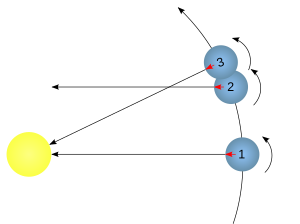
Star days - the period of rotation of a celestial body around its own axis in an inertial reference frame , which is usually taken as a reference frame associated with distant stars. For the Earth, this is the time during which the Earth makes one revolution around its axis with respect to distant stars.
For the year 2000, stellar days on Earth are 23 hours 56 minutes 4.090530833 seconds = 86164.090530833 s .
The stellar day is divided into stellar hours, minutes and seconds. Stellar day for 3 min. 56 s. shorter than average sunny day , stellar hour is shorter than generally accepted by 9.86 s. As a unit of time , it is rarely used in organizing astronomical observations.
The hourly angle of the vernal equinox is zero at the time of its climax. A complete revolution of the vernal equinox, like any other point in the celestial sphere (the so-called stellar day, or "24 hours of stellar time") occurs in 23 hours 56 min 04 sec. average solar time. A year contains stellar days exactly one more than the average solar day. The duration of stellar days varies slightly due to nutation and the movement of the poles (that is, the wobble of the Earth relative to its axis of rotation), and also due to the uneven rotation of the Earth around the axis. These changes are less than 0.001 s.
We can distinguish smaller periods of stellar days:
- A high point is a unit of time used in astronomy and equal to 1/24 of a stellar day. In a stellar hour, the Earth rotates 15 ° relative to distant stars, taken as an inertial reference system . For 2000, the high point is 0 h 59 min 50.1704387847 sec .
- A stellar minute is a unit of time used in astronomy equal to 1/60 of a stellar hour. In a stellar minute, the Earth rotates 15 ′ relative to distant stars, taken as an inertial reference system . For 2000, the stellar minute is 0 h 0 min 59.8361739797451 sec .
- Stellar second is a unit of time used in astronomy and equal to 1/60 of a stellar minute. For a stellar second, the Earth rotates 15 ″ relative to distant stars, taken as an inertial reference system . For 2000, the stellar second is 0 h 0 min 0.9972695663290856 sec .
Earth's angular velocity
Since the Earth relatively distant stars, taken as an inertial reference frame , makes a full revolution for a stellar, not a sunny day, then when calculating the angular velocity of rotation of the Earth, this value should be taken:
- s −1 .
It is necessary to know the angular velocity of the Earth’s rotation when calculating the inertia forces ( centrifugal , Coriolis ), which is required when solving problems of hydrology , meteorology , ballistics , as well as cosmonautics . Having taken the Earth's rotation period for 86400 seconds, we will make a mistake of 0.3%, which can be decisive in the conduct of artillery fire, and even more so when calculating the movement of spacecraft.
See also
- Sidereal time
- Day
- Sunny day
- Sidereal period
- Synodic period
- Rotation period