Koritoplektus ( lat. Corytoplectus ) is a genus of flowering plants of the Gesneriaceae family ( lat. Gesneriaceae ), which includes about 15 species of perennial shrubs and herbaceous plants.
| Coritoplektus | |||||||||||||||||||
|---|---|---|---|---|---|---|---|---|---|---|---|---|---|---|---|---|---|---|---|
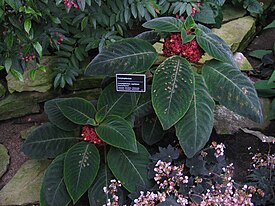 Coritoplektus capitus ( Corytoplectus capitatus ) | |||||||||||||||||||
| Scientific classification | |||||||||||||||||||
| |||||||||||||||||||
| International scientific name | |||||||||||||||||||
Corytoplectus Oerst. | |||||||||||||||||||
| Kinds | |||||||||||||||||||
See text | |||||||||||||||||||
Content
- 1 Etymology of the name
- 2 Botanical Description
- 3 Area and climatic conditions
- 4 Economic value and application
- 5 Agricultural technology
- 6 Views
- 7 notes
- 8 Literature
- 9 References
Name Etymology
The name of the genus comes from the Greek. κωρυς , "kōrys" - a helmet, or (less likely) Greek. κωρυτος , kōrytos (Latin corytus ) - "leather bag, quiver", and Greek. πλεκτος , plectos - "folded", which indicates the shape of the sepals, which resemble a helmet or quiver.
Botanical Description
Perennial land plants up to 60 cm high. Stems semi-gingival or grassy. Leaves are opposite, isophyllic , velvety, of various colors. Inflorescences are axillary, dense, sit near the stem itself, little or multi-flowered, often of an umbrella type. Sepals are equal, variable in shape, brightly colored, do not fall off after flowering. The corolla is tubular, rising from the calyx, swollen, narrow limb with equal shares, narrow pharynx. Stamens 4, usually equal in length to corolla; nectaries 4, 2 or occasionally 1. Ovary superior, pestle capitate or two-lobed. Fruit - spherical, black shiny or translucent berries with black seeds.
Habitat and climatic conditions
Western Cordillera , Bolivia , Panama and the coast of Venezuela , the highlands of Guyana . Ground plants of alpine forests.
Economic Significance and Application
In a temperate climate, it is grown as an indoor and greenhouse ornamental plant.
Agricultural Engineering
Landing. Planted in a loose, nutritious water and breathable substrate with the addition of sheet earth, perlite, sphagnum. At the bottom of the pot, drainage from a layer of expanded clay or shards is necessarily arranged.
Care. Prefers a place light or slightly shaded. Needs increased humidity, which can be achieved by placing the pot in a wide tray with wet peat. Watering is moderate, regular, be sure to avoid stagnation of water in the pan. The optimum temperature is 18-20 ° C. Regular top dressing during the growth period - in the spring of 1 time in 2 weeks, in the summer - less often, with liquid complex fertilizer. From late autumn to February, during low light conditions, reduce watering and do not fertilize.
Transfer. Transplanted every year or every two years in a fresh earthen substrate. Propagated by sowing seeds.
Reproduction. In spring - leafy, stem cuttings, sowing seeds at 22-24 ° C.
Views
According to the database of The Plant List , the genus includes 12 species [2] :
- Corytoplectus capitatus ( Hook. ) Wiehler
- Corytoplectus congestus ( Linden ex Hanst. ) Wiehler
- Corytoplectus cutucuensis wiehler
- Corytoplectus deltoideus ( CVMorton ) Wiehler
- Corytoplectus grandifolius ( Britton ex Rusby ) Rodr.-Flores & LESkog
- Corytoplectus longipedunculatus Rodr.-Flores & LESkog
- Corytoplectus oaxacensis Ram.-Roa , C. Chávez & Rodr.-Flores
- Corytoplectus purpuratus Rodr.-Flores & LESkog
- Corytoplectus riceanus ( Rusby ) Wiehler
- Corytoplectus schlimii ( Planch. & Linden ) Wiehler
- Corytoplectus speciosus ( Poepp. ) Wiehler
- Corytoplectus zamorensis ( Linden & André ) Rodr.-Flores & LESkog
Notes
- ↑ For the conventionality of specifying the class of dicotyledons as a superior taxon for the plant group described in this article, see the APG Systems section of the Dicotyledonous article .
- ↑ Corytoplectus (English) . The Plant List . Version 1.1. (2013). Date of treatment August 13, 2016.
Literature
- All about indoor violets. / Van der Neer, - SPb .: S3KEO Crystal LLC, Moscow: Onyx, 2007
Links
- Coritoplektus in A. Weber & LE Skog 2007, Genera of Gesneriaceae .
- World Checklist of Gesneriaceae