Erast Evgenievich Gulyaev (1851-1919) - scientist , shipbuilder , constructor and designer of coastal defense battleships for the Russian Imperial Navy , member of the Marine Technical Committee and the board of the Baltic Shipbuilding and Mechanical Plant , the first in the world to substantiate the constructive protection of ships from underwater explosions , adjutant of His Imperial Highness General-Admiral Grand Duke Konstantin Nikolaevich and Alexei Alexandrovich , Lieutenant-General Corps of naval Architects , translator and author of science x works on shipbuilding, metallurgy and mechanics , a member of the British Society of Engineers shipbuilders.
| Gulyaev Erast Evgenievich | |||||||
|---|---|---|---|---|---|---|---|
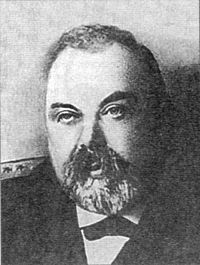 Senior shipbuilder Gulyaev E.E. | |||||||
| Date of Birth | October 17, 1851 | ||||||
| Date of death | 1919 | ||||||
| A place of death | Peterhof | ||||||
| Affiliation |  Russian empire Russian empire | ||||||
| Type of army |  Fleet Fleet | ||||||
| Rank |  Lieutenant General Lieutenant General Marine Corps Lieutenant General Lieutenant General Marine Corps | ||||||
| Awards and prizes | Russian Empire
Foreign
| ||||||
| Retired | 1908 | ||||||


Biography
Erast Evgenievich Gulyaev was born on October 17, 1851 [1] . In 1865 he graduated from the preparatory class of the Naval Artillery and Engineering School [2] and entered the shipbuilding department of the same school, renamed the Marine Engineering School, which he graduated with honors from 1868 and was promoted to the conductors of the Marine Engineers Corps. After graduation, he served in the New Admiralty . He took part in the construction of the three-tower armored frigate Admiral Greig under the leadership of N. G. Korshikov [3] [4] .
Under the leadership of Admiral A. A. Popov, he participated in the design and testing of round-type vessels (“ cadre ”), the battleship “Cruiser” (later renamed “ Peter the Great ”), which was built by ship engineer A.E. Leontyev, and then M. M. Okunev , armored cruiser " Admiral-General " [4] .
In 1870, E. Gulyaev was appointed adjutant to His Imperial Highness Admiral General Grand Duke Konstantin Nikolaevich . In the same year he was sent to improve education in England , at the Royal Kensington School of Naval Architecture and Ship Mechanics, which he graduated in 1872 [3] .
In 1875 he was appointed representative of the Maritime Department to oversee the construction in England of a floating dock for the Black Sea Fleet . In 1876, at the invitation of the board of the London Institute of Ship Engineers, he gave a lecture on "On Armadillos of Round Shape", and in 1878 made a report in the same society "On the Nikolaev Floating Dock" [3] .
In 1877-1878, during the Russo-Turkish war , shipbuilding engineer E. E. Gulyaev was sent to the English plants Tornicroft and Yarrow to place an order and monitor the construction of the first destroyers for the Russian fleet [5] . In 1879, for the first time, it posed to the Maritime Department the question of creating a domestic experimental basin (built in 1894) to determine water resistance on models of designed vessels [3] .
In 1879-1880, E. Gulyaev, on the instructions of the acting chairman of the Marine Technical Committee, Vice Admiral A. A. Popov, developed the drawings and specifications of the steam imperial yacht with an elliptical hull Livadia (renamed the ship “Experience”). This type of hull was supposed to provide the yacht with high stability and late rocking with insignificant scope, as well as achieving a speed of 14 knots . [6] . Gulyaev was the representative of the customer during the construction of the yacht at the shipbuilding company John Elder & Co., laid down on March 25, 1880 and launched four months later, on June 25. The descent ceremony was attended by Grand Duke Alexey Alexandrovich. Gulyaev participated in sea trials of the yacht, and in the autumn of 1880 made the transition from England to the Black Sea [7] .
| External Images | |
|---|---|
| Certificate of Award to E. Gulyaev of the Order of St. Anna of the 3rd degree | |
Upon returning from England in 1880, Captain Gulyaev was appointed a member of the shipbuilding department of the Marine Technical Committee , and began to develop a system for on-board mine protection of ships. Since 1881, Gulyaev - adjutant to the Admiral-General of Grand Duke Alexei Alexandrovich [3] . September 15, 1883 was awarded the Order of St. Anne of 3 degrees [8] .
In 1888–1891 he designed new battleships of coastal defense of small displacement of the Admiral Ushakov type [9] . The author of the projects of the “small” battleships “The Twelve Apostles ” and “ Gangut ”, as well as the project “unsinkable and non-tipping armadillo”. The design task for the construction of armadillos of this type provided for the creation of a small and cheap, but at the same time strong armadillo. The Twelve Apostles turned out to be a very successful project, close to solving the task. The ship was built in the Nikolaev Admiralty and launched on September 13, 1890, served for nineteen years, without participating in military campaigns. The battleship "Gangut" was built in the New Admiralty. Of the three projects submitted at the beginning of 1888 to the Maritime Technical Committee of the three projects of the battleship of the senior shipbuilder E. E. Gulyaev, the chief ship engineer of the St. Petersburg port N. A. Subbotin and the authorized Franco-Russian plant P. K. Dubuy, the project Gulyaev was approved, which provided for the use of steel armor. The ship was laid down on October 29, 1888, launched on October 6, 1890, finally completed and put into operation in October 1894. The battleship had a dramatic fate. On June 12, 1887, the Gangut carried out artillery training in the Vyborg Bay, caught pitfalls on the bottom, a leak formed, after which the ship landed on the port side and then quickly plunged into the water. Numerous projects of lifting the ship were rejected and by imperial decree of August 18, 1899 the squadron battleship Gangut was excluded from the lists of the fleet [10] .
- Armadillos designed by E. E. Gulyaev
Battleship Admiral Ushakov
Armadillo "The Twelve Apostles"
Armadillo Gangut
In 1893, at the London Institute of Naval Engineers, he gave a lecture “On the new formulas of Afanasyev for approximate solution of problems connected with the movement of ships” [4] .
In 1894, senior shipbuilder E. E. Gulyaev took part in the consideration of the draft of the new gunboat “ Gilyak ”, specially adapted for warfare on rivers. Comparing the designed boat with foreign analogues (English “Torch” and “Alert”), he came to the conclusion that the latter did not have “any significant advantages” and suggested that the development of the project take into account the increase in the main measurements and the displacement of the designed ship. The project of the new boat was finally adopted in 1895, on April 30, 1896, the solemn laying of the gunboat, called "Gilyak", took place. The construction manager was appointed junior shipbuilder P.E. Chernigovsky [11] [12] . From 1896 to 1904 he was an assistant to the chief inspector of shipbuilding, Lieutenant General N. E. Kuteinikov . In 1897, E. Gulyaev represented Russia as a member of the English Society of Ship Engineers at the 1st International Congress of Ship Engineers, held in London [4] .
In 1900, for the first time in the world, he substantiated the need for constructive protection of ships from underwater explosions. In his articles “Protection of underwater parts from self-propelled mines and rams” and “The form of ships, the most profitable for achieving high speeds” published in the journal “Marine collection”, Gulyaev compiled the first description of his new form of ships, which allows to protect ships from explosions mines , battering rams and in collisions with other ships, build them substantially unsinkable and non-tilting. The leadership of the Maritime Department rejected this proposal, and a few years later this system of mine protection was used first by German shipbuilders, and then by the Americans. Mine protection from internal bulkheads abroad began to be called "American", although its author was a Russian scientist E. E. Gulyaev [13] .
Since 1904, E. E. Gulyaev became a member of the board of the Baltic Shipbuilding and Mechanical Plant . In 1908, he was dismissed from service due to illness with the rank of lieutenant general and was awarded the Order of St. Anna of the 1st degree [4] .
Erast Evgenievich Gulyaev died in 1919. He was buried in Peterhof at the Holy Trinity Cemetery, the burial was not preserved [14] .
The Gulyaev family house on Prudovaya Street in Peterhof was included in the list of cultural heritage sites , but in 2007, by order of the Committee for State Control, Use and Protection of Historical and Cultural Monuments of the Government of St. Petersburg, the building was excluded from the “List of Newly Recognized Cultural Heritage Sites” [15 ] .
Bibliography
E. E. Gulyaev began his literary work as a graduate of the Marine Engineering School, publishing his translated articles from English on shipbuilding, metallurgy and mechanics in the Technical Collection, and then for many years collaborated with the journal Marine Collection . He was the author of more than 50 scientific papers on the theory, technology and practice of shipbuilding, the most famous of them [3] :
- Gulyaev E.E. Research of Red and Itets of the local fortress of ship bulkheads and claddings under water pressure. 1892.
- Gulyaev E. E. The cost of building modern military ships. 1896.
- Gulyaev E.E. Wood and copper ship cladding. On the descent of ships on the keel. 1896.
- Gulyaev E.E. American destroyers. 1898.
- Gulyaev E. E. Unsinkable and non-tilting ships of Gulyaev’s form and system. 1908.
- Gulyaev E.E. Influence of modern improvements in the size and speed of steam vessels on the arrangement of ports and harbors. 1910.
Articles by Gulyaev E.E. in the journal "Marine Collection" [3] :
- 1885 - Notes on the lateral keels.
- 1887 - On the means to reduce the roll of ships.
- 1895 - Military shipbuilding in England and France in 1894 - 95 years. ; - Historical examples for determining the type of modern ships.
- 1896 - The construction of the modern German Navy; The value of the lateral keels on modern battleships.
- 1897 - On the two-year anniversary of the death of the battleship Victoria; - The development of the mathematical theory of shipbuilding during the existence of the English Institute of ship engineers.
- 1898 - Studies of the nature of the surface resistance of water in pipes and on ships. The latest and future armadillos.
- 1899 - Recent and future improvements to high-speed steam ships.
- 1900 - Parsons steam turbines as applied to marine engines; - Proven success of the submarine; The latest floating docks; - The shooting of the English battleship "Belleisle"; - Protection of underwater parts from self-propelled mines and rams; - The shape of the vessels, the most advantageous for achieving high speeds.
- 1902 - Displacement and size of ships; Some recent inventions and the future of naval warfare; About liquid fuel on ships.
- 1903 - The effect of a further increase in modern speed on the growth of ship sizes; Unsinkable and non-tilting vessels of Gulyaev’s form and system.
In 1911, an article by E. Gulyaev “On shipping on inland waterways and a new way to improve it” was published in the magazine “Motor Boat” [3] .
Notes
- ↑ List of generals, headquarters and chief officers of the corps of naval engineers of the offshore construction unit. - SPb. : Printing house of the Ministry of the Sea, 1902. - V. V. - S. 3.
- ↑ Chernavin V.N. Gulyaev, Erast Evgenievich // Naval Dictionary. - M .: Military Publishing House, 1990. - 544 p. - ISBN 5-203-00174-X .
- ↑ 1 2 3 4 5 6 7 8 Gulyaev, Erast Evgenievich // Military Encyclopedia / Ed. Novitsky V.F. - St. Petersburg. : Type of. T-va I. D. Sytin, 1912 .-- T. 8 .-- 642 p.
- ↑ 1 2 3 4 5 Varganov Yu.V. Admirals of the naval sciences. Russian and Soviet scientists, shipbuilders - members of the English society // "Sea newspaper". - October 23, 2008.
- ↑ Afonin N.N., Yarovoy V.V. Minonoski of the Russian fleet. - SPb. : “Gangut”, 2002. - 52 p. - ISBN 5-85875-016-8 .
- ↑ Krylov A.N. Some memoirs about N.E. Zhukovsky // Academician A.N. Krylov. Memoirs and essays. - M .: Publishing House of the Academy of Sciences of the USSR, 1956. - S. 336. - 884 p.
- ↑ Larionov A. L. From the History of the Imperial Yachts of the Russian Fleet // “Gangut”: Journal. - 2000. - No. 22 . - S. 41-56 . - ISSN 5-85875-053-2 .
- ↑ Skritsky N.V. The most famous shipbuilders of Russia. Gulyaev E.E. - M .: Veche, 2002 .-- 416 p. - ISBN 5-7838-1124-6 .
- ↑ Gribovsky V. Yu., Chernikov I.I. Battleship Admiral Ushakov. - SPb. : Shipbuilding, 1996. - ISBN 5-7355-0356-1 .
- ↑ Krestyaninov V.Ya. The fate of the squadron battleship "Gangut" // Shipbuilding: Journal. - 1986. - No. 7 . Archived August 23, 2011.
- ↑ Skvortsov A.V. Gunboat of the Siberian Flotilla "Gilyak" // "Gangut": Magazine. - 2000. - No. 23 . - S. 16-26 . - ISSN 5-85875-053-2 .
- ↑ Afonin N.N. Gunboat Gilyak // Shipbuilding: Journal. - 1987. - No. 3 .
- ↑ Zverev B.I. Conclusion // Pages of the naval annals of Russia. The manual for students. - M .: Education, 1992 .-- 223 p. - ISBN 5-09-003142-8 .
- ↑ Abasaliev R. Assistant to the Chief Inspector of Shipbuilding // Municipal Perspective: Newspaper. - July 30, 2014. - No. 13 (344) . - S. 7 .
- ↑ Order of the Committee for State Control, Use and Protection of Monuments of History and Culture of the Government of St. Petersburg dated December 26, 2007 No. 8-291 “On the Deletion of Certain Objects from the List of Recognized Cultural Heritage Sites” . Information and legal portal "bestpravo.com". Date of treatment January 27, 2015.
Literature
- Isanin N.N., Kalinin V.S. Maritime Encyclopedic Reference. - M .: Book on demand, 1986. - T. 1. - S. 206. - 512 p.
- Polenov L. L. Cruiser . - L .: Shipbuilding, 1987.- S. 26, 56, 57. - 264 p.
- Luchininov S.T. Young shipbuilder . - 2-e .. - M .: Young Guard, 1955. - 264 p.
Links
- Gulyaev, Erast Evgenievich // Military Encyclopedia / Ed. Novitsky V.F. - St. Petersburg. : Type of. T-va I. D. Sytin, 1912 .-- T. 8 .-- 642 p.