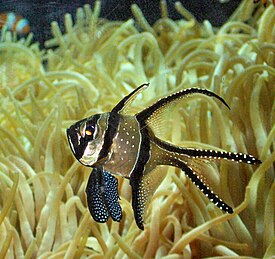
Pterapogon kauderni (lat.) Is a species of small marine fish from the Apogonidae family that live in a small water area east of the Indonesian island of Sulawesi .
| Pterapogon kauderni |
 |
| Scientific classification |
|---|
| No rank : | Bilateral symmetrical |
|
| International scientific name |
|---|
Pterapogon kauderni Koumans, 1933 |
| Security status |
|---|
Endangered speciesIUCN 3.1 Endangered : 63572 |
|
Content
The species epithet is given in honor of the Swedish ethnologist Walter Alexander Kaudern (1881-1942), who was the first to find fish in 1920. He caught two specimens and sent them to the . There, in 1933, Frederick Petrius Cumans gave a description of them and named them after the discoverer.
The body is oval, high in silver, white-gray color with long, elongated fins. The body is 8 cm long. Two large, black transverse stripes pass through the body. The first begins at the base of the dorsal fin and ends at the ventral fin. The second begins at the base of the second very long dorsal fin and ends at the anal fin. On the head, a transverse strip runs through the large eyes. The thymus tail has two longitudinal black stripes. The first dorsal fin has 8 hard rays, the second - 14 soft rays. The anal fin begins with two rigid and is supported by 13 soft rays [1] . All fins, the sides between the transverse stripes and the tail stem have a pattern of white spots, individual for each individual [2] . Sexual dimorphism is absent.
The species lives in a small area around the islands: Banggai , Bandang , Kembongan , South Peleng and other small islands. The entire distribution area has an area of 5500 km². Since fish live in this area only in sheltered, isolated bays from each other on the weatherproof side of 30 islands, the actual area is 34 km² [2] [3] .
Fish live in shallow water in the thickets of Enhalus acoroides (family Water-Red ), in mangroves, lagoons and coral reefs. They even inhabit the mouths of streams with fresh water and the port waters polluted by sewage. They prefer depths from half a meter to 4.5 m. The water in their natural habitat is very warm from 28 to 31 ° C.
Fishes live in groups of up to 500 individuals, with the majority being young individuals six months old. Big eyes are evidence that fish are active during twilight. They feed on various zooplankton, mainly copepod crustaceans, small decapod crustaceans, marine wood lice, as well as eggs and larvae of various marine animals. Studies of the contents of the stomach showed that the feed size is from 0.1 to 14 mm. The share of copepods is 79% of the total feed.
Young fish 1 to 1.5 cm long are held for protection by groups of 2 to 12 individuals between the needles of sea urchins Diadema setosum , tentacles of coral Heliofungia actiniformis , sea anemones of the genus Stichodactyla or Entacmaea quadricolor . Adult individuals also find shelter in growing branched stony corals such as Acropora , Montipora digitata , Seriatopora hystrix or fire corals ( Millepora sp). When counting, 43.7% of the animals lived under rocky corals, 31.9% in sea urchins, and 24.4% preferred protection of sea anemones [2] . Fishes share their living space with other species of the family, reef fish , sea needles and clown fish , such as Amphiprion clarkii , Amphiprion perideraion and Amphiprion ocellaris [4] .
The natural enemies of the species are lionfish , Epinephelus merra , Cymbacephalus beauforti , Synanceia horrida , moray eels , and also the yellow-lipped flat-tailed sea snake ( Laticauda colubrina ).
The female begins toating. She constantly circles under the tail of the male and this can continue hundreds of times over several hours. Since the males carry eggs in their mouth, they must be “persuaded” to spawn. The spawning process itself continues for several seconds. After the transfer of eggs, there is another long currenting, which often lasts from 30 to 40 minutes, but can last almost 1 hour. Both partners circle around each other. Only in this case, perhaps, insemination of eggs occurs [5] .
Caviar consists of only 5-25 eggs of orange color, approximately 2.5 mm in size. Males bearing eggs in their mouths do not eat anything during this period. The fry do not have a larval phase and hatch from the egg approximately 25 days after the final metamorphosis. After the appearance of fry, adult fish no longer care about them [6] .
- ↑ Pterapogon kauderni (English) in the FishBase database.
- ↑ 1 2 3 Allen, GR & Donaldson, TJ 2007. Pterapogon kauderni. In: IUCN 2007. Red List of Threatened Species
- ↑ Daniel Knop: Fünf vor zwölf: Pterapogon kauderni. In KORALLE, Meerwasseraquaristik-Fachmagazin, Nr. 54 Dezember / Januar 2008/2009, Natur und Tier Verlag Münster, ISSN 1439-779X
- ↑ Joachim Frische: Quo Vadis Kauderni, in Der MeerwasserAquarianer 3/2003, Rüdiger Latka Verlag, ISSN 1432-1505
- ↑ Ellen Thaler: Maulbrüter in Riff und Aquarium. In KORALLE, Meerwasseraquaristik-Fachmagazin, Nr. 54 Dezember / Januar 2008/2009, Natur und Tier Verlag Münster, ISSN 1439-779X
- ↑ Wolfgang Mai: Der Banggai-Kardinalbarsch Pterapogon kauderni, Aufopfernde Maulbrutpflege der Männchen, in Dieter Brockmann: Nachzuchten für das Korallenriff-Aquarium, Schmettkamp Verlag, ISBN 3-928819-34-8
- Ellen Thaler: Pterapogon kauderni. Ein Modefisch? , in DATZ 12/96, Verlag Eugen Ulmer, ISSN 0941-8393
- Johannes Dürbaum: Pterapogon kauderni. Ethologische Betrachtungen , in Datz 6/97 and 7/97