Charles Gordon Fullerton ( Eng. Charles Gordon Fullerton ; 1936 - 2013 ) - NASA astronaut . In 1977, he participated in atmospheric flight tests (ALT) of the aerodynamic qualities of shuttles , flew on the Enterprise . He made two space flights: as a pilot on the shuttle Columbia - STS-3 (1982) and as a crew commander on the Challenger - STS-51F (1985).
| Charles Gordon Fullerton | |||||
|---|---|---|---|---|---|
| Charles Gordon Fullerton | |||||
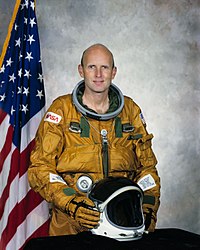 | |||||
| A country |  USA USA | ||||
| Specialty | engineer, NASA astronaut | ||||
| Military rank | US Air Force Colonel | ||||
| Expeditions | ALT , STS-3 , STS-51F | ||||
| Time in space | 15 days 22 h 50 min 12 s | ||||
| Date of Birth | October 11, 1936 | ||||
| Place of Birth | Rochester , New York , USA | ||||
| Date of death | August 21, 2013 (76 years old) | ||||
| A place of death | Lancaster , California , USA | ||||
| Awards |
| ||||


Content
Birth and Education
Born October 11, 1936 in Rochester , New York . He graduated from Grant High School in Portland , Oregon . In 1957 he graduated from the California Institute of Technology in Pasadena and received a bachelor of science degree in mechanical engineering. In 1958, he received a master 's degree in mechanical engineering from the same institute [1] .
Military career
In 1958, several months before being drafted into the army, he worked as a mechanical design engineer at Hughes Aircraft , in Culver City , California . In service in the U.S. Air Force since July 17, 1958. He completed initial flight training at Banbridge Air Force Base in Georgia and at Webb Air Force Base in Texas , as well as training as an F-86 interceptor pilot at Perran Air Force Base in Texas in September 1959. From May to December 1960 he was trained as a bomber pilot at the McConnell Air Force Base in Kansas . Then he served as the pilot of the B-47 aircraft as part of the 303rd bomber wing of the US strategic aviation command at the Davis-Monten Air Force base in Arizona . In May 1964, he graduated from the Aerospace Research Pilot School at Edwards Air Force Base in California . After graduating from the School, he was sent to serve as a test pilot at the Wright-Patterson, Ohio Air Force Bomber Aviation Division, where he served until his admission to the astronaut squad of the Manned Orbital Laboratory (FL) . He also trained at the School of Squadron Officers and graduated from the Industrial College of the Armed Forces. The total flight time is more than 16,000 hours on 135 types of aircraft, including T-33 , T-34 , T-37, T-39, F-86 , F-101 , F-106 , F-111 , F-14 , X-29 , KC-135 , C-140 , B-47 . Military rank: second lieutenant of the Air Force (in 1958). Captain of the Air Force (in 1966). Air Force Colonel (retired from 1988.06.27) [2] .
Space Training
In June 17, 1966 was one of the five pilots selected under the MOL Air Force program (second set under the MOL program). He remained in the detachment until the program was closed in June 1969. After the disbandment of the MOL detachment, in August 1969 he was enrolled in the NASA astronaut squad as part of the so-called 7th set . Passed a course of general space training. He entered the reserve crew of the Apollo 14 and Apollo 17 ships as a pilot of the lunar module . He was a member of the Apollo 15 and Apollo 16 support crew. During the flights of the Apollo 14 - Apollo 17 ships, it acted as a communications operator with the crew at the Control Center in Houston . After starting work on the Space Shuttle program, he was trained as a shuttle pilot. On February 24, 1976, he was appointed pilot of one of two crews that conducted an ALT test flight in 1977 in the atmosphere when dropping from a Boeing 747 at an altitude of 25,000 feet (7,620 m). It was Charles Fullerton, together with the commander of the ship, Fred Hayes, who performed the first free flight on the Shuttle Enterprise on August 12, 1977. On March 17, 1978, he was assigned as the pilot for the fourth test flight of the shuttle (Orbital Flight Test-4 - OFT-4), but since astronaut Fred Hayes left NASA in June 1979, Fullerton replaced him as the pilot of the crew of the third test flight (OFT -3).
Spaceflight
- The first flight is STS-3 [3] , the shuttle Columbia . From March 22 to March 30, 1982 as a pilot. The flight duration was 8 days 06 minutes [4] .
- The second flight is STS-51F [5] , the Challenger shuttle . From July 29 to August 6, 1985 as a crew commander. The flight duration was 7 days 22 hours 46 minutes. This flight is the first with the Spacelab Space Laboratory. 13 major experiments were carried out, in particular in the fields of astronomy , solar physics, the study of the ionosphere , biology, and several experiments with superfluid helium [6] .
The total duration of space flights is 15 days 22 hours 52 minutes.
After flying
Resigned from the astronaut squad in November 1986. Since November 1986, he has been working as a research pilot at the Dryden Research Center at Edwards Air Force Base in California . He piloted the NASA NB-52 carrier aircraft and the aircraft for transporting the Boeing 747 shuttle. He participated in the test program of the rescue ship for the ISS X-38 (V-131R) as a pilot of the NB-52 aircraft. He piloted the NB-52 during the launch of the Pegasus launch vehicle from it. In September 1998, he took part in the joint US-Russian program “Joint Research of High Speed” as one of two American pilots of the supersonic Tu-144 LL aircraft (flying laboratory). All flights were performed in Russia , at the Zhukovsky Central Aerohydrodynamic Institute (TsAGI) . However, on July 31, 2002, he was admitted to the NASA astronaut manager category, while continuing to work as a research pilot at the Dryden Research Center. In October 2007, he was appointed Assistant Chief of Flight Management at the Dryden Research Center. In December 2007, he left NASA and left his post at the Dryden Research Center.
Charles Gordon Fullerton died on August 21, 2013, at the age of 77 [7] .
Rewards
Awarded: Cross of Merit of Merit (USA) , Medal for Outstanding Service (NASA) , Medal for Exceptional Merit , Medal for Space Flight (1983 and 1985), Prize of the American Institute of Aeronautics and Astronautics, Member of the American Society of Astronautics ".
Family
Wife - Mary Jannet Battner. Daughter - Molly Mary (06/26/1973), son - Andrew Alexander (10.24.1975). Hobbies: woodwork, tennis and photography.
See also
- List of astronauts and astronauts (and candidates) .
- List of US astronauts - participants in orbiting space flights .
- Timeline of manned spaceflight .
Notes
- ↑ Fullerton . astronautix.com. Date of treatment April 24, 2019. Archived March 6, 2019.
- ↑ Astronaut Bio: C. Gordon Fullerton . jsc.nasa.gov. Date of treatment April 24, 2019. Archived on April 10, 2017.
- ↑ NASA - NSSDCA - Spacecraft - Details . nssdc.gsfc.nasa.gov. Date of appeal April 24, 2019.
- ↑ Lynda Warnock: KSC. NASA - STS-3 (English) . nasa.gov. Date of appeal April 24, 2019.
- ↑ NASA - NSSDCA - Spacecraft - Details . nssdc.gsfc.nasa.gov. Date of appeal April 24, 2019.
- ↑ Lynda Warnock: KSC. NASA - STS-51F (English) . nasa.gov. Date of appeal April 24, 2019.
- ↑ Gordon Fullerton, space shuttle test pilot, dies at 76 | collectSPACE collectSPACE.com. Date of appeal April 24, 2019.
Links
- Astronaut Biography: Gordon Fullerton spacefacts.de. Date of appeal April 24, 2019.
- C. Gordon Fullerton Oral History . historycollection.jsc.nasa.gov. Date of appeal April 24, 2019.