HMS Cleopatra (33) (His Majesty's ship Cleopatra ) - British light cruiser, such as "Dido" . It was ordered under the 1938 program on August 18 [2] 1938 and laid down at the Hawthorn Leslie & Co shipyard in Hebburn-on-Tyne on January 5, 1939 . The cruiser was launched March 27, 1940 , becoming the seventh ship bearing this name in the British Navy since 1779. It was commissioned on December 5, 1941 . The motto of the ship was: "Unconquered as ever" - "Never Subjugated."
| Light cruiser Cleopatra | |
|---|---|
| HMS Cleopatra | |
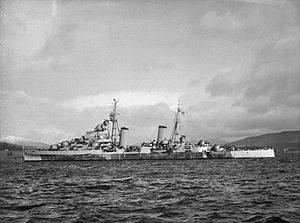 Light cruiser "Cleopatra" anchored in Clyde, April 1945 | |
| Service | |
 Great Britain Great Britain | |
| Class and type of vessel | Light cruiser "Dido" |
| Manufacturer | Shipyard Hawthorn Leslie & Co, Hebburn-on-Tyne |
| Construction started | January 5, 1939 |
| Launched | March 27, 1940 |
| Commissioned | December 5, 1941 |
| Withdrawn from the fleet | 1958 year |
| Status | scrapped |
| Main characteristics | |
| Displacement | standard 5600 t , total 6850–7170 t |
| Length | 147.82 / 154.23 m |
| Width | 15.4 m |
| Draft | 5.1 m |
| Reservation | Belt - 76 mm; traverses - 25 mm; deck - 51 ... 25 mm; towers - 13 mm |
| Engines | 4 TZ Parsons |
| Power | 62 000 liters with. (45.6 MW ) |
| Speed | 32.25 knots (59.7 km / h ) |
| Sailing range | 5560 nautical miles at 15 knots |
| Crew | 487-530 people |
| Armament | |
| Artillery | 5 × 2 - 133 mm / 50 |
| Flak | 2 × 4 - 40 mm / 40, 4-8 20 mm / 70 [1] |
| Mine torpedo armament | Two three-pipe 533 mm torpedo tubes |
Content
Service History
The cruiser completed manning on December 5, 1941 and began testing, after which it began to operate as part of the Scapa Flow fleet, although it was immediately assigned to the 15th squadron of cruisers of the Mediterranean fleet.
As part of the Mediterranean Fleet
In early February 1942 he moved to Clyde, where he left on February 5, heading for Malta. He arrived on the island on February 11 along with the destroyer Fortune en route to Gibraltar.
Bomb Hit
Located in the bay of Grand Harbor, in Malta, Cleopatra was attacked by air. The ship was hit by a 500 kg bomb, which exploded after passing through the bow. The bow of the cruiser was flooded and it also received some fragmentation damage to the torpedo tubes and hull from other bombs that fell near the ship. On November 12, he got down for repairs at the Malta shipyard.
On March 10, after the repair was completed, the cruiser, together with the Kingston destroyer, became part of Compound B, which in addition to them included the flagship of the cruiser squadron of the same type Naiad . On March 11, Compound B went in search of Italian convoys. At the passage, the ships were subjected to continuous air attacks. After the death of Naiad from torpedoes of the German submarine U-565 , Cleopatra became the flagship of the cruiser squadron.
On March 15, ships of the 15th cruiser squadron shelled Rhodes .
2nd Battle of Sirte Bay
On March 20, Cleopatra participated in the piloting of the Maltese convoy MW-10 at its crossing from Alexandria (Operation MG-1), together with the cruisers Dido and Euryalus, Compound “B”. Compound K also participated in the operation: the Penelope cruiser and the Legion destroyer operating from Malta. On March 21, Compound B met with an escort convoy: the cruiser Carlisle and the Hunt type escort destroyers. On March 22, the ships took part in the second battle in Sirte Bay, against the Italian fleet, which included the battleship Littorio and three cruisers. In bad weather, cruisers managed to keep the enemy at a distance, and after a torpedo attack by British destroyers, the enemy turned away and the convoy was saved. During the battle, Cleopatra got hit by a 152-mm shell from an Italian cruiser in the bridge, which entailed some casualties. The convoy suffered heavy air attacks and suffered losses. The cruisers returned to Alexandria on March 28, where Admiral Vien, commanding the battle, received a congratulatory telegram from the Prime Minister for his successful actions in the battle with the Italian fleet.
From April to May, the cruiser along with the squadron was in the Eastern Mediterranean, based on Alexandria. The diversion of the fleet's forces for Operation Ironclad — a landing in Madagascar — did not allow the convoy to be sent to Malta at that time.
On June 13, Cleopatra came out as the flagship of the escort of the next convoy to Malta - MW11. The cruising forces were reinforced by the cruisers Newcastle and Birmingham , who returned from the Eastern Fleet after the end of the Ironclad operation. The operation that began was called Vigorous . Due to the lack of battleships, the target ship was included in the convoy, the former old battleship Centurion disguised as the latest battleship such as King George V. On June 14th, heavy attacks of horizontal and diving enemy bombers took place. On June 15, after a night attack by enemy torpedo boats and the threat of a collision with Italian surface forces, the operation was interrupted by the commander of the Mediterranean Fleet and the ships returned to base.
Syrian Campaign
On June 30, the cruiser, along with the squadron ships, was transferred to Haifa for operations as part of the bomber formation accompanying the military operation ( Operation Exporter ). The army invaded Syria and the ships were to accompany its advance from Haifa, since it was known that the Vichy ships were active. Throughout July, Cleopatra, along with the squadron ships, acted from Haifa.
On August 12, Cleopatra came out together with the cruiser Arethusa , and the destroyers Javelin , Kelvin , Sikh and Nubian to carry out the shelling of Rhodes . The aim of the shelling was to divert attention from the convoy traveling to Malta from Gibraltar ( Operation Pedestal ).
After this operation, the cruiser was sent for repair in Massawa , on the Red Sea, which took place during September. due to the lack of a suitable floating dock, it was impromptu to act. Only half of the ship could be raised from the water in time. At the same time, the ship received some damage when it slipped from the blocks.
In October, the ship returned to the Mediterranean Sea and operated with Orion and Euryalus in the Eastern Mediterranean.
On November 16, Cleopatra left with the cruisers Arethusa , Dido , Euryalus , Orion and the destroyers of the 14th flotilla to cover the convoy to Malta from Port Said - MW-13 ( Operation Stoneage ). This was the first convoy after lifting the siege from the island. On November 18, Arethusa was seriously damaged by air attacks and returned with difficulty to Alexandria.
As part of Compound K, Malta
On November 19, the cruiser was assigned to Compound K, which was supposed to be based in Malta. In addition to it, the Compound included the cruisers Dido , Euryalus , the destroyers Jervis , Javelin , Kelvin and Nubian . On November 25, ships left Alexandria to base on Malta.
On December 4, Compound K ships left the island to meet the convoy at the final stage of the Maltese MW-14 crossing ( Operation Portcullis ).
As part of Compound Q, Bon
On December 10, Cleopatra, along with the cruisers Argonaut , Dido and Euryalus, was relocated to Bon to form Compound Q, operating off the coast of North Africa. On December 12, along with Euryalus and the 4th destroyers, she participated in a battle with a convoy from Tunisia, sinking 3 enemy ships.
On the night of January 22-23, 1943, Cleopatra, along with the cruiser Euryalus and the destroyers Jervis , Javelin , Kelvin and Nubian, fired on the retreat routes of the enemy rearguards from Libya near Zuara . Later, shelling Zuara herself.
From February to April, the cruiser participated in the defense of convoys and support for military operations in the Central Mediterranean, based on Bon. In May, the cruiser was transferred to 12 cruiser squadron, continuing to be based on Bon. In June, the cruiser escorted military convoys carrying troops for an upcoming landing in Sicily.
Sicily Actions, Torpedo Hit
Since July 1, Cleopatra was in Beaune, preparing to participate in the landing. On July 6, she left Algeria to participate in the operation. On July 8, she covered the convoy movement in Sirte Bay in conjunction with Compound H and the Mediterranean Fleet. On July 10, the cruiser was deployed in the Ionian Sea together with the battleships Nelson , Rodney , Warspite , Valiant , Indomitable and Formidable aircraft carriers and other squadron ships. July 11, the cruiser was deployed for fire support at the northern flank of the landing beach. The ship participated in the “friendly fire” incident along with the cruiser Euryalus and the torpedo boat. This incident was not advertised until 1993. On July 12, Cleopatra, along with the cruiser Euryalus and the destroyers Ilex and Echo, was sent to the intercepting patrol. During this patrol, destroyers sunk the Italian submarine Nereide 10 miles northeast of Augusta . On July 14, the cruiser was attacked by a torpedo bomber during firing. July 16, the cruiser at received a torpedo hit in the middle of the hull from an Italian submarine, which was either Dandolo or Alagi . The cruiser suffered serious damage to the hull with the flooding of the engine room. Artillery control could only be performed “locally”. 30 crew members were killed or missing, another 23 were injured. On July 17, the cruiser came to Malta under cover of the destroyers Quiberon and Quail and the cruiser Euryalus as an anti-aircraft shield.
U.S. Repair
From August to September, the cruiser was in Malta, carrying out preparatory repairs. In October, the cruiser was determined to undergo repairs in the United States, and therefore moved to Gibraltar, with the call to Algeria. On November 7, he left Gibraltar and headed to Philadelphia, where he embarked on repairs and refurbishment at a naval shipyard in Philadelphia. Repair continued until September 1944, when the cruiser went to the after-repair test. In November, the cruiser left for Bermuda before moving to Clyde, where it arrived on November 28.
In Clyde, from December to April 1945, the cruiser completed the repair and installation of artillery. It installed new radar and equipment "friend or foe", inaccessible for installation in the United States. From artillery, the nasal elevated 133-mm gun was removed and replaced by short-range anti-aircraft artillery. In April, the cruiser went on a post-repair test, at the same time he was determined to serve in the Eastern Fleet. On May 3, the cruiser left Clyde for action with the Mediterranean fleet and on May 12 arrived in Malta. In June, the cruiser left Malta to join the 5th squadron of Eastern Fleet cruisers. The cruiser crossed the Red Sea and the Indian Ocean, arriving in Colombo on July 12 and joining the 5th cruising squadron.
As part of the Eastern Fleet
In August, the ship conducted exercises in the Eastern Fleet in connection with the proposed landing in Malaya ( Operation Zipper ). However, the operation was canceled at the request of the American command.
On August 15, the cruiser returned to Colombo and was assigned to carry out the Singapore Return Operation ( Operation Tiderace ).
On August 27, the cruiser departed from Colombo with the commander of the Eastern Fleet aboard via Sabang to Penang , where he arrived on September 1 to conduct the ceremony. On September 2, he covered for a trawling operation during the passage through the Strait of Malacca to Singapore. September 3, he arrived in Singapore with the Indian minesweeper Bengal and remained until the landing forces.
On September 9, the cruiser covered the landing at Port Swettenham together with battleships Nelson and the French Richelieu , ships of 21 squadrons of escort aircraft carriers, cruisers Nigeria , Ceylon and the 15th destroyer flotilla ( Operation Zipper ). On September 12, the ship participated in the formal surrender of Singapore. September 17 finished participating in Operation Zipper and went to Trincomalee .
Post-War Service
Cleopatra ended her service in the Eastern Fleet on January 7, 1946 and returned to Great Britain, at Portsmouth on February 7. After a break due to manning problems, the cruiser continued his service as part of the 2nd squadron of Home Fleet cruisers, until his withdrawal to the reserve in January 1951. After repair and a new commissioning on October 30, the cruiser continued his service in the 1st squadron of cruisers of the Mediterranean fleet. in February 1953, Cleopatra returned to the UK and participated in the royal show, which took place in June of that year, after which she was put into reserve in Chatham. In the period 1954-1956, the cruiser was used as the flagship of the reserve fleet in Portsmouth. While parked in Portsmouth, in 1958, the cruiser was listed on the decommissioned ships and sold for scrap for dismantling at the Cashmore shipyard in Newport. He left Portsmouth on December 9 and arrived on December 15 at the scene of his showdown.
Notes
- ↑ All data is given at the time of entry into operation.
- ↑ according to other sources, March 18
Links
- Gordon Smith. Naval-History.net - HMS CLEOPATRA (English) . Date of treatment March 10, 2012. Archived December 12, 2012.
- Gudmundur Helgason. uboat.net - The U-boat War 1939-1945 HMS Cleopatra (33 ) . Date of treatment March 10, 2012. Archived December 12, 2012.
- Mike. World War 2 Cruisers. HMS Cleopatra (33) Date of treatment March 10, 2012. Archived December 12, 2012.