
Capture of the interceptor “0” of the Imperial Japanese Navy on Akutan Island ( “Zero” Kogi and Aleutian “Zero” ) - capture by US Navy specialists at arch. Aleutian Islands ( Akutan Island , Alaska , USA ) who made an emergency landing of a ship interceptor "0-2-1" of the Navy of Imperial Japan . The plane was captured slightly damaged after the death of the pilot of the 1st article T. Kogi, becoming the first flightable model captured and tested by aviation specialists of the US Navy [1] [2] .


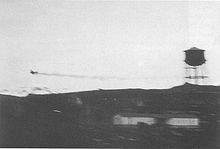
Capture the emergency interceptor sample “0”
In the summer of 1942, during the strategic operation to seize arch. The Aleutian Islands ( Alaska , USA), an attack group from the 4th DAV Navy of Imperial Japan [3] raided the Dutch Harbor base at Arch. Aleutian Islands . One of the accompanying group of ship-based interceptors “0-2-1” under the command of foreman of the 1st article [4] T. Kogi was shot down by the anti-aircraft fire of the air defense division of the 20th US artillery regiment of the USA and crashed over the nearby Akutan island of the Aleutian archipelago .
During an emergency landing on wetlands, the foreman of the 1st article, T. Koga, died, and the emergency interceptor was stuck in a swamp. Parts of the US Navy and US NE garrison of the Aleutian Islands organized the evacuation and transportation of an emergency vehicle to the metropolis at the US Navy military airfield ( North Island military unit , San Diego , California , USA), where the trophy machine was accessed by aviation specialists. The captured sample was restored and transferred for flight tests to specialists of the US Navy.
US Navy Search for Ways to Combat Interceptor “0”
Expert Opinion
The US Navy testers noted in the report the exceptionally high build quality and metal processing technologies, comparing the quality of the center section parts processing with the “clockwork”. The center section and cladding parts were precision made of ultra-light magnesium alloy. A striking design feature was a single magnesium center wing (US aircraft technology provided for undocking of the wing and fuselage), which complicated assembly, but gave a double gain in weight [5] . In order to reduce resistance, blind rivets were used, and all technological holes, air intakes, LDPE and armament were mounted flush with the casing and covered with hatches. The instrument panel was designed so as not to distract the pilot with the readings of secondary instruments (which was a drawback of American cabs).
Flight Tests
US Navy testers noted the interceptor’s angular over-maneuverability at speeds of up to 320 km / h with its fall at maximum speeds [6] . US and British Navy fighters surpassed the Japanese aircraft at speeds over 400 km / h, as well as diving. The weakness of the Japanese design was the lack of steel or aluminum armoring of the cabin and units. In addition to over-maneuverability at medium speeds, the Japanese machine had three times greater combat radius and cannon weapons, which made it a dangerous enemy at any battle distance [5] . In the flight tests of the captured interceptor, specialists from the US Navy and allies participated.
Test pilot of the British Navy 1st-Class Captain E. Brown noted that the manufacturing technology and flight qualities of the Mitsubishi interceptor made a very big impression on him:
| In my memory, I don’t remember a single production car with angular velocities approaching the speed of entering the turn of the Mitsubishi interceptor. In terms of this indicator of maneuverability, the "0" interceptor exceeded all the machines available in the world, having air supremacy in the Pacific theater of operations until 1943. [7] |
After flight tests of the interceptor model “0”, US Navy testers were able to assess the balance of characteristics of the Japanese machine. Due to the widespread use of ultralight alloys and the lack of reservation, the interceptor had angular super maneuverability and an extremely small turning radius in the speed range of up to 500 km / h, high rate of climb, and stall speed of about 110 km / h (which gave an overwhelming advantage in aerial combat with a US Navy fighter Wildcat F4F ), as well as a flight range of up to 3,500 km.
Flights of naval testers in the autumn of 1943 made it possible to identify the weaknesses of the interceptor. The low rigidity of the center section caused the relative weakness of the power set and sensitivity to maximum overload, which manifested itself in the dive. In the battles for New Guinea and Port Moresby, pilots of the US Navy and Australian Air Force repeatedly noted that ultra-light Japanese cars could not break away from the pursuit in a dive and in several cases were destroyed when they suddenly left the low point. At speeds of about 500 km / h, the “0” interceptor also lost a significant part of its supercontrollability.
Making recommendations
Based on the results of flight tests and training air battles with combat vehicles, Navy testers drafted detailed instructions for the line units, which listed situations in which the US Navy pilots had the opportunity to withstand the fighter formations of the Japanese Navy. The US Navy pilots were given several basic prohibitions that had to be observed when entering into an air battle with the interceptor "0" :
- a ban on combat at speeds up to 450 km / h (300 knots)
- bans on bends and sets
US Navy testers strongly recommended maximum lightweight Navy combat vehicles in the field by dismantling all possible additional equipment. As tactics, the testers primarily recommended short attacks with a sharp dive through the enemy’s line, or going up (the so-called “boom-zoom” ), as well as pair attack tactics with a slave attacking the enemy at the exit of the turn (maneuver “ scissors " ).
Upgrading Interceptor “0”
Since the fall of 1942, the coastal aviation combat units of the Imperial Japanese Navy began to receive the latest modification of the 0-3 interceptor ( A6M3 ) with a two-speed turbo engine and a redesigned shortened wing. The wing with a greater load, which gave an increase in dive speed, but significantly reduced super-maneuverable qualities and caused serious complaints of the flight crew. On a further “0-5” modification , the maneuverability drop was corrected by returning to the old wing structure [8] .
See also
- USA in World War II
- Mitsubishi A6M Zero
Bibliography
- Bergerud, Eric M. Fire in the Sky: The Air War in the South Pacific - Westview Press, 2001, ISBN 0-8133-3869-7 .
- Handel, Michael I. War, Strategy, and Intelligence - Routledge, 1989. ISBN 0-7146-3311-9 .
- Lundstrom, John B. The First Team and the Guadalcanal Campaign: Naval Fighter Combat from August to November 1942 - Naval Institute Press , 2005. ISBN 1-59114-472-8 .
- Okumiya, Masatake , Jiro Horikoshi and Martin Caidin . Zero! - New York: EP Dutton & Co., 1956.
- O'Leary, Michael . United States Naval Fighters of World War II in Action. Poole, Dorset, UK: Blandford Press, 1980. ISBN 0-7137-0956-1 .
- The Oxford Guide to World War II. Edited by ICB - Dear. Oxford University Press, 1995. ISBN 978-0-19-534096-9 .
- Rearden, Jim. Koga's Zero: The Fighter That Changed World War II - ISBN 0-929521-56-0 , second edition. Missoula, Montana: Pictorial Histories Publishing Company, 1995. Originally published as Cracking the Zero Mystery: How the US Learned to Beat Japan's Vaunted WWII Fighter Plane . ISBN 978-0-8117-2235-3 .
- Rearden, Jim. “Koga's Zero — An Enemy Plane That Saved American Lives” - Invention and Technology Magazine. Vol. 13, Issue 2, Fall 1997. Retrieved on 2008-12-09.
- Degan, Patrick Flattop Fighting in World War II - McFarland, 2003. ISBN 978-0-7864-1451-2 .
Notes
- ↑ Readen . Enemy
- ↑ http://www.j-aircraft.com/research/WarPrizes.htm
- ↑ AG Ryujo
- ↑ Itto Hiko Heyso
- ↑ 1 2 Error in footnotes ? : Invalid
<ref>; nolife1942110986forlife1942110986 - ↑ Green and Swanborough 2001> [ page not specified 1226 days ]
- ↑ Error in footnotes ? : Invalid
<ref>; For footnotesThompson with Smith p. 231.Thompson with Smith p. 231.text not specified - ↑ 堀 越 二郎 ・ 奥 宮 正 武 『零 戦』 学 研 M 文庫 274-275 頁