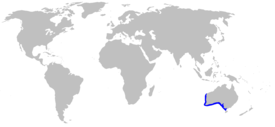
The mustachioed cunya shark [1] ( lat. Furgaleus macki ) is the only species of cartilaginous fish of the genus mustachioed marten sharks of the family marten sharks of the order Carchariformes . This widespread shark lives on the continental shelf off the coast of the Australian continent from Western Australia to the Bass Strait at a depth of about 220 m. It prefers a rocky or algae- covered bottom. The body is stocky, almost "hunchbacked." The mustachioed cunya shark differs from other sharks of its family by the presence of antennae. Two large dorsal fins are the same size. The color is gray-brown on top, the belly is white. The back of young sharks is covered with saddle-shaped dark marks. The maximum size is 1.6 m.
| Moustached Mustel Shark |
 |
| Scientific classification |
|---|
| No rank : | Bilateral symmetrical |
| Gender: | Mustachioed Cun Shark ( Furgaleus Whitley, 1951 ) |
| View: | Moustached Mustel Shark |
|
| International scientific name |
|---|
Furgaleus macki ( Whitley , 1943) |
| Synonyms |
|---|
Fur macki whitley , 1943
Fur ventralis whitley, 1943 |
| Area |
|---|
|
| Security status |
|---|
Least ConcernedIUCN 3.1 Least Concern : 39351 |
|
The diet consists mainly of octopuses . Propagated by placental live birth . Females bring from 4 to 28 cubs annually from August to October. Pregnancy lasts 7-9 months. There is no danger to humans. The meat is eaten. In large numbers, it enters gill nets off the coast of Western Australia. In the 1970s and early 1980s, the number of these sharks decreased significantly due to overfishing . In the mid-80s, measures were taken to preserve the species. Since then, the population has stabilized and even increased.
|
|---|
|
| |
|
| Triakis megalopterus + Scylliogaleus + Mustelus |
|
|
|
Phylogenetic relationships of marten sharks [2] . |
Content
The scientific description of this species was first given by the Australian ichthyologist Gilbert Percy Whiteley under the name Fur macki in 1943 in the issue of the scientific journal Australian Zoologist [3] . 3 Since the name Fur was already used to describe the genus of the family of dipterans , in 1951 Whiteley replaced it with Furgaleus [4] . The type specimen is a 50 cm long immature male caught off the coast of Victoria , Australia . Sharks from the western part of the range were considered for some time as a separate species of Furgaleus ventralis , while in the course of comparative studies conducted by Leonard Compagno, it was found that these sharks are no different from barked mustelids [5] .
Based on morphology, Leonard Compagno grouped baleen mustine sharks, soup sharks Hemitriakis , yago and gogolia into a single tribe within the subfamily Galeorhininae of the family of marten sharks [5] . In 2006, studies by J. Andre Lopez confirmed that the mustachioed marten sharks and Hemitriakis soup sharks are sister taxa ; the study called into close kinship with Iago, and ruled out such a relationship with gogolii. [2]
Mustachioed cunny sharks are endemic to Australia's coastal waters. They live in temperate waters on the continental shelf from the North West Cape , Western Australia , to Wynyard , Tasmania . They are especially common in the southwestern part of its range between Calberria and Albany ; they are rarely found off the coast of Victoria and Tasmania. Probably, the area is inhabited by a single population. These bottom fish are kept at a depth of 220 m [6] [7] . They prefer a stony and algae- covered bottom [8] .
The mustachioed mustel sharks have a dense body, somewhat "hunchbacked" in profile. The short snout is rounded; when viewed from above, it has a wedge-shaped shape. They differ from other representatives of their family by the presence of skin folds that precede the nostrils and turn into a thin antennae. Oval eyes, elongated horizontally, are located high on the head and are equipped with a rudimentary third century . There are protruding ridges under the eyes, and tiny splashes are located behind the eyes. The mouth forms a short, wide arch; there are long furrows in the corners. There are 24–32 upper and 36–42 dentitions in the mouth. Each upper tooth is equipped with a sharp central tooth and small lateral teeth; in the lower teeth there are no lateral teeth. There are five pairs of gill slits [7] [8] .
The first dorsal fin is rather large, shifted closer to the pectoral than to the ventral fins. Its base lies between the pectoral and ventral fins. Dorsal fins approximately the same size. The base of the second dorsal fin is located slightly in front of the base of the anal fin. The anal fin is significantly smaller than the dorsal fins. Caudal fin with small lower lobe; ventral notch at tip of upper lobe. Adult sharks are colored in gray-brown, light belly. Young sharks are lighter, on the back and fins they have dark saddle marks, which fade with age and disappear [7] [8] . The maximum size is 1.6 m, the maximum body weight is 13 kg [9] .
The basis of the diet of mustachioed mustel sharks are octopuses.
Kunya sharks are active and highly specialized predators . Octopuses make up 95% of their diet, and only 5% are other cephalopods . 9 Also in their stomachs can be found bony fish , small real spiny lobsters , ekhiur and sea herbs [9] . The tapeworm Calliobothrium pritchardae parasitizes on these sharks [10] .
Like other representatives of the family of marten sharks, the mustachioed marten sharks reproduce by live birth. Embryos feed on the yolk and, probably, the histotroph produced by the female [7] . Males can mate each year, while females have a two-year breeding cycle. Mating takes place from August to September. Females retain sperm until the end of January or the beginning of April of the following year, when the eggs mature. After 7–9 months from August to October, 4 to 28 newborns 22–27 cm long are born. The number of cubs in the litter directly depends on the size of the female. Immature sharks rarely end up on industrial nets. This fact makes it possible to assume that natural nurseries are located in depth, or in places where fish are not harvested. The first 15-17 months of shark life grow 3 times, rapid growth lasts up to 3-4 years. Sexual maturity in sharks of both sexes occurs at a length of 1.3-1.3 m, which corresponds to 5 years in males and 7 years in females. Adult sharks show slight growth, since all their forces are directed to reproduction [11] [12] . The maximum life expectancy is 15 years [6] .
It is not dangerous to humans. The meat of these sharks is eaten fresh [9] . Along with the dark shark and the Australian marten, the shark is a commercial fishing target in Western Australia. Extraction began in the 40s of the XX century. Until the 70s, the catch of baleen marten sharks was small. The peak of production occurs in the 80s, when annually up to 400-600 tons of these sharks were caught. In the mid-80s, due to overfishing, the population was reduced to 30%. The government of Western Australia has taken measures to regulate the hunting of mustachioed sharks, which helped to stabilize their numbers [6] [12] [13] . As a result, the International Union for Conservation of Nature (IUCN) assigned him the conservation status of “Least Concerns” [6] .
- ↑ Reshetnikov Yu.S. , Kotlyar A.N. , Russ T.S. , Shatunovsky M.I. The Bilingual Dictionary of Animal Names. Fish. Latin, Russian, English, German, French. / edited by Acad. V. E. Sokolova . - M .: Rus. Yaz., 1989 .-- P. 28 .-- 12,500 copies. - ISBN 5-200-00237-0 .
- ↑ 1 2 López, JA; Ryburn, JA; Fedrigo, O .; Naylor, GJP "Phylogeny of sharks of the family Triakidae (Carcharhiniformes) and its implications for the evolution of carcharhiniform placental viviparity." (English) // Molecular Phylogenetics and Evolution . - Academic Press , 2006. - Iss. 40 . - P. 50-60 . - DOI : 10.1016 / j.ympev.2006.02.011 . - PMID 16564708 .
- ↑ Whitley, GP (April 30, 1943). "Ichthyological notes and illustrations (Part 2)." Australian Zoologist 10 (2): 167-187.
- ↑ Whitley, GP (April 2, 1951). "New fish names and records." Proceedings of the Royal Zoological Society of New South Wales 1949-50: 61-68.
- ↑ 1 2 Compagno, LJV Sharks of the order Carcharhiniformes .. - Princeton University Press., 1988. - S. 233–236. - ISBN 978-0-691-08453-4 ..
- ↑ 1 2 3 4 Simpfendorfer, CA & McAuley, R. (SSG Australia & Oceania Regional Workshop, March 2003) 2003. Furgaleus macki. In: IUCN 2012. IUCN Red List of Threatened Species. Version 2012.1. <www.iucnredlist.org>. Downloaded on 03 October 2012.
- ↑ 1 2 3 4 Last, PR; Stevens, JD Sharks and Rays of Australia. - (second ed.). - Harvard University Press, 2009 .-- P. 226. - ISBN 0674034112 .
- ↑ 1 2 3 Compagno, Leonard JV 2. Carcharhiniformes // FAO species catalog. - Rome: Food and Agricultural Organization of the United Nations, 1984. - Vol. 4. Sharks of the World: An Annotated and Illustrated Catalog of Shark Species Known to Date. - P. 384–385. - ISBN 92-5-101383-7 .
- ↑ 1 2 3 Template: FisBase
- ↑ Caira, JE; Ruhnke, TR A New Species of Calliobothrium (Tetraphyllidea: Onchobothriidae) from the Whiskery Shark, Furgaleus macki , in Australia (Eng.) // Journal of Parasitology: journal. - 1990 .-- June ( vol. 76 , no. 3 ). - P. 319-324 . - PMID 2352061 .
- ↑ Simpfendorfer, CA; Unsworth, P. "Reproductive biology of the whiskery shark, Furgaleus macki, off south-western Australia." // Marine and Freshwater Research 49 (7) :. - 1998. - S. 687-693 .
- ↑ 1 2 Simpfendorfer, CA; Chidlow, J .; McAuley, RB; Unsworth, P. "Age and growth of the whiskery shark, Furgaleus macki, from southwestern Australia." // Environmental Biology of Fishes 58 (3). - (July 2000) .. - S. 335—343 .
- ↑ Simpfendorfer, CA; Donohue, K .; Hall, NG "Stock assessment and risk analysis for the whiskery shark (Furgaleus macki (Whitley)) in south-western Australia." Fisheries Research 47 (1) . - (June 2000) .. - S. 1-17 .