Joe Henry Engle ( born August 26, 1932 ) is a former NASA astronaut . As part of the X-15 project, in 1965, it made three suborbital space flights (according to the US Air Force standards) on the aircraft of the same name - rocket - planes . In 1977, he participated in atmospheric flight tests (ALT) of the aerodynamic qualities of shuttles , and flew on Enterprise . He made two space flights as a shuttle crew commander: Columbia - STS-2 and Discovery - STS-51I .
| Joe Engle | |
|---|---|
| Joe engle | |
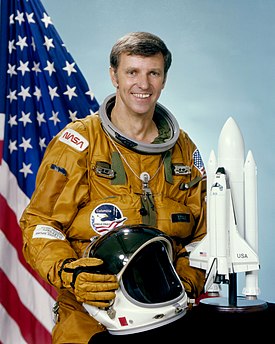 NASA Test Pilot | |
| A country |  USA USA |
| Specialty | Test pilot |
| Military rank |  Major general Major general (  Air Force ) Air Force ) |
| Expeditions |  X-15 ( 1965 ), X-15 ( 1965 ), ALT ( 1977 ), ALT ( 1977 ), STS-2 ( 1982 ), STS-2 ( 1982 ), STS-51I ( 1985 ) STS-51I ( 1985 ) |
| Time in space | 9d 08h 30m |
| Date of Birth | August 26, 1932 (86 years old) |
| Place of Birth | Chapman , Kansas , USA |
| Awards | Harmon's trophy [d] Astronaut Hall of Fame |
Content
Birth and Education
Born August 26, 1932 in the city of Abilene in the county of Dickinson, Kansas . He graduated from elementary and high school in Chapman, Kansas, and then graduated from Dickinson County High School. In 1955 he graduated from the University of Kansas with a bachelor of science degree in aeronautical engineering.
He worked as a technical consultant to the joint commission of the Advisory and Expert Council of Rosaviakosmos - the Special Commission of the NASA Advisory Committee (Anfimov-Stafford Commission). Now he is the president of the company "Engle Technology" [1] .
Military career
During training at the university, he underwent training under the program of reserve officers of the US Air Force, and upon completion of training he was called up for active service, where he decided to become a test pilot. He flew Cessna all summer and studied it well. In 1957, he began to undergo initial flight training and in 1958 became a military pilot. He was assigned to the 474th fighter squadron, flew on the F-100 , and then to the 309th tactical fighter squadron at George Air Force Base, in California . The commander of another squadron, based on this base, was the legendary test pilot Chuck Yeager (hereinafter - the U.S. Air Force general), who drew attention to Engle and was impressed with the young pilot's skill and reaction. And when Joe Engle wrote a request to send him to the school of test pilots, it was Yeager who gave him his recommendation. In 1962, he was trained at the US Air Force Test Pilot School at Edwards Air Force Base . By this time, Yeager was already the head of the school, and since he considered Engle one of the best test pilots, he immediately enrolled him in the recently organized Aerospace School of Researchers Pilots, which was often called the "School of Military Astronauts ." Engle graduated from the aerospace school in 1963, and immediately after that he was sent to work on the X-15 program. In 1965 (29.06, 10.08 and 14.10) he made three suborbital space flights (according to the US Air Force standards - to an altitude of more than 50 miles - 80.5 kilometers) on the X-15 rocket plane . Thus, he became an astronaut according to the US Air Force and received the “astronaut wings” patch. During his flying career, Angle flew 175 different types of airplanes, flying more than 15,400 hours, of which 9,000 were on jet airplanes [2] .
Space Training
Angle's first approach to space occurred in June 1963, when he was included in a group of pilots who conducted test flights on an X-15 aircraft. The first flight on the Kh-15 was performed on October 7, 1963, and in total, before flying out of the group on October 14, 1965, it completed 16 flights. The maximum altitude was reached by him in flight on June 29, 1965, and amounted to 85 527 m. He was enrolled in the NASA astronaut squad during the 5th set on April 4, 1966. Thus, he became the first person to be enrolled in the NASA astronaut squad, already having space flight experience. Engle's first appointment as part of the US lunar program was his inclusion in the Apollo 10 support crew. Then he was included in the backup crew of the Apollo 14 ship (1971) and in the main crew (by the lunar module pilot) of the Apollo 17 ship (1972). But since the program of flights to the moon was reduced, and the flight of Apollo 17 was supposed to be the last flight, Angle had to give up his place in the ship to the geological scientist Harrison Schmitt . The experience he gained while flying on the X-15 was fully claimed during the first test flights under the Space Shuttle program. Since the flight control techniques and systems that were developed to return to the Earth’s atmosphere and land the X-15 were subsequently almost completely copied when creating the shuttle, it is not surprising that it was Engle who was appointed commander of one of their two crews, who carried out an Approach and Landing Test in 1977 of the Enterprise shuttle in the atmosphere when dropping a Boeing 747 from an airplane at an altitude of 25,000 feet (7,620 m). Engle made three such test flights, including two “free” flights. Having gained experience in atmospheric shuttle flights, he was appointed commander of the backup crew of the first test flight of the Columbia shuttle STS-1 and commander of the main crew of the second test flight - STS-2 .
Spaceflight
- The first flight is STS-2 [3] , the shuttle Columbia . This is the first flight in which a manned spacecraft was reused and the Canadian manipulator Canada was tested for the first time. It launched into space on November 12, landing on November 14, 1981 as a crew commander. The flight duration was 2 days 06 hours 13 minutes. He became an astronaut NASA [4] .
- The second flight - STS-51I [5] , the Shuttle Discovery . Launching of three telecommunication satellites into orbit, repair of the SYNCOM IV-3 satellite. Flight - from August 27 to September 3 (7 days 2 hours 18 minutes) in 1985 as a crew commander [6] .
The total duration of space flights: 9 days 8 hours 31 minutes.
After flying
He received the military rank of Air Force captain in 1963, resigned from the US Air Force on November 30, 1986 with the rank of colonel, and on December 1 he was enlisted in the Air Force of the Kansas National Guard and received the rank of brigadier general.
After he left the Air Force National Guard, Joe Engle works as a consultant in the sale of aerospace and sports goods and continues flying on aircraft with high flight performance.
Rewards
Awarded: Astronaut Patch, First Flight Award of the American Institute of Astronautics and Aeronautics (1965), Cross of Merit of Merit (USA) (1964 and 1978), Ministry of Defense Medal for Outstanding Service (USA) , twice - Medal "For Space Flight" ” , Medal“ For Exceptional Merit ” , Medal“ For Outstanding Service ”(NASA) , Diploma of V. M. Komarov of the International Aviation Federation (1981), Gold Medal of Yu. A. Gagarin of the International Aviation Federation (1981), Kansas University Prize ( 1982), Medal of Excellence for the Air Force. His name is listed in the Hall of Fame of American astronauts .
Family
Angle is married to Mary Catherine Lawrence, has two adult children - a son and a daughter. Hobbies: fishing and hunting, likes to fly F-15 and F-16 , as well as combat aircraft of the Second World War .
See also
- List of astronauts and astronauts (and candidates) .
- List of US astronauts - participants in orbiting space flights .
- Timeline of manned spaceflight .
Notes
- ↑ Engle . Encyclopedia Astronautica . astronautix.com. Date of treatment March 3, 2019. Archived July 7, 2018.
- ↑ Joe H. Engle
- ↑ NASA - NSSDCA - Spacecraft - Details . nssdc.gsfc.nasa.gov. Date of treatment March 3, 2019.
- ↑ Lynda Warnock: KSC. NASA - STS-2 (English) . nasa.gov. Date of treatment March 3, 2019.
- ↑ NASA - NSSDCA - Spacecraft - Details . nssdc.gsfc.nasa.gov. Date of treatment March 3, 2019.
- ↑ Lynda Warnock: KSC. NASA - STS-51I (English) . nasa.gov. Date of treatment March 3, 2019.
Links
- Engle, Joe Henry - National Aviation Hall of Fame
- Joe H. Engle Oral History . historycollection.jsc.nasa.gov. Date of appeal April 24, 2019.
- Astronaut Biography: Joe Engle . spacefacts.de. Date of appeal April 24, 2019.