Blue-headed thimelia [1] ( lat. Garrulax courtoisi ) is a species of passerine birds from the family of comical thimelia (Pellorneidae) [2] . Very rare endangered species. A specific Latin name is given in honor of Frederic Courtois (1860-1928), a French missionary and naturalist [3] .
| Blue-headed thimelia |
 |
| Scientific classification |
|---|
| No rank : | Bilateral symmetrical |
| Infrastructure : | Passerida |
| View: | Blue-headed thimelia |
|
| International Scientific Name |
|---|
Garrulax courtoisi
Ménégaux , 1923 |
| Security status |
|---|
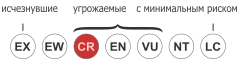
Endangered SpeciesIUCN 3.1 Critically Endangered : 22732350 |
|
Shrub is small, about 23 cm long. The upper and back parts of the head are bright blue, there is a black “mask” around the eyes, the throat and abdomen are yellow, a grayish streak on the chest. The dorsal side is olive brown, the outer webs of the primary feathers are gray-blue. The undertail is white, the tail is black with a gray base and white top.
Endemic of China . Blue-headed thimelias nest in a very small area in Jiangxi province in southeast China. The range of this species is about 320 km². Wintering sites are not reliably known, but they are believed to be near breeding sites. In 2016, the total population of blue-headed thimelia in nature was just over 323 birds, but the number of mature individuals was estimated at less than 250. In April 2012, about 170 more birds were kept in captivity.
They feed on trees and on the ground, flying in noisy groups. They feed on the fruits of lokva and insects ( dragonflies ).
They nest in forests, consisting mainly of maples and camphor trees . Nests are built on trees and bushes near rivers, sometimes not far from villages. Most chicks appear in May, some in early June. Both parents feed the chicks. We also observed how other adult birds that were not their parents fed the chicks.
There are 2 subspecies (as of February 2018) [2] :
- Garrulax courtoisi courtoisi Ménégaux, 1923 - east of China;
- Garrulax courtoisi simaoensis Cheng & Tang, 1982 - south of China.