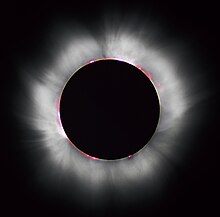
Eclipse is an astronomical situation in which one celestial body obscures light from another celestial body.
The most famous are lunar and solar eclipses. There are also such phenomena as the passage of planets ( Mercury and Venus ) through the disk of the Sun.
Content
- 1 lunar eclipse
- 2 Solar eclipse
- 3 Frequency of lunar and solar eclipses
- 4 Other types of eclipses
- 5 The role of eclipses in the culture and science of mankind
- 6 Eclipses in the cinema
- 7 Notes
- 8 Literature
- 9 References
Lunar Eclipse
A lunar eclipse occurs when the Moon enters a cone of shadow cast by the Earth. The diameter of the Earth’s shadow spot at a distance of 363,000 km (the minimum distance of the Moon from the Earth) is about 2.5 diameters of the Moon, so the Moon can be completely obscured.
Solar Eclipse
A solar eclipse occurs when the moon enters between the observer and the sun , and blocks it. Since the Moon before the eclipse is turned to us by the unlit side, then before the eclipse there is always a new moon , that is, the Moon is not visible. It seems that the sun is closing with a black disk; the observer from the Earth sees this phenomenon as a solar eclipse. The longest solar eclipse occurred on January 15, 2010 in Southeast Asia and lasted more than 11 minutes. [one]
Lunar and Solar Eclipse Frequency
Currently, there are mathematical models that accurately describe the motion of the moon, earth and planets. Using computers, the location of any observed objects in the sky can be calculated with high accuracy for thousands of years into the past and into the future. But even before the advent of modern computing tools and mathematical models, scientists were able to predict solar and lunar eclipses. According to historical information, Middle Eastern and Chinese scholars did this several thousand years ago. Successfully predicted eclipses in antiquity .
If the moon’s orbit lay in the plane of the ecliptic , each month (strictly speaking, every 29.5 days), one lunar (full moon) and one solar (new moon) eclipse would be observed on Earth. But the inclination of the lunar orbit is about 5 degrees, so for an eclipse it is necessary that the moon during the new moon or full moon passes near one of the nodes of the orbit (that is, near the intersection point of the orbit and the ecliptic). Such coincidences occur infrequently, although regularly, which is the reason for the comparative rarity of eclipses. Long-term observations and recording of eclipses have shown that lunar and solar eclipses occur with a cycle whose length is 6585.3 days, or 18 years, 11 days and a little less than 8 hours. This period is called saros . For one saros, 28 - 29 lunar eclipses and 41 - 43 solar eclipses occur (from solar - 15 - 17 private, 15 ring-shaped and 13 complete). Contrary to widespread misconception, in general lunar eclipses occur less frequently than solar ones. However, a lunar (total or partial) eclipse is observed in half the globe, partial solar not more than a quarter of the globe, total solar - only in a strip no wider than 250 km. Due to the fact that saros is not a multiple of days, the eclipse band in the next period does not pass where it passed in the previous one. As a result, in one locality, total solar eclipses are indeed rarely repeated: on average, once every three hundred years. That is why an observer living in one place can see during his life many lunar eclipses and not a single solar one. For example, in Moscow over the historical period, five total solar eclipses were recorded: August 11, 1124 (observed south-west of Moscow), March 20, 1140, June 7, 1415, February 25, 1476, and August 19, 1887 (observed north of Moscow), and the next, lasting 4 minutes, will be observed on October 16, 2126 [2] .
Saros was also known to astronomers of ancient Egypt and Babylon . Thanks to saros, ancient astronomers accurately predicted eclipses, having no clear idea of celestial mechanics, or computing devices. Indeed, in order to predict the date and time of the eclipse, it is enough to have a list of the last eclipses that have occurred and add an integer number of saros to the date and time of each of them. Predicting lunar eclipses is not at all difficult. With solar eclipses, everything is somewhat more complicated, because you need to consider that when the eclipse repeats through the saros, its strip will pass in another place, and be able to calculate this place. To facilitate the calculation of solar eclipses, ancient scientists used triple saros or exeligmosis - a period of 19 755.9 days, which is much less divergent from the whole number of days.
Predictions of eclipses by saros give acceptable accuracy within plus or minus 300 years, in more remote times, failures begin, caused by the accumulation of errors.
Other types of eclipses
In addition to lunar and solar eclipses, other bodies eclipse in the sky. For example, planets can overshadow the stars. Similar phenomena are called coatings .
Artificial solar eclipses were received in space when the spacecraft covered the sun, for example, the 1975 experiment during the Soyuz-Apollo flight.
The role of eclipses in the culture and science of mankind
Since ancient times, solar and lunar eclipses, as well as other rare astronomical phenomena, such as the appearance of comets , have been perceived as negative events. People were very afraid of eclipses, since they rarely occur and are unusual and frightening natural phenomena. In many cultures, eclipses were considered harbingers of misfortunes and disasters (especially lunar eclipses, apparently due to the red color of the shaded moon associated with blood). In mythology, eclipses were associated with the struggle of higher forces, one of which wants to disrupt the established order in the world (“extinguish” or “eat” the Sun, “kill” or “blood” the Moon), and the other to save it. Beliefs of some peoples demanded complete silence and inaction during eclipses, others, on the contrary, active witchcraft actions to help the "light forces". To some extent, this attitude towards eclipses remained until the new times, despite the fact that the mechanism of eclipses has long been studied and is well known.
Eclipses have given rich material to science. In antiquity, observations of eclipses helped to study celestial mechanics and to understand the structure of the solar system. Observation of the Earth’s shadow on the moon gave the first “cosmic” evidence of the sphericity of our planet. Aristotle for the first time pointed out that the shape of the earth’s shadow at lunar eclipses is always round, which proves the sphericity of the Earth. Solar eclipses made it possible to begin the study of the corona of the sun, which is impossible to observe in normal times. During solar eclipses, the phenomena of gravitational curvature of the path of light rays near a significant mass were first recorded, which was one of the first experimental evidence of the conclusions of the general theory of relativity . A large role in the study of the inner planets of the solar system was played by observations of their passage through the solar disk. So, Lomonosov , observing the passage of Venus in 1761 on the solar disk, for the first time (30 years before Schroeter and Herschel) discovered the Venusian atmosphere by detecting the refraction of sunlight when Venus enters and leaves the solar disk.
Movie Eclipses
- Eclipse Days (film) .
- The film “Pitch Black” (“Dark Darkness”), called the “ Black Hole ” at the Russian box office, is dedicated to the eclipse on another planet.
- Thanks to a total solar eclipse, the hero of the film Mel Gibson Apocalypse was saved from death on the sacrificial stone of the Aztec pyramid.
- Stephen King's book Dolores Claiborne describes a murder during a total solar eclipse. According to the book the movie of the same name is put.
Notes
- ↑ http://www.vesti.ru/doc.html?id=336046 News
- ↑ Solar eclipses in 2004–2024. Astronomical site "Galaxy"
Literature
- Eclipses // Kazakhstan. National Encyclopedia . - Almaty: Kazakh encyclopedias , 2005. - T. II. - ISBN 9965-9746-3-2 .