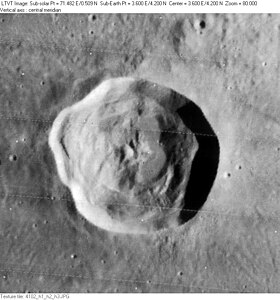
Trisnecker Crater ( lat. Triesnecker ) - impact crater in the central part of the visible side of the moon , located in the Central Bay . The name was given in honor of the Austrian astronomer - Jesuit Franz von Paul Trisnekker (1745-1817) and approved by the International Astronomical Union in 1935. The formation of the crater belongs to the Copernican period [1] .
| Trisnekker | |
|---|---|
| lat Triesnecker | |
 Shot of the Lunar Orbiter IV probe | |
| Specifications | |
| Diameter | 25 km |
| Deepest | 2760 m |
| Title | |
| Eponym | Franz von Paula Trisnekker (1745-1817) - Jesuit, Austrian astronomer |
| Location | |
| Heavenly body | Moon |


Content
Crater Description
To the west of this crater are the craters Hladni , Murchison , Pallas ; in the northwest - Ukert crater; in the northeast - Gigin crater; in the east - the craters of Dembowski , Agrippa , Goden ; in the south - Ratik Crater. To the east of the crater is a system of furrows named after the crater and extending over a distance of over 200 km in the north-south direction; in the west - a linear tectonic dislocation, possibly graben [2] . The selenographic coordinates of the center of the crater are , diameter 25.0 km [3] , depth 2.76 km [4] .
The crater shaft has an irregular shape with a noticeable radial protrusion in the western part. The eastern part of the shaft is slightly higher than the western one, the average height of the crater shaft above the bottom of the bowl is 2780 m, and over the surrounding area - 870 m [5] . The inner slope of the crater has a terrace-like structure. The bottom of the crater bowl is uneven, with a central peak elevation of 370 m [5] . The crater has a system of rays extending over a distance of over 300 km, especially noticeable when the sun is high. The volume of the crater is approximately 440 km³. [5] .
Trisnekker is a typical representative of craters with a diameter of 15-50 km, which are characterized by the presence of a central peak (starting from a diameter of 26 km), terrace-like and traces of collapse of the inner slope. Such craters are classified as TRI (by the name of the crater).
The crater is included in the list of craters with a bright ray system of the Association of Lunar and Planetary Astronomy (ALPO) [6] .
Crater Section
The graph below shows a cross-section of the crater in various directions [7] , the scale along the ordinate axis is indicated in feet , the scale in meters is indicated in the upper right part of the illustration.
Satellite Craters
| Trisnekker [3] | Coordinates | Diameter, km |
|---|---|---|
| D | 5.8 | |
| E | 4.2 | |
| F | 3.2 | |
| G | 3,5 | |
| H | 2,5 | |
| J | 2.9 |
See also
- List of Craters on the Moon
- Lunar crater
- Morphological catalog of Moon Craters
- Planetary nomenclature
- Selenography
- Mineralogy of the Moon
- Geology of the moon
- Late heavy bombardment
Notes
- ↑ Crater description on The Moon-Wiki.
- ↑ Trisnekker Crater on LAC59 map
- ↑ 1 2 Handbook of the International Astronomical Union
- ↑ John E. Westfall's Atlas of the Lunar Terminator, Cambridge Univ. Press (2000)
- ↑ 1 2 3 Lunar Impact Crater Database . Losiak A., Kohout T., O'Sulllivan K., Thaisen K., Weider S. (Lunar and Planetary Institute, Lunar Exploration Intern Program, 2009); updated by Öhman T. in 2011. Archived page .
- ↑ List of craters with a bright ray system of the Association of Lunar and Planetary Astronomy (ALPO) Archived on March 4, 2016.
- ↑ Catalog of lunar craters cross sections I Craters with peaks by Gerald S. Hawkins, William H. Zack and Stephen M. Saslow
Links
- Digital Photographic Atlas of the Moon
- Photos of the crater and its environs on the Lunar Picture of the Day website
- Photos of the crater from the side of Apollo 10, Apollo 12
- Selenological map of the vicinity of the crater
- Trisnekker Crater on AIC59C map
- Andersson, LE, and EA Whitaker, NASA Catalog of Lunar Nomenclature, NASA Reference Publication 1097, October 1982.