Floorball rules are established by the International Floorball Federation . Changes to the rules are made every four years on the basis of a multi-stage system of testing and coordination [1] . The current edition was approved in 2010 [2] .
Key
Two teams take part in the game. The goal is to score as many goals as possible against opponents, without violating the rules of the game. Meetings are usually held indoors on a hard and level surface [3] .
It is allowed to control the ball only with a club that is available to all field players. It is allowed to stop the ball with the foot, but not to hit the goal.
Site
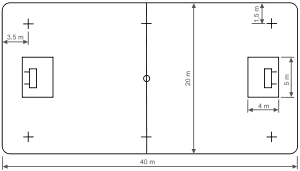
The game takes place on a rectangular area measuring 40 × 20 meters, covered with sides. The corners at the site are rounded. According to the rules of the International Floorball Federation (IFF), the use of the site is slightly larger or slightly smaller. The minimum size is 36 × 18 meters, the maximum size is 44 × 22 [4] . There is a version of the game on a small (24 × 14 meters) area with three field players and a goalkeeper.
The marking on the site is applied with lines 4–5 cm wide. It should contain [5] :
- A central line parallel to the short side of the site and dividing it into two equal halves, with a marked center of the field.
- Penal areas of rectangular shape measuring 4 × 5 meters including the width of the lines, marked at a distance of 2.85 meters from the front lines. Penalty areas should be located in the middle of the court.
- Goalkeeper squares of rectangular shape measuring 1 × 2.5 meters including the width of the lines, marked at a distance of 0.65 meters from the back lines of the corresponding penalty areas.
- The back line of the goal area also plays the role of the lines of the respective goal. Places for goalkeeper posts should be marked on it, the distance between which should be 1.6 m.
- Face-offs on the center line and on an imaginary extension of the goal line at a distance of 1.5 m from the corresponding long sides of the court. They should be in the shape of a cross, and their diameter should not exceed 30 cm.
The gate size is 1.60 by 1.15 meters. The gates used in competitions held under the auspices of the IFF must undergo a special audit and be certified [6] .
Directly adjacent to the site are areas of substitution 10 m long marked in a special way on both sides of the side of the board. They should be located at a distance of 5 m from the center line and, among other things, should include benches for substitutes. The depth of the replacement zones should not exceed 3 meters. Benches should be designed for 19 players [7] . Opposite the substitution zones, there are places for the secretariat and benches for remote players [8] .
Match Time
The match contains 3 periods of 20 minutes with two 10-minute breaks between periods. In some cases, the third period is not played, and the length of the period can be reduced to 15 minutes. The game time is considered “clean”, that is, the countdown stops during the game stops and starts again after the game resumes [9] .
During the match, each team has the right to take one timeout lasting 30 seconds [10] .
If the match, in which the winner must be determined, ends in a draw, an additional time of 10 minutes is assigned. Before extra time, teams are entitled to a 2-minute break without a change of side [11] . If the winner cannot be identified in extra time, a series of free throws of five attempts on each side will be awarded. Free throws must be performed by different players. If even after this a draw is retained, the same five players from each of the teams continue to make successive throws (not necessarily in the same order) until a positive result is achieved for one of the teams [12] .
Game participants
Each team is allowed to engage 20 players. However, no more than six players of one team, including no more than one goalkeeper properly equipped [13] , may be present at the site, however. During the game, it is allowed to make an unlimited number of replacements carried out without stopping the game. All replacements must be carried out exclusively in the substitution zone of the corresponding team [14] .
Goalkeepers are marked in the protocol in a special way (usually with the capital letter G ) and are not allowed to take part in the match as field players with clubs. If all the goalkeepers of the team were injured, she has the right to equip one of the field players as a goalkeeper for three minutes (this time, however, cannot be used to warm up a player). If the goalkeeper completely leaves the goalkeeper zone during the match, he is considered as an ordinary field player, but without a stick [15] .
Each team must have a captain marked in the protocol in a special way (usually with the capital letter C ). Captain replacement is possible only in cases of injury or removal before the end of the match. Only the captain has the right to communicate with the judges, in addition, he is obliged to assist them [16] . The captain is required to wear a special bandage on his arm [17] .
Each team has the right to declare no more than five staff members. Not declared employees are not allowed to be in the replacement zone. Staff members have no right to enter the site without the permission of the arbitrators, with the exception of the timeout [18] .
The match is served by two referees with equal rights. They have the right to stop the game at any time if it cannot be continued in compliance with the rules [19] . The secretariat is responsible for maintaining a report on the game, tracking the time and functions of the announcer [20] .
Equipment and inventory
Form
All field players of each team should be dressed in the same uniform, consisting of a T-shirt , shorts and leggings . For women, it is allowed to replace shorts with skirts or dresses (T-shirt and skirt as a whole). The shape color may be arbitrary, but not gray. If the colors of the meeting teams are close, then at the request of the judges, the guest team must change form. Leg warmers should cover the leg to the level of the knee and should not differ in color from other clothes. Goalkeepers should wear sweaters and long trousers. All T-shirts must bear the number of the corresponding player. The numbering of players is allowed in the range from 1 to 99. All players must be shod, in case of loss of shoes during the match, it is allowed to continue the game without it until the next stop. It is not allowed to wear leggings over shoes [21] .
Unlike field players, goalkeepers are not allowed to use the club . Goalkeepers must be equipped with a mask to protect their face from hitting the ball. They are also allowed to use other protective equipment that does not block the gate space. In particular, helmets and gloves are permitted. It is forbidden to apply substances to the form that contribute to the increase or decrease of friction with the surface of the site [22] .
Players are not allowed to have personal equipment that could injure other players. This kind of equipment includes: watches, earrings, protective and medical equipment, and so on. The danger of equipment is assessed by the referees of the match.
Judges must wear identical T-shirts, black shorts and black leggings [23] . They should be equipped with medium-sized plastic whistles, measuring instruments and red cards [24] .
Ball
Only certified certified balls are allowed to play. The ball should be made of plastic, its diameter is 72 mm, the maximum weight is 23 grams. There are 26 holes in the ball. It should be painted in plain color with non-fluorescent paint [25] .
Sticks
Sticks must also undergo mandatory certification. It is forbidden to carry out any manipulations with the stick of the club except for its shortening and covering with a winding above the grip level. The clubs are usually made of plastic, their length should not exceed 105 cm, and the mass should be 350 g. The club's hook should not be sharp, and its length should be less than 30 cm. The hook is bent [26] .
Standard situations
General Provisions
Standard situations are called the process of putting the ball into the game after stops due to various reasons. Standard situations include a controversial ball, opening kicks, free kicks and free kicks. When assigning a standard situation, the referee blows one whistle and clearly indicates in which direction the ball is being brought in, which violation has been committed and what type of standard situation is assigned. The ball must be brought into the game from a stationary state and from the place indicated by the referee. If necessary, a second referee's whistle may be required to enter the ball. In non-critical cases, at the discretion of the judge, the ball may be entered without a complete stop and not from the place of violation. It is forbidden to deliberately delay the process of putting the ball into the game from the standard situation [27] .
Controversial ball
A controversial ball begins the match and each of the periods. Also a controversial ball is played after goals scored. In addition, the disputed ball is appointed in situations when the game was stopped, but none of the teams received the right for an introductory strike, these situations include [28] :
- inadvertent damage to the ball;
- the ball is in a position not accessible for play;
- the integrity of the sides is broken and it is impossible to determine whether the ball left the court or not;
- the gates are inadvertently moved and cannot be returned back within a reasonable time;
- a player is seriously injured or an injured player significantly affects the course of the game;
- an unusual situation has arisen requiring a stop in the opinion of the judge;
- a goal scored is canceled for reasons not requiring a free kick (for example, the ball hits the goal without crossing the goal line);
- the executed penalty kick is not counted, including due to improper execution;
- in the case of a delayed penalty, after losing the ball by the attacking team, as well as in the case of a deliberate delay in the game by the attacking team;
- violation of the rules of the game, not directly related to the game, but occurred during its course, for example, the withdrawal of a removed player ahead of time;
- referees cannot make a decision in which direction an introductory or free kick should be assigned, for example, if the rules of the opposing teams violate the rules;
- the judges made an incorrect or erroneous decision.
In the event of the beginning of the period or after a goal is scored, the ball is played at a central point. In other cases - at the “cross” closest to the stopping point (the point of drawing of the disputed ball).
During the controversial ball, all players, with the exception of those who directly carry out the rally, are required, without reminding the referees, to move a distance of at least three meters (including a club) from the point of play. One player per team takes part in the draw. They are located face to face, not touching each other. The feet of the players are placed perpendicular to the center line at some distance from it. The clubs must be held with a normal grip above the grip mark. The usual grip is understood as such a grip, which is used by the players in the game. The hooks of the clubs are located on opposite sides of the ball, the player of the defending team chooses the location of the hook first, and in the case of a draw on the center line - the player of the guests.
A goal scored from a controversial ball counts [29] .
Opening strike
An opening kick is awarded if the ball leaves the court. It is performed by the opponent of the team whose player last touched the ball. An introductory strike is performed from a point located 1.5 meters from the side at the point where the ball exits the court, but not beyond the imaginary goal line. In unprincipled cases, the exact implementation of these rules is optional. If a team can take advantage of the ball from a distance of less than 1.5 meters from the side, they are allowed to do so. If the ball has left the area beyond the imaginary goal line, its entry into the game is carried out from the nearest point of the disputed ball. If during the game the ball touches the ceiling or structures above the court, the opening hit is made from the center line from a point located at a distance of 1.5 meters from the side.
Players of the opposing team must, without reminding the referees, move a distance of at least 3 meters, including their clubs. However, the player introducing the ball is not required to wait for the opposing players to leave. In the event that the ball is entered before the opponent takes the correct position, the referees must not interrupt the game.
Putting the ball into the game is done exclusively by the club. It is forbidden to carry out a ball pull, a sharp hit on the ball, as well as lifting the ball to a club. The player entering the ball is not allowed to touch the ball until it is touched by someone else on the field.
A goal scored from an opening stroke counts [30] .
Free kick
Free kick is appointed by decision of the judge in case of certain violations of the rules of one of the teams. A free kick is made to the opponents of the offending team. When assigning a free kick, the advantage rule applies, if a team that does not violate the rules continues to posses the ball and can get an advantage from the current situation compared to a free kick, the free kick is not assigned, and the teams continue to play without stopping. If, when applying the advantage rule, the team that did not violate the rule loses control of the ball, a free kick from the place of violation is awarded.
A free kick is usually awarded from the point where the rule violation occurred. An exception is if the violation occurred behind an imaginary goal line or closer. In this case, a free kick is performed from the nearest point of the rival ball. The ball is also taken out at a distance of 3.5 meters from the goalkeeper zone, if the violation occurred at a distance of less than 3.5 meters from the goalkeeper zone. In this case, the defending team has the right to establish a “wall”. If the team performing the free kick interferes with the establishment of the “wall”, the right to free kick passes to the defending team. At the same time, the attacking team is not obliged to wait until the “wall” is established and has the right to position its players in front of it.
As in the case of an opening stroke, in unprincipled cases, at the discretion of the arbitrators, the strike may not be executed exactly from the place of the violation, and the ball does not have to be stationary. A free kick must be carried out from a point located at least 1.5 meters from the side, unless the team insisted on the opposite is awarded the right to free kick.
When assigning a free kick, players who violate the rules of the team must, without reminding the referees, move to a distance of at least 3 meters from the ball, including clubs. Players of the free kick team are not required to wait for the opponents to move 3 meters away and may play the ball earlier. In this case, the arbitrators shall not take any action.
A player performing a free kick must not touch the ball after the impact until it has been touched by any other player.
A goal scored from a free kick counts [31] .
Free kick is assigned in the following cases [32] :
- a player strikes (with a club or foot), blocks or raises an opponent's club, unless the player first plays the ball;
- the player holds the opponent’s hands or his stick;
- the player raises the club’s hook above the level of the belt before or after the strike, including when simulating a strike; it is permitted to carry the club up after an impact if there are no rival players nearby who could be injured in this way;
- a player uses a leg or any part of his club to play a ball above the knee level; it is allowed to stop the ball with the thigh if there is no danger of the knee injuring the opponent;
- the player places his stick or foot between the opponent’s legs;
- when waging a fight for a ball, a player exerts force pressure or makes an opponent push in any way except for shoulder-to-shoulder contact;
- игрок, владея мячом, пытаясь овладеть им или пытаясь занять более выгодную позицию, движется спиной вперед в сторону соперника, а также в случае, если игрок пытается помешать движению противника в выбранном им направлении, в том числе при выставлении защищающейся командой стенки при исполнении свободного удара;
- игрок умышленно (по мнению судьи) выполняет два раза подряд (без касания клюшки или другого игрока) удар ногой по мячу;
- полевой игрок находится во вратарской зоне; разрешается пересекать вратарскую зону, если это не мешает ходу игры и вратарю; игрок считается находящимся во вратарской зоне, если любая часть его тела касается зоны, не считается нарушением игра клюшкой во вратарской зоне;
- игрок умышленно сдвигает с места ворота команды противника;
- игрок, находясь в штрафной площади или на расстоянии менее трёх метров от вратаря, пассивным образом (ненамеренно) мешает ему выбросить мяч;
- игрок совершает прыжок при выполнении остановки мяча, прыжком считается ситуация, когда от поля оторываны обе ноги, но бег прыжком не считается; разрешается перепрыгивать через мяч, не касаясь его;
- игрок играет в мяч, находясь за пределами игровой площадки (когда одна или обе его ноги находятся за пределами площадки), при этом выбегать за пределы площадки разрешается; игра из-за пределов площадки при смене составов расценивается как нарушение численного состава; игра со стороны игрока, не участвующего в замене, расценивается как задержка (срыв) игры;
- вратарь полностью покидает штрафную площадь (включая её линии) при вводе мяча в игру; если вратарь покинул штрафную площадь уже после того, как выпустил мяч из рук, это нарушением не считается;
- мяч, выкинутый рукой или выбитый ногой вратаря, полностью пересекает центральную линию площадки, не касаясь бортов, пола или других игроков;
- розыгрыш спорного мяча или выполнение вводного или свободного ударов производится с нарушением правил или неоправданно задерживается; если вводный или свободный удар выполнен из неправильного места или по подвижному мячу, он может быть выполнен заново;
- вратарь владеет мячом дольше трёх секунд, в том числе, если он отпустил мяч и взял его снова;
- вратарь получает умышленный пас от игрока своей команды, под получением паса имеется в виду касание мяча рукой, даже если остановка произведена любой другой частью тела; вратарю разрешается принимать пас за пределами штрафной площади, когда он считается полевым игроком, в этом случае он может вернуться в штрафную площадь и взять мяч в руки;
- совершено нарушение правил, подразумевающее удаление игрока;
- игрок задерживает игру, например, занимая позицию на поле или за воротами так, что отнять у него мяч, не нарушив правила, невозможно.
Штрафной бросок
Штрафной бросок назначается в случае, когда голевая ситуация прервана нарушением, ведущим в обычной ситуации к назначению свободного удара или удалению. Являлась ли ситуация голевой решается судьями, нарушение в штрафной площади не ведёт автоматически к назначению штрафного броска. Штрафной бросок всегда назначается в тех случаях, когда защищающаяся команда умышленно сдвигает ворота или нарушает численный состав. Также штрафной бросок всегда назначается в тех случаях, когда при исполнении свободного удара мяч летит в ворота, и игрок защищающейся команды находится во вратарской площади или в воротах [33] .
Для штрафного броска действует правило отложенного наказания, заключающееся в том, что не нарушившая правила команда может продолжить свою атаку после нарушения, если продолжает контролировать мяч. Атака продолжается до тех пор, пока голевая ситуация не разрешится, в том числе и после окончания времени периода или матча. Если в ситуации отложенного штрафного броска не нарушившая правила команда забивает гол, то он засчитывается, а штрафной бросок отменяется [34] .
На время исполнения штрафного броска время матча останавливается. Во время исполнения штрафного броска все игроки, за исключением исполняющего бросок и вратаря противника, должны находиться в своей зоне замен. Вратарь должен находиться на линии своих ворот. Запрещается проводить замену голкипера на полевого игрока. Если во время исполнения броска вратарь нарушает правила, назначается новый штрафной бросок. Если во время исполнения броска правила нарушает любой другой игрок провинившейся команды, штрафной бросок повторяется, а нарушение расценивается как попытка срыва игры.
Штрафной бросок исполняется из центральной точки. Исполняющий его игрок может неограниченное число раз касаться мяча, но ему разрешается двигать мяч только в сторону атакуемых ворот. Если после удара мяч отскакивает от стоек ворот, попадает во вратаря и оказывается за линией ворот, то гол засчитывается, несмотря на движение мяча в обратную сторону. Если движение мяча в обратном направлении происходит в самом начале штрафного броска, то выполнение броска начинается сначала. Как только мяча коснётся вратарь, исполняющему бросок игроку запрещается касаться мяча.
Если вместе со штрафным броском провинившийся игрок должен быть удалён на 2 минуты (в том числе за нарушение, совершённое до назначения броска, то есть когда штрафной бросок назначен во время отложенного удаления), то это наказание отменяется в случае броска, приведшего к голу [35] .
Удаления
Помимо свободных и штрафных ударов нарушение правил может быть наказано удалением игрока. Удаления делятся на командные и персональные. Командные удаления могут быть на две или на пять минут, а персональные — на 10 минут или до конца матча в зависимости от тяжести нарушения.
General Provisions
Обычно штрафное время на скамье штрафников отбывается тем игроком, который совершил нарушение правил, приведшее к удалению. Если судьи не могут определить, кто из игроков совершил нарушение, или если нарушение совершенно одним из официальных лиц команды, то игрока для отбывания штрафа должен выбрать из числа полевых игроков капитан. Если капитан отказывается сделать выбор или сам отбывает наказание, выбор осуществляется судьями.
Если 2-минутное удаление зарабатывает вратарь, то за него штрафное время отправляется отбывать один из полевых игроков по решению капитана. В случае 5-минутных и персональных удалений вратарь должен отбывать штрафное время сам. Если он зарабатывает 2-минутное удаление, отбывая штрафное время, или вместе с 5-минутным или персональным удалением, то эти две минуты штрафа он также должен отбыть самостоятельно.
Всё штрафное время удалённый игрок должен отбывать на скамье штрафников. Разрешается покидать скамейку в перерывах между периодами, но не между основным временем матча и овертаймом. Удалённому игроку запрещено принимать участие в тайм-аутах. Все удаления заканчиваются с окончанием времени матча, однако в случае назначения овертайма, удаление продлевается. По окончании штрафного времени удалённый игрок должен покинуть скамейку штрафников, если это позволяет сделать количество игроков его команды, находящихся на площадке, а также если им отбывалось командное, а не персональное удаление. Удалённому голкиперу разрешается покинуть скамейку штрафников только при возникновении в игре паузы. Если игрок покидает скамью штрафников до окончания штрафного времени, он удаляется до конца игры.
Травмированный удалённый игрок может быть заменён на скамье штрафников любым другим полевым игроком [36] .
Отложенные удаления
Любое удаление может быть отложено, если не нарушившая правила команда продолжает владеть мячом. Откладывать, однако, можно не более одного удаления, за исключением голевых ситуаций. Отложенное удаление означает, что не нарушившая правила команда может продолжать свою атаку до тех пор, пока не потеряет контроль над мячом. Во время отложенного удаления атакующая команда может заменить голкипера полевым игроком. Игра во время отложенного удаления может продолжаться и после окончания основного времени периода или матча. после того, как нарушившая команда возвращает себе контроль мяча, матч останавливается, удалённый игрок отправляется на скамью штрафников, а матч возобновляется с розыгрыша спорного мяча.
Во время отложенного штрафа владеющая мячом команда должна пытаться организовать атаку. если судьи посчитают, что команда намеренно затягивает игру, они должны вынести предупреждение. Если это не помогает, игра прерывается, а атакующей команде выносится удаление за задержку времени, и игра возобновляется с розыгрыша спорного мяча.
Если отложенное удаление прерывается по каким-либо другим причинам, игра возобновляется тем способом, который предусмотрен возникшей ситуацией.
Если в ходе розыгрыша отложенного удаления атакующая команда забивает гол, он засчитывается, а 2-минутное удаление отменяется. 5-минутное и персональные удаления накладываются вне зависимости от забитого гола. Если гол забивает наказанная команда, то гол не засчитывается, но если забит автогол атакующей командой, то он засчитывается [37] .
Командные удаления
В случае командного удаления удалённый игрок не может быть заменён на площадке другим игроком, то есть наказанная команда играет в неполном составе. Одновременно отсчитывается не более одного удаления на игрока и двух удалений на команду. Это означает, что в случае наложения на игрока двух и более удалений, их время отсчитывается не одновременно, а последовательно: игрок удалённый дважды на две минуты, должен отбыть в общей сложности 4 минуты штрафа. Если на команду накладывается одновременно более двух удалений, капитан выбирает, какие из них будут отсчитываться вначале, а какие — потом. При этом короткие (2-минутные) удаления всегда отсчитываются раньше длинных (5-минутных).
Команда, имеющая более двух командных удалений, имеет право выставить на площадку четырёх игроков. Она должна играть с таким количеством игроков до тех пор, пока на скамье штрафников не останется только один игрок, отбывающий командное удаление. Игрок, штрафное время которого завершилось во время, когда на площадке всё ещё должно находиться четыре игрока, обязан оставаться на скамье штрафников до возникновения паузы в игре. Удалённые игроки должны покидать скамью штрафников в том же порядке, в котором заканчивается их штрафное время
Если после окончания штрафного времени, связанного с командным удалением, игрок должен остаться на скамье штрафников, чтобы ещё отбыть и персональный штраф, то вместе с ним на скамье размещается ещё один игрок, выбранный капитаном, который может войти в игру вместо удалённого игрока, когда время командного удаления истечёт [38] .
2-минутное удаление
Если во время 2-минутного удаления забивается гол в ворота наказанной команды, отсчёт штрафного времени прерывается, и удалённый игрок возвращается на поле. Это не относится к ситуации, когда наказана и противоположная команда, и игра проходит в неполных, но равных составах, или противоположная команда играла в меньшинстве. Также штрафное время не прерывается, если гол был забит в ситуации отложенного удаления или при выполнении штрафного удара, назначенного при удалении игрока [39] .
К 2-минутному удалению ведут следующие нарушения правил [40] :
- игрок ударяет (клюшкой или ногой), блокирует или поднимает клюшку соперника или держит руками оппонента или его клюшку, чтобы получить существенное преимущество или в ситуации, когда не может достать мяч;
- игрок играет в мяч на уровне выше уровня пояса любой частью своего тела или клюшки;
- игрок виновен в опасной игре клюшкой, в том числе при неконтролируемом замахе назад вверх или проводке вперёд вверх, а также при проведении клюшкой над головой соперника, если это представляется опасным для соперника;
- игрок толкает или иным образом атакует противника на борт или ворота;
- игрок захватывает противника или делает ему подножку;
- после требования капитана команды измерить загиб крюка клюшки или провести контроль комбинации «рукоятка-крюк» оказывается, что экипировка удовлетворяет всем требованиям;
- полевой игрок участвует в развитии игровой ситуации без клюшки, за исключением случаев, когда как полевой игрок расценивается вышедший из ворот голкипер;
- полевой игрок берёт клюшку не в зоне замен своей команды;
- полевой игрок не поднимает части своей сломанной клюшки (за исключением мелких частей) или не относит их в зону замен своей команды;
- игрок намеренно мешает продвижению (блокирует) игрока соперника, не владеющего мячом; если нарушивший игрок пытался занять более выгодную позицию, двигаясь задом, то назначается только свободный удар;
- игрок активно мешает произвести вратарю выброс мяча; считается нарушением только если игрок находится в штрафной площади или на расстоянии не более трёх метров от места, где вратарь взял мяч в руки; «активно» означает, что игрок сопровождает передвижения вратаря или пытается сыграть клюшкой;
- игрок нарушает правило трёх метров при выполнении вводного или свободного ударов;
- игрок пытается сыграть в мяч, находясь в сидячем или лежачем положении, в том числе если на полу находится оба колена или рука, не держащая клюшку;
- игрок останавливает или играет мяч рукой или головой;
- была неправильно произведена замена; заменяемый игрок должен полностью пересечь бортик, прежде чем новый игрок может выйти на поле; наказание выносится только в том случае, если игра проходит вблизи зоны замен и нарушение оказало существенное влияние на развитие игровой ситуации;
- на поле находится слишком много игроков одной команды, удалением наказывается только один игрок;
- удалённый игрок покидает скамью штрафников, не выходя на площадку, или во время остановки игры или отказывается покидать её после окончания своего штрафного времени; если удалённый игрок до окончания штрафного времени выходит на площадку во время игры, это расценивается как срыв игры;
- игрок совершает повторяющиеся нарушения, приводящие к назначению свободных ударов;
- команда систематически задерживает игру, совершая нарушения, приводящие к назначению свободных ударов;
- игрок намеренно задерживает игру, например, выбивая мяч в сторону во время остановки игры, умышленно прижимая мяч к борту или воротам или умышленно повреждая мяч;
- команда систематически задерживает игру;
- игрок или один из официальных представителей команды протестует против судейского решения или управление командой происходит в некорректной форме; сюда относятся ситуации, когда капитан постоянно безосновательно требует объяснений судейских решений;
- голкипер, игнорируя указания судей, отказывается вернуть сдвинутые ворота на место;
- игрок, несмотря на указания судей, не поправляет свою экипировку;
- игрок использует некорректную экипировку;
- вратарь участвует в игре без соответствующей экипировки; если голкипер теряется маску в ходе игрового эпизода, игра должна быть остановлена и возобновлена с розыгрыша спорного мяча;
- игрок намеренно предотвращает гол или острую голевую ситуацию путём нарушения, за которое в обычной ситуации был бы назначен свободный удар.
5-минутное удаление
В отличие от 2-минутного удаления, если во время 5-минутного удаления забивается гол в ворота наказанной команды, отсчёт штрафного времени не прерывается, таким образом, удалённый игрок в любом слуаче отбывает штраф в полном объёме [41] .
К 5-минутному удалению ведут следующие нарушения правил [42] :
- полевой игрок совершает сильный или опасный удар клюшкой соперника, в том числе касание головы соперника при переносе над ней своей клюшки;
- полевой игрок совершает задержку соперника клюшкой;
- игрок бросает свою клюшку или другой элемент экипировки на площадку с целью попытаться выбить или отбить мяч;
- игрок бросается всем телом на соперника или иным образом грубо его атакует;
- игрок хватает, толкает или совершает подножку сопернику вблизи ворот или бортика;
- игрок совершает повторяющиеся однотипные нарушения, наказываемые 2-минутными штрафами.
Персональные удаления
Персональный штраф может быть наложен только одновременно с командным и не должен начинать отмеряться раньше, чем закончится время командного удаления. Одновременно может отсчитываться время неограниченного количества персональных удалений. Если игрок, получивший персональное удаление, во время его отбывания получает командный штраф, то отсчёт времени персонального штрафа приостанавливается до тех пор, пока не закончится командное удаление. Капитан команды в этом случае должен выбрать неудалённого игрока, который бы находился во время командного штрафа на скамье штрафников, чтобы выйти на площадку в момент окончания времени штрафа.
Персональное удаление относится только к игроку и поэтому его место на площадке может быть занято другим игроком его команды. Капитан команды должен выбрать игрока, который бы находился вместе с удалённым игроком на скамье штрафников, чтобы выйти на площадку в момент окончания времени командного штрафа, наложенного вместе с персональным. Этот игрок не считается удалённым, и его имя не вносится в протоколы матча. После окончания времени персонального штрафа удалённый игрок не имеет права вернуть на плоадку до тех пор, пока не произойдёт остановка игры [43] .
Забитые во время отбывания игроком персонального удаления голы никак не влияют на время его возвращения на площадку [44] .
10-минутное удаление
10-минутный персональный штраф, сопровождающийся также 2-минутным командным удалением, может быть назначен за поведение, признанное судьями неспортивным. Таковым считается, например, оскорбительные поступки или непристойное поведение по отношению к судьям, игрокам, официальным лицам команд, организаторам соревнований, зрителям, а также симуляции, направленные на введение судей в заблуждение. Кроме того, неспортивным поведением являются умышленные удары ногой или клюшкой, опрокидывание ворот, а также выбрасывание клюшки или другой экипировки, даже во время остановок игры и в зоне замен [45] .
Матч-штраф
Игрок, допустивший особо грубое нарушение правил, может быть наказан матч-штрафом. В этом случае он должен незамедлительно уйти в раздевалку, и не имеет права принимать какое-либо дальнейшее участие в матче. Матч-штраф всегда сопровождается командным 5-минутным удалением, которое должен отбывать игрок, выбираемый капитаном наказанной команды [46] .
Матч-штрафы делятся на три типа:
- Матч-штрафы первого типа не ведут к каким-либо последствиям для игрока за исключением собственно удаления [47] . Это наказание может быть применено в следующих случаях [48] :
- игрок во время игры использует несертифицированную клюшку; клюшку с крюком, размеры которого превышает допустимые; клюшку, крюк и рукоятка которой выпущены разными марками;
- голкипер использует, защитный шлем не соответствующий стандартам;
- в игре принимает участие игрок, не значащийся в заявленном протоколе;
- травмированный игрок, заменённый на скамье штрафников, выходит на поле до времени истечения штрафа;
- игрок во второй раз за игру наказывается 10-минутным штрафом за аналогичное неспортивное поведение; в этом случае (2+10)-минутное удаление заменяется матч-штрафом, а также назначается 5-минутный штраф, который должен отбываться другим игроком;
- игрок в ярости ломает свою клюшку или другой инвентарь;
- игрок совершает действия, наносящие физическую опасность противнику, в частности, если совершаются преднамеренные и неспровоцированные жестокие действия.
- Матч-штраф второго типа ведёт к дисквалификации удалённого игрока и на следующую игру в том же соревновании [49] . Это наказание может быть назначено за следующие действия [50] :
- игрок или официальное лицо команды принимают участие в потасовке; под потасовкой понимает лёгкая форма драки, без применения ударов кулаками и ногами;
- игрок во второй раз за матч совершает нарушение, ведущее к 5-минутному удалению; в этом случае он удаляется до конца игры, но один из игроков его команды должен отбыть удаление;
- член командного штаба неоднократно совершает неспортивные поступки;
- игрок, экипировку которого собираются проверить судьи, начинает её исправлять или менять;
- игрок или официальное лицо команды совершает нарушение, явным образом направленное на саботаж игры; в том числе, сюда относятся ситуации, когда удалённый игрок намеренно выходит на поле до истечения времени окончания его штрафа, в процессе игры из зоны замен выбрасывает экипировка или инвентарь, игрок, находящийся не в процессе замены, участвует или пытается участвовать в игре из зоны замены своей команды, игрок участвует в игре как полевой игрок после того, как уже принимал участие в этом же матче в роли вратаря, команда умышленно нарушает правило о численности состава;
- игрок использует в игре неисправную клюшку или клюшку с удлинённой или усиленной рукояткой.
- Матч-штраф третьего типа ведёт к дисквалификации на следующую игру в том же турнире и возможным дополнительным санкциям со стороны организаторов [51] . К этому наказанию могут привести следующие действия [52] :
- игрок или официальное лицо принимают участие в драке с применением ударов кулаками и ногами;
- игрок или официальное лицо совершают грубую атаку на соперника, в частности, кидают в него клюшку или другой инвентарь;
- игрок или официальное лицо ведут себя чрезвычайно грубым неподобающим образом, например, оскорбления или нападая на судей, игроков, официальных лиц команды или зрителей;
- игрок или официальное лицо совершает грубый толчок какого-либо лица даже без нанесения травмы.
Notes
- ↑ IFF system on changing the Rules of the Game
- ↑ Rules of the Game.
- ↑ Rules of the Game. Conditions of the game.
- ↑ Rules of the Game. 101 Dimensions of the rink.
- ↑ Rules of the Game. 102 Markings on the rink.
- ↑ Rules of the Game. 103 Goal cages.
- ↑ Rules of the Game. 104 Substitution zones.
- ↑ Rules of the Game. 105 Secretariat and penalty benches.
- ↑ Rules of the Game. 201 Regular game time.
- ↑ Rules of the Game. 202 Time out.
- ↑ Rules of the Game. 203 Extra time.
- ↑ Rules of the Game. 204 Penalty shots after extra time.
- ↑ Rules of the Game. 301 Players.
- ↑ Rules of the Game. 302 Substitution of players.
- ↑ Rules of the Game. 303 Particular regulations for goalkeepers.
- ↑ Rules of the Game. 304 Particular regulations for team captains.
- ↑ Rules of the Game. 404 Particular team captain's equipment.
- ↑ Rules of the Game. 305 Team staff.
- ↑ Rules of the Game. 306 Referees.
- ↑ Rules of the Game. 307 Secretariat.
- ↑ Rules of the Game. 401 The players' clothing.
- ↑ Rules of the Game. 403 Particular goalkeeper's equipment.
- ↑ Rules of the Game. 402 The referees' clothing.
- ↑ Rules of the Game. 408 The referees' equipment.
- ↑ Rules of the Game. 406 Ball.
- ↑ Rules of the Game. 407 Stick.
- ↑ Rules of the Game. 501 General regulations for fixed situation.
- ↑ Rules of the Game. 503 Events leading to a face-off.
- ↑ Rules of the Game. 502 Face-off.
- ↑ Rules of the Game. 504 Hit-in.
- ↑ Rules of the Game. 506 Free-hit.
- ↑ Rules of the Game. 507 Offences leading to a free-hit.
- ↑ Rules of the Game. 510 Offences leading to a penalty shot.
- ↑ Rules of the Game. 509 Delayed penalty shot.
- ↑ Rules of the Game. 508 Penalty shot.
- ↑ Rules of the Game. 601 General regulations for penalties.
- ↑ Rules of the Game. 604 Delayed penalty.
- ↑ Rules of the Game. 602 Bench penalty.
- ↑ Rules of the Game. 603 2 minute bench penalty.
- ↑ Rules of the Game. 605 Offences leading to a 2 minute bench penalty.
- ↑ Rules of the Game. 606 5 minute bench penalty.
- ↑ Rules of the Game. 607 Offences leading to a 5 minute bench penalty.
- ↑ Rules of the Game. 608 Personal penalty.
- ↑ Rules of the Game. 609 10 minute bench penalty.
- ↑ Rules of the Game. 610 Offences leading to a 2 minute bench penalty + 10 minute personal penalty.
- ↑ Rules of the Game. 611 Match penalty.
- ↑ Rules of the Game. 612 Match penalty 1.
- ↑ Rules of the Game. 613 Offences leading to a match penalty 1.
- ↑ Rules of the Game. 614 Match penalty 2.
- ↑ Rules of the Game. 615 Offences leading to a match penalty 2.
- ↑ Rules of the Game. 616 Match penalty 3.
- ↑ Rules of the Game. 617 Offences leading to a match penalty 3.
Literature
- The International Floorball Federation. Rules of the Game . Rules and Interpretations. Valid from 1st July 2010.
Links
- Правила и интерпретации , официально утверждённые Федерацией флорбола России в редакции от 1 июля 2002 года.