The Lorentz group is a group of Lorentz transformations of the Minkowski space that preserve the origin (that is, they are linear operators ) [1] . In mathematics is denoted .

The Lorentz group consists of homogeneous linear transformations of the coordinates of four-dimensional space-time: , which leave the quadratic form invariant, which is the mathematical expression of the four-dimensional interval, {\ displaystyle s ^ {2} = c ^ {2} t ^ {2} -x ^ {2} -y ^ {2} -z ^ {2}} and do not change the direction of time. Lorentz group includes spatial rotations in three planes Lorentz transformations , reflection of spatial axes and all their works. [2]
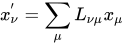

 and do not change the direction of time. Lorentz group includes spatial rotations in three planes



Lorentz Task Force Is a subgroup of transformations whose determinant of the matrix is 1 (in the general case, it is )


Orthochronous Lorentz group , special orthochronous Lorentz group - similarly, but all transformations preserve the direction of the future in time (coordinate sign ) Group , the only one of the four, is connected and isomorphic to the Mobius group .


Content
Representations of the Lorentz group
| Symmetry in Physics | ||
|---|---|---|
| Conversion | Relevant invariance | Appropriate law conservation |
| ↕ Broadcast time | Uniformity time | ... energy |
| ⊠ C , P , CP, and T symmetries | Isotropy time | ... parity |
| ↔ Broadcast space | Uniformity of space | ... momentum |
| ↺ Space rotation | Isotropy of space | ... of the moment momentum |
| ⇆ Lorentz group (boosts) | Relativity Lorentz covariance | ... movement center of mass |
| ~ Gauge Conversion | Gauge invariance | ... charge |
Let a physical quantity (for example, a four-dimensional vector of energy-momentum or the potential of an electromagnetic field) be described by a multicomponent coordinate function . When passing from one inertial reference frame to another, the components of a physical quantity are linearly transformed through each other: . Moreover, the matrix has a rank equal to the number of components of the quantity . To each element of the Lorentz group corresponds to linear transformation , the identity element of the Lorentz group (the identity transformation) corresponds to the identity transformation , and the product of two elements of the Lorentz group and corresponds to the product of two transformations . A system of matrices with the listed properties is called a linear representation of the Lorentz group. [3] Representations of the Lorentz group in complex linear spaces are very important for physics, since they are related to the concept of spin . All irreducible representations of the special orthochronous Lorentz group can be built using spinors .
Notes
- ↑ The semi-direct product of the Lorentz group and the group of parallel transfers of the Minkowski space is called the Poincare group for historical reasons. On the other hand, the Lorentz group contains as its subgroup the rotation group of 3-dimensional space.
- ↑ Shirkov, 1980 , p. 146.
- ↑ Shirkov, 1980 , p. 147.
Literature
- Gelfand I.M. , Minlos R.A. , Shapiro Z. Ya. Representations of the rotation group and the Lorentz group. - M .: Fizmatgiz, 1958.- 367 p.
- Dubrovin B.A., Novikov S.P. , Fomenko A.T. Modern geometry: methods and applications. - M .: Nauka, 1986 .-- 760 p.
- Lyubarsky G. Ya. Group theory and its application in physics. - M .: Fizmatgiz, 1958.- 355 p.
- Naimark M. A. Linear representations of the Lorentz group. - M .: Fizmatgiz, 1958.- 376 p.
- Fedorov F.I. Lorentz Group. - M .: Nauka, 1979.- 384 p. (The vector parameterization of the Lorentz group and its application are described)
- Artin, Emil. Geometric Algebra. - New York: Wiley, 1957. - ISBN 0-471-60839-4 . . See Chapter III for the orthogonal groups O (p, q).
- Carmeli, Moshe. Group Theory and General Relativity, Representations of the Lorentz Group and Their Applications to the Gravitational Field. - McGraw-Hill, New York, 1977 .-- ISBN 0-07-009986-3 . . A canonical reference; see chapters 1-6 for representations of the Lorentz group.
- Frankel, Theodore. The Geometry of Physics (2nd Ed.). - Cambridge: Cambridge University Press, 2004 .-- ISBN 0-521-53927-7 . . An excellent resource for Lie theory, fiber bundles, spinorial coverings, and many other topics.
- Fulton, William; & Harris, Joe. Representation Theory: a First Course. - New York: Springer-Verlag, 1991 .-- ISBN 0-387-97495-4 . . See Lecture 11 for the irreducible representations of SL (2, C ).
- Hall, GS Symmetries and Curvature Structure in General Relativity. - Singapore: World Scientific, 2004. - ISBN 981-02-1051-5 . . See Chapter 6 for the subalgebras of the Lie algebra of the Lorentz group.
- Hatcher, Allen. Algebraic topology. - Cambridge: Cambridge University Press, 2002. - ISBN 0-521-79540-0 . . See also the online version . Date of treatment July 3, 2005. Archived on February 20, 2012. See Section 1.3 for a beautifully illustrated discussion of covering spaces. See Section 3D for the topology of rotation groups.
- Naber, Gregory. The Geometry of Minkowski Spacetime. - New York: Springer-Verlag, 1992 .-- ISBN 0-486-43235-1 (Dover reprint edition). . An excellent reference on Minkowski spacetime and the Lorentz group.
- Needham, Tristam. Visual Complex Analysis. - Oxford: Oxford University Press, 1997 .-- ISBN 0-19-853446-9 . . See Chapter 3 for a superbly illustrated discussion of Möbius transformations.
- Shirkov D.V. Physics of the microworld. - M .: Soviet Encyclopedia, 1980 .-- 527 p.
See also
- Thomas precession
- Poincare Group