Tibetan tangka - the monetary unit of Tibet from the XVI century to 1941. [one]
| Tibetan tangka | |||||
|---|---|---|---|---|---|
| |||||
| Territory of circulation | |||||
| Issuing country |  Tibet Tibet | ||||
| Derivative and parallel units | |||||
| Fractional | Shokang ( 1 ⁄ 1.5 ) | ||||
| Scarung ( 1 ⁄ 15 ) | |||||
| Multiple | Rupee (3) | ||||
| Shrang (6 2 ⁄ 3 tangka) | |||||
| Coins and Banknotes | |||||
| Coins | 1 ⁄ 2 , 1, 2 1 ⁄ 2 , 5, 7 1 ⁄ 2 skarungs, 1 ⁄ 8 , 1 ⁄ 4 , 1, 2, 3, 5 shokangs, 1, 2 tangs, 1 ⁄ 4 , 1 ⁄ 2 , 1 rupee, 1, 1 1 ⁄ 2 , 3, 10, 20 lines | ||||
| Banknotes | 5, 10, 15, 25, 50 tangka | ||||
| Story | |||||
| Retirement | 1941 — 1959 | ||||
| Successor currency | Shrang | ||||
 Wikimedia Commons Media Files Wikimedia Commons Media Files | |||||

History
The first tangka was allegedly minted in Nepal in the 16th century. Nepal minted Tibetan silver coins. Own coinage began in Tibet in the middle of the 18th century; the circulation of coins was not significant.
In 1791, with the help of China, a mint was opened, which allowed to increase the circulation of coins, but two years later the yard was closed. In 1792, the Chinese opened another courtyard in Lhasa , which worked until 1836. The coins of this courtyard, in addition to inscriptions in the Tibetan language, had inscriptions in Chinese characters. The year of minting was indicated by the year of the reign of the Qing emperor . Soon, the Tibetan mint was reopened and worked until 1953.
In the XVIII century, silver coins were minted: 1 ⁄ 2 , 1 shokanga, 1 ⁄ 2 , 1 tangka [2] .
In the 19th century, silver 1 ⁄ 2 , 1 shokang and tangka were minted [3] . Since small coins were not issued, cut coins were used. The monetary system of this period: 1 tangka = 1 1 ⁄ 2 shokanga .
In 1901, the minting of copper coins began. In 1909, denominations began to be minted, which previously existed only as counting units - skarungs and shrangs . The monetary system of this time: tangka = 1 1 ⁄ 2 shokanga = 15 Scarungs, shrang = 6 2 ⁄ 3 tangka. In 1918-1921, gold coins were minted. In 1934, the use of cut coins was prohibited.
Coins were minted in the XX century:
- copper coins - in 1 ⁄ 2 , 1, 2 1 ⁄ 2 , 5, 7 1 ⁄ 2 skarungs, 1 ⁄ 8 , 1 ⁄ 4 , 1, 3, 5 shokangs;
- silver coins: 1, 2, 5 shokangs, 1, 2 tangs, 1, 1 1 ⁄ 2 , 3, 10 shranks;
- Gold: 20 strans [4] .
In 1902-1942, silver and gold coins were also minted in rupees (1 rupee = 3 tangs): 1 ⁄ 4 , 1 ⁄ 2 , 1 rupee [5] .
In 1930, the minting of coins in the tangka was suspended. The last time the tangka was minted in 1953, the entire circulation was intended for gifts to monks.
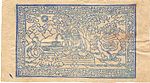
In 1912-1941, banknotes were issued in 5, 10, 15, 25 and 50 tang [6] .
In 1941, the new monetary unit was the shrang . Previously minted coins were not withdrawn from circulation and were in circulation until 1959, when the Chinese yuan was put into circulation in Tibet.
Notes
- ↑ CH, 1993 , article “ Tangka ”.
- ↑ Cuhaj, 2010 , pp. 1279-1280.
- ↑ Cuhaj, 2009 , pp. 1171-1173.
- ↑ Cuhaj, 2011 , pp. 2085-2092.
- ↑ Cuhaj, 2011 , pp. 2091-2092.
- ↑ Cuhaj, 2008 , pp. 1149-1150.
Literature
- Fengler H., Girow G., Unger V. Dictionary of numismatism . - 2nd ed., Revised. and additional .. - M: Radio and communications, 1993.
- Cuhaj G., Michael T. Standard Catalog of World Coins 1701-1800. - 5th ed. - Iola: Krause Publications, 2010 .-- 1344 p. - ISBN 978-1-4402-1364-9 .
- Cuhaj G., Michael T., Miller H. Standard Catalog of World Coins 1801-1900. - 6th ed. - Iola: Krause Publications, 2009 .-- 1296 p. - ISBN 978-0-89689-940-7 .
- Cuhaj G., Michael T., Miller H. Standard Catalog of World Coins 1901-2000. - 39th ed. - Iola: Krause Publications, 2011 .-- 2345 p. - ISBN 978-1-4402-1172-8 .
- Cuhaj GS Standard Catalog of World Paper Money. General Issues 1368-1960. - 12th ed. - Iola: Krause Publications, 2008 .-- 1223 p. - ISBN 978-0-89689-730-4 .
Links
- Converting Tibetan Coin Dates , apps.creounity.com