The Australian python Ramsey [1] ( lat. Aspidites ramsayi ) is a snake from the genus of black-headed pythons.
Australian Python Ramsey | ||||||||||||||||||||||
|---|---|---|---|---|---|---|---|---|---|---|---|---|---|---|---|---|---|---|---|---|---|---|
 | ||||||||||||||||||||||
| Scientific classification | ||||||||||||||||||||||
| ||||||||||||||||||||||
| Latin name | ||||||||||||||||||||||
| Aspidites ramsayi MacLeay , 1882 | ||||||||||||||||||||||
| Area | ||||||||||||||||||||||
 |
International Red Book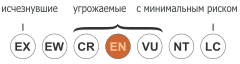 IUCN 3.1 Endangered : 2176 |
Named after the Australian ornithologist Edward Pearson Ramsay .
Content
- 1 Description
- 1.1 Appearance
- 1.2 Distribution and habitats
- 1.3 Nutrition
- 1.4 Reproduction
- 2 notes
- 3 Literature
Description
Appearance
Body length 1.5, maximum 2.7 m. The color is tan, the ridge is darker. Across the body are frequent red-brown stripes. The head is red. Dorsal scales are small and smooth, with 50-65 rows in the middle of the body. Ventral scales are 280-315, with an undivided anal plate and 40-45 mainly single subcaudal scales. Some of the posterior hesitations may be irregularly divided.
The color may be pale brown to almost black. The template consists of a primary color that ranges from medium brown and olive to lighter shades of orange, pink and red, superimposed on dark striped or spotted markings. The belly is cream or light yellow with brown and pink spots. The scales around the eyes are usually darker in color than the rest of the head.
A. ramsayi can reach a total length of 2.3 m (7.5 ft), with a cutting edge length of 2.0 m (6.6 ft).
Snakes of the genus Aspidites lack the heat-sensitive pits of all other pythons. A. ramsayi is similar in appearance to A. melanocephalus, but without an explicit neck. Coloring or wanting to find this species can lead to confusion with the poisonous species Pseudonaja nuchalis, commonly known as gwardar. [2]
Distribution and habitat
It lives from Queensland and New South Wales in the west through central Australia to its southwestern tip.
Lives in xerophytic forests and thickets. Active at night.
Nutrition
Feeds on mammals, birds and reptiles.
Reproduction
Oviparous species. Oval, with 5-20 eggs per clutch, the females remain folded around their eggs until they hatch, and the incubation period lasts 2-3 months. An adult female is about 4-5 years old and 5 feet (about 1.5 m) in total length usually contains about 11 eggs.
Notes
- ↑ Ananyeva N. B. , Borkin L. Ya. , Darevsky I.S. , Orlov N.L. The five-language dictionary of animal names. Amphibians and reptiles. Latin, Russian, English, German, French. / edited by Acad. V. E. Sokolova . - M .: Rus. Yaz., 1988 .-- S. 273. - 10,500 copies. - ISBN 5-200-00232-X .
Literature
- Darevsky I.S. , Orlov N.L. Rare and endangered animals. Amphibians and reptiles: Ref. allowance / ed. V. E. Sokolova . - M .: Higher school, 1988 .-- S. 310-311. - 463 p., [16] p. silt - 100,000 copies. - ISBN 5-06-001429-0 .