Church of Santa Maria del Suffraggio ( Italian: Chiesa di Santa Maria del Suffragio ), or Church of the Holy Souls ( Italian: Chiesa delle Anime Sante ) - a church in the archdiocese of L'Aquila of the Roman Catholic Church in the city of L'Aquila , in the province of L'Aquila , in the region of Abruzzo , in Italy .
| Catholic temple | |
| Church of Santa Maria del Suffraggio | |
|---|---|
| Chiesa di santa maria del suffragio | |
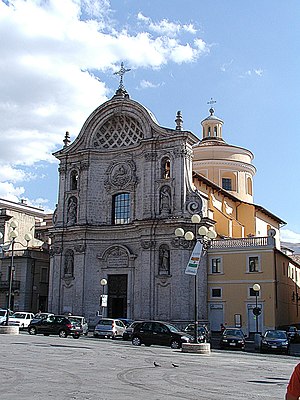 Church of Santa Maria del Suffraggio, L'Aquila | |
| A country |  Italy Italy |
| City | L'Aquila |
| Denomination | Catholicism |
| Diocese | L'Aquila |
| Type of building | cross dome church |
| Architectural style | baroque , neoclassicism |
| Architect | |
| First mention | XVIII century |
| Established | April 9, 1715 |
| Building | 1715 - 1805 |
| Status | parish of the Archdiocese of L'Aquila |
| Site | |
The temple was built in the XVIII century . Together with the Cathedral of Saints George and Maxim , he shares the space of Cathedral Square (Piazza del Duomo) in L'Aquile. He was badly damaged during the 2009 earthquake . Restoration work is underway. Since 2010, partial access has been opened to the temple.
Content
History
The church was built as the seat of the brotherhood of the Blessed Virgin Mary of the Helper (Santa Maria del Suffraggio), or suffragists. Until the 17th century, the brotherhood gathered in a small oratorio of St. Joseph Minim, not far from Cathedral Square. During the earthquake of 1703, the oratorio suffered significant damage, so it was decided to build a new building in the Baroque style . [1] .
On September 30, 1708, the Archbishop of L'Aquila blessed the construction of a new church, on the site of the brotherhood’s temporary residence in a wooden building on Cathedral Square. Against this, clerics of the Cathedral of St. George and Maxim and the Church of St. Blasius from Amiterno spoke out, fearing that their churches, after the construction of a new church, would lose the status of cathedrals.
On October 10, 1713, the territory was prepared for the construction of the temple, the construction itself began on April 9, 1715, by a group led by the architect Carlo Buratti from Rome , a student of Carlo Fontana. The construction of the church was completed (without the current facade and dome ) in four years, and in December 1719 the church was open to parishioners.
In the second half of the XVIII century , work was carried out on the internal improvement of the temple. In 1753, an altar by Orazio Antonio Bucci and Giovanni Pirri was installed in the chapel to the left of the main altar . In 1755, pilasters and chapel walls were covered with facing stone. The facade is concave, reminiscent of the facades of the churches of St. Marcellus and St. Mary Magdalene in Rome. Built between 1770 and 1775 by Orazio Antonio Bucci, designed by Gianfrancesco Leomporri [1] . The decoration of the facade, including the statues of St. George and St. Sixtus , located in the upper niches, dates back to 1772-1775 and belongs to Filippo Zugi. [1] ;
In 1805, the construction of a dome in the neoclassical style by Giuseppe Valadier, according to the original plan of Carlo Buratti, completed the construction of the church. In 1896, the facade was decorated with two statues, St. Anthony of Padua and St. Nicholas of Tolentino in small lower niches. [one]
The temple suffered significant damage during the earthquake on April 6, 2009 : the facade and the bearing wall were destroyed, the dome collapsed, the floor and the main altar were damaged. [2] The restoration of the church began immediately after the earthquake. March 19, 2010 was opened to visitors part of the temple. [2]
Description
The church is located on the south side of Cathedral Square, opposite Patini Street (Via Patini), which leads to Palace Square (Piazza del Palazzo) and a short walk from the Cathedral of Saints Maxim and George.
The project of the baroque facade was developed in 1769 by Gianfranchesko Leomporri and was built over the next five years by the sculptor Orazio Antonio Bucci. A small staircase leads to the temple, which together with a concave central niche forms a porch .
The high facade is divided horizontally into two levels, the last of which ends with a spherical concave caisson roof. In the middle of the castle stone is a record from 1755, when the facade was completed. Two double orders with Corinthian pilasters vertically divide the facade into three areas. In the middle of the central portal of the work of Filippo Zugi, a pediment with a skeleton inserted in it symbolizing death, and the following inscription: IUVETUR MORTUUS NON LACRYMIS, SED PRECIBUS, SUPPLICATIONIBUS, ET ELEMOSYNIS. S.CHRYS. ( Russian. Tears will not help the dead, but prayer, petition and alms ).
Above the portal , in the second level, there is a rectangular window, above which there is a round stone medallion with the image of the Blessed Virgin Mary Helper. There are four niches in the side compartments with statues of St. George and St. Sixtus (1772-1775) in the upper part and St. Anthony of Padua and St. Nicholas of Tolentino (1896) in the lower part. Above the double group of statues are two windows with a bell in each.
In terms of the temple is a Latin cross, has one nave , ending with a rectangular apse . The central space of the transept is decorated with a dome. The nave is divided into three parts by pilasters. There are two side chapels on both sides: the first on the left in honor of the Holy Spirit, in which is the painting "St. Anthony of Padua" by Teofilo Patini.
In the chapels located in the wings of the transept, there are two marble altars of 1701 by Francesco Ferradini and Perseus Petrilli. The main altar is the work of Francesco Bedeschini.
The temple had an old organ , built by Pachifiko Inzolli in 1897 , framed by richly decorated carvings. The organ was restored between 2002 and 2005, after the earthquake of 2009, in order to avoid damage, it was removed from the choirs above the entrance, where it was, and moved to another place, waiting for the completion of the reconstruction to take its former place in the church.
Notes
- ↑ 1 2 3 4 Regione Abruzzo. Chiesa di Santa Maria del Suffragio. Archived July 22, 2011.
- ↑ 1 2 Protezione Civile. All'Aquila riapre la Chiesa delle Anime Sante (link not available)
Sources
Literature
- Orlando Antonini, Architettura religiosa aquilana , Todi (Pg), Tau Editrice, 2010.
- Alessandro Clementi, Elio Piroddi, L'Aquila , Bari, Editori Laterza, 1986.
- Touring Club Italiano, L'Italia - Abruzzo e Molise , Milano, Touring Editore, 2005.