Troy ( Greek Τροία, Τροίη ), or Ilion ( Greek Ἴλιον ) is an ancient fortified city in Asia Minor on the Troas peninsula off the coast of the Aegean Sea , on the shores of the lagoon at the entrance to the Dardanelles .
| Ancient city | |
| Troy | |
|---|---|
| Greek Τροία, Τροίη; Ἴλιον Hitt . Wilusa ( URU Wi-lu-ša ) | |
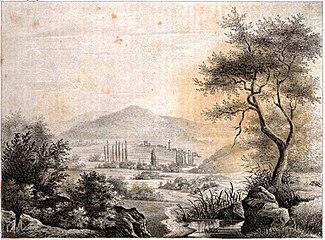 the ruins of Troy; 1835 drawing | |
| Based | OK. 3000 BC e. |
| Names of residents | trojans |
| Modern location | Turkey , the village of Tevfikiye |
The Trojan War is sung in the poem The Iliad, whose author is Homer . The events described by Homer, in the current view of historians, belong to the Crete-Mycenaean era . The people who inhabited Troy, in ancient Greek sources, are called tevkras [1] .
Troy ruins discovered in the late 1860s. Heinrich Schliemann during excavations of the Gissarlyk hill (7 km from the modern coast), since 1998, inscribed on the UNESCO World Heritage List . Gissarlyk is located in the modern Turkish province of Canakkale .
Presumably it is Ilion that is referred to in the Hittite sources of Vilus ( Hitt . URU Wi-lu-ša ). The nearest settlements to Three in ancient times were called Dardania and Scamander .
Content
Title
The name Ilion dates back to the founder of the city, Ilus , the son of Tros . In turn, Tros called the country in his own name "Troy."
The name “Troy” appears in the Hittite cuneiform tablets of the Bogazkoy archive as Taruish. On the Egyptian stele of the times of Ramses III , his victory over the sea people “Tursha” is mentioned. This name is often compared with the Teresh people, mentioned earlier in the famous Merneptah stele. Unanimity of opinion about whether these aliens were Trojans is not observed in the scientific world. Names with this root are found in Mycenaean texts [2] , for example, the commander of the detachment to-ro-o [3] .
Before, it was suggested that the terms “Troy” and “Ilion” could mean different cities of the same ancient state, or one of these terms could mean the capital, and the other - the state itself, and “merged” into one term only in the “Iliad” "(According to Gindin and Tsymbursky, Troy is the designation of the country, and Ilion is the city [4] ). Such a point of view is not without foundation, because in the Iliad, in turn, fragments with parallel plots are highlighted, that is, possibly going back to different paraphrases of the same plot; In addition, the Iliad arose many centuries after the events of the Trojan War , when many details could be forgotten.
Excavations of Troy
Among modern historians Heinrich Schliemann , the hypothesis that Troy was located at the site of the village of Bunarbashi was widespread . The identity of Gissarlyk Hill with Homer's Troy was suggested in 1822 by Charles Maclaren . A supporter of his ideas was Frank Calvert , who began excavating in Hissarlık 7 years before Schliemann. Ironically, the section of Gissarlyk Hill that belonged to Calvert turned out to be aloof from Homer's Troy. Heinrich Schliemann, who was familiar with Calvert, began a focused study of the second half of the Gissarlyk hill at the end of the 19th century.
Most of Schliemann's finds after World War II were exported from Germany to the USSR (see captured art ). Priam's famous treasure has been considered lost for decades. Only in the 1990s. it turned out that the artifacts discovered by Schliemann are stored in the Pushkin Museum and in the State Hermitage . Subsequent archaeologists discovered in Gissarlyk the traces of nine fortresses-settlements that existed in different eras.
The first of the settlements found in Gissarlyk (the so-called Troy I) was a fortress with a diameter of less than 100 m and, obviously, existed for a long period. The seventh layer belongs to the era described in the Iliad. During this period, Troy is an extensive (with an area of over 200 thousand m²) settlement, surrounded by strong walls with nine-meter towers.
After Schliemann, excavations in Gissarlyk were carried out by Wilhelm Dörpfeld , Karl Blegen and Manfred Korfman , who discovered the remains of the lower city around the hill. Large excavations in 1988 showed that the population of the city in the Homeric era was from six to ten thousand inhabitants - at that time, a very impressive number. According to the Korfman expedition, the area of the lower city was approximately 170 thousand m² , the citadel - 23 thousand m² [5] (which is 15 times more than the figures cited by Korfman’s predecessors).
To attract tourists in the 1970s. a full-sized model of the Trojan horse was erected on the territory of the archaeological zone. For a fee, those who wish can climb inside.
The Nine Basic Layers of Ancient Troy
Ancient Ilion stood on the shore of a shallow lagoon and controlled the crossing between Europe and Asia in one of the most convenient places for this, as well as the entrance to the Marmara and Black Seas . When the lagoon was covered with silt, this role passed to the northern city of Byzantium (aka Constantinople ). Gissarlyk Hill, located 5 km from the modern coast, contains the remains of at least nine successive settlements [6] :
- Kumtepe or Troy 0 is a Neolithic settlement that existed in the vicinity of Troy.
- Troy I (3000-2600 BC): The first Trojan settlement, 100 m in diameter, was built up with very primitive clay brick dwellings. Judging by the remaining traces, it died in a fire. Pottery is similar to the ceramics of the Jesero culture in Bulgaria [7] . D. Anthony connects him with the first wave of Indo-European settlement of Anatolia (ancestors of the Hittites, Luvians, etc.).
- Troy II (2600–2300 BC): The next settlement was extremely developed and rich for its time. It was protected by powerful walls (limestone below, adobe above) 5 m high and 4 m wide, as well as a wooden fence [8] . In 1873, the German archaeologist Schliemann discovered the famous Trojan treasure in this layer, which consisted of numerous weapons, copper trinkets, parts of precious jewelry, gold vessels, gravestones of the prehistoric and early historical period . In the III millennium BC. e. this highly developed culture was also destroyed by fire.
- Troy III — IV — V (2300-1900 BC): These layers indicate a period of decline in the history of the ancient city.
- Troy VI (1900–1300 BC): The upper city increased in diameter to 200 meters, the lower to 400 meters; the height of the walls reached 10 meters [8] . The lower city was surrounded by a moat 4 meters wide and 2 meters deep. Traces of a water supply system were discovered. The settlement was the victim of a strong earthquake in 1300 BC. e.
- Troy VII-A (1300–1200 BC): The famous Trojan War may belong to this period. The war put an end to the settlement: unburied corpses, throwing shells of slingers , and tips of Aegean arrows were found on the streets of the lower city.
- Troy VII-B (1200-900 BC): The dilapidated Troy was captured by the Phrygians .
- Troy VIII (900-350 BC): At that time, the city was inhabited by Alean Greeks. Numerous sights reminiscent of the heroes of the Trojan War attracted travelers to Troy. Among them is King Xerxes , who sacrificed more than 1,000 cattle here.
- Troy IX (350 BC - 400 AD): A fairly large center of the Hellenistic era. The Romans, who considered themselves descendants of the Trojans, spared no means to maintain the shrines of the city in exemplary condition.
| Reconstruction of the citadel | Excavation plan | Hissarlik in the context |
Language and Writing
The question of the language of Hector and Priam has occupied scientists from antiquity. At the same time, written monuments were not found for a long time in the layers of Gissarlyk belonging to the Bronze Age. From Hittite sources it is known that in Vilus, wooden rather than clay tablets were used for writing [8] . Such letter carriers do not differ in durability and inevitably die in case of fires.
In the mid-1980s NN Kazansky published several fragments of clay vessels from Troy with obscure signs resembling the Cretan letter : he called these signs a Trojan letter . According to most experts, this is not an inscription, but only an imitation of writing.
In 1995, a seal with Luvian hieroglyphs was discovered in the layers of Troy VII [9] . In combination with the latest evidence that the names of Priam and other Trojan heroes are most likely of Luvian origin, the notion that the ancient Trojans spoke the Luvian dialect is more and more rooted in the scientific world. In a monograph published in 2004 by Oxford University, concludes that the Luwian language was the official language of Homer's Troy. The question of the everyday language of the Trojans remains open.
Despite this, Troy was under strong Hellenic influence, many noble Trojans simultaneously bore the local and Greek names (for example, Paris bore the name Alexander at the same time). The fact that the Greek names of the Trojans are not the invention of Homer is confirmed by the Hittite inscriptions mentioning Alaksanda (i.e.Alexander) and other rulers of Taruisa (Vilusa).
See also
- Trojan war
- Trojan horse
- Priam's treasure
- Troas in ancient Greek mythology
Notes
- ↑ The peoples of TKR and TRS, supposedly identified with the Tevras (a synonym for the Trojans) and the Trojans (or the Thyrsens ?), Are mentioned in the inscriptions of the Ramses II era among the “ peoples of the sea ”.
- ↑ Gindin L.A. , Tsymbursky V.L. Homer and the history of the Eastern Mediterranean. M., 1996. P.208
- ↑ Subject-conceptual dictionary of the Greek language. Mycenaean period. L., 1986. P.134
- ↑ Gindin L.A., Tsymbursky V.L. Homer and the history of the Eastern Mediterranean. M., 1996. S.100-103
- ↑ Latacz J. Troy and Homer. Oxford UP. 2004. P.26
- ↑ Troy (Site)
- ↑ Ryndina N.V., Degtyareva A.D. Eneolithic and the Bronze Age. M. 2002.S. 46.
- ↑ 1 2 3 YouTube
- ↑ Latacz J. Troy and Homer. Oxford UP. 2004. P.69
Literature
- Ivic O. Troy. Five thousand years of reality and myth. - M., 2017.
- Gindin L.A. Population of Homer Troy. - M., 1993.
- Gindin L.A., Tsymbursky V.L. Homer and the history of the Eastern Mediterranean. - M., 1996.
- Blegen K. Troy and the Trojans. - M., 2002.
- Schliemann G. Ilion. City and country of Trojans. - M., 2009, t. I-II.
- Schliemann G. Troy. - M., 2010.
- Treasures of Troy. From the excavation of Heinrich Schliemann. - M., 2007.
- The History of the Ancient East, Part 2. - M., 1988.
- Virkhov R. Ruins of Troy // Historical Bulletin, 1880. - T. 1. - No. 2. - P. 415-430.
- Stone Irving , Greek treasure. Biographical novel about Henry and Sophia Schliemann. 1975
Links
- Troy in the Annales Library.
- Illustrated Archaeological History of Troy (in English)