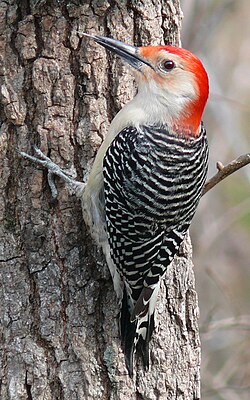
Caroline melanerpes [1] ( lat. Melanerpes carolinus ) is a small bird of the woodpecker order. It has a characteristic color of plumage - gray-white breast, red top of the head, dark back and wings with multiple bright stripes of different lengths. It feeds like other woodpecker insects.
| Caroline melanerpes |
|---|
 |
|
| No rank : | Bilateral symmetrical |
| Subfamily : | Real woodpeckers |
| Gender: | Melanerpes woodpeckers |
|
|
Melanerpes carolinus Linnaeus , 1758 |
|
Least ConcernedIUCN 3.1 Least Concern : 22680856 |
|
Caroline melanerpes reaches 24 cm in length, with an average weight of 75 g; males are usually 10% heavier than females.
Adult, visible reddish bottom of abdomen
Carolina melanerpes is a monogamous bird within one breeding season. The male tries to attract the attention of the female with a knock near the chosen place for arranging the hollow. If the female agrees with the chosen place, then she lowers at the entrance to the hollow and informs the male about her consent with a knock. The hollow is set up in the dead stump of an old tree or at the bottom of a thick dying branch, and any old abandoned wooden structures can also be used under the hollow. If the hollow is hollowed out in a still growing tree, then the types of tree with very soft wood, such as willow or poplar, are always chosen. Often, Caroline melanerpes hollows out a new hollow in a new tree, although there are cases of using the old tree to hollow a hollow repeatedly. In such cases, the new hollow is hollowed out below the old. Both partners are involved in the construction of the hollow, however, the male performs the main work. Depending on the density of the wood, a new hollow can be equipped within two weeks. The entrance is usually 5 cm in diameter. The earliest time for the first brood to appear is April, if for some reason the brood was lost, the female lays another egg laying, in exceptional cases, three clutch can be laid until the end of August. The eggs in the clutch are white, oblong-oval, slightly shiny, 25 x 19 mm in size, usually 4-5 eggs in the clutch. Chicks hatch both parents for 12-14 days, in the daytime a female sits on a clutch, at night a male. Chicks are fed for 26 days. After leaving the nest, the chicks for some time follow the parents in two groups separately.