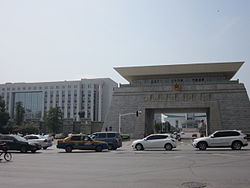
Defense Science and Technology University People's Liberation Army of China ( Chin. Ex. 中国人民解放军国防科学技术大学, pinyin : Zhōnggúo Rénmín Jiěfàngjūn Guófáng Kēxuéjìshù Dàxué, Pall. : Zhongguo Renmin Jiefangjun Guofang kesyuetszishu dasyue, reduction -国防科学技术大学,国防科技 大学 or 国防科大) is a military university in Changsha , Hunan Province , PRC. It is one of the key national universities. It is under the leadership of two ministries at once: national defense (the university reports directly to the Central Military Council of the PRC ) and the Ministry of Education . Participates in project 211 and project 985 - national plans for the development of higher education in China.
| Defense Science and Technology University of the People’s Liberation Army of China ( 国防 科学 技术 大学 ) | |
|---|---|
| 中国人民解放军 国防 科学 技术 大学 | |
 | |
| International title | National University of Defense Technology (NUDT) |
| Former names | Military Engineering Institute PLA Harbin Institute of Engineering Changsha Workers Institute |
| Year of foundation | 1953 |
| The president | Zhang Yulin (2008-) |
| Students | 17 thousand |
| Specialty | 11 thousand |
| Graduate School | 2 thousand |
| Professors | ~ 300 |
| Teachers | 2 thousand |
| Location | Changsha |
| Site | nudt.edu.cn |
Content
History
Founded in 1953 under the name of the Military Engineering Institute PLA in Harbin , Heilongjiang Province. In 1966 he was renamed the Harbin Engineering Institute and removed from the subordination of the Ministry of Defense. In 1970, the university management and 4 faculties moved to Changsha and were renamed the Changsha Workers' Institute . The remaining 4-5 faculties were relegated to regional or to other national universities. In 1978, the university returned to the jurisdiction of the Ministry of Defense, and received its current name.
The PLA Defense Science and Technology University is China’s leading institute in the development of supercomputers and in China’s Space Program .
University supercomputers
Yinhe-I (YH-I)
Developed in 1983, Yinhe-1 was China’s most powerful supercomputer and had a performance of 100 Mega FLOPS .
Yinhe-II (YH-II)
Yinhe-II was created in 1992 and achieved a performance of 1 GFLOPS.
Yinhe-III
By 1996, Yinhe-II was updated and renamed Yinhe-III. Performance was 13 GFLOPS. [1] [2]
Tianhe-i
Tianhe-I was first introduced to the public on October 29, 2009. It became the fifth among the fastest supercomputers in the world (according to the TOP500 rating, announced in November 2009 at the SC09 conference in Portland).
Tianhe-IA
By October 2010, Tianhe-I was upgraded to Tianhe-1A and reached a performance of 2.57 petaflop / s [3] . Information about the update was presented at the HPC 2010 conference (China). The computer ranked first in the TOP500 rating of November 2010. [4] [5] [6]
In November 2011, Tianhe-1A became the second among the fastest supercomputers, giving up its title to K computer (Japan).
Tianhe-2
In June 2013, the Tianhe-2 supercomputer with a capacity of 33.86 Pflops (24 MW) was introduced. He took the first line in the ranking of TOP500 supercomputers in the world according to Linpack.
Location
The university is located in Changsha , Hunan Province . It covers an area of about 373 hectares.
Staff and students
At the end of the 2000s - the beginning of the 2010s, about 2 thousand teachers work at the university, of which about three hundred are professors. More than 17 thousand students study, including about 2 thousand graduate students.
See also
- TOP500
- HPC Challenge Benchmark
- Project 211
- Program 863
- YinHeFeiTeng
Notes
- ↑ China's Indigenous Supercomputer Development , nti.org (January 1996). Archived June 4, 2011.
- PeMichael Pecht, China's Electronics Industry Report : China's Supercomputers, page 66
- ↑ New York Times (October 28, 2010). China Wrests Supercomputer Title From US . Press release .
- ↑ TOP500 (11 November 2010). China Grabs Supercomputing Leadership Spot in Latest Ranking of the World's Top 500 Supercomputers . Press release .
- ↑ Peopledaily.com.cn (17 November 2010). Chinese supercomputer ranked world's fastest by TOP500 . Press release .
- ↑ National University of Defense Technologies of China has created the most powerful supercomputer in the world // Military Parity, 01/31/2012