Relaxation time - the period of time during which the amplitude value of the perturbation in the unbalanced physical system decreases by e times ( e is the base of the natural logarithm ), mainly indicated by the Greek letter τ .
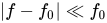
According to the Le Chatelier-Brown principle , when a physical system deviates from a state of stable equilibrium, forces arise that try to return the system to an equilibrium state. If in equilibrium some physical quantity f has a value Moreover, the deviation from equilibrium , then, as a first approximation, we can assume that these forces are proportional to the deviation. The kinetic equation for f is written as

- ,
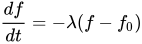
where λ is a parameter, and a minus sign indicates that the reaction of the system to a disturbance leads to a return to an equilibrium state.
Relaxation time

In this case, the value of f will change according to the law:
- ,

Where - initial disturbance.

Usage
The relaxation time approximation is widely used in the description of kinetic processes in physics when it comes to the kinetics of establishing an equilibrium state. The transition from a nonequilibrium state to equilibrium is accompanied by energy dissipation and is an irreversible process. The establishment of equilibrium often takes place in several stages, which are characterized by their individual relaxation times. Thus, upon excitation of molecules by light, the establishment of thermal equilibrium occurs in a time of the order 
In the description of many physical processes, the relaxation time is taken as a phenomenological parameter, but in some cases it can be determined through the parameters of microscopic processes, such as the probability of a quantum-mechanical transition or scattering cross section .
See also
- Time constant
- Lifetime
Literature
- Relaxation time // Physical Encyclopedia : [in 5 volumes] / Ch. ed. A.M. Prokhorov . - M .: Soviet Encyclopedia, 1988. - T. 1: Aaronova - Bohm effect - Long lines. - 707 p. - 100,000 copies.
- D.N. Zubarev. Relaxation // Physical Encyclopedia : [in 5 volumes] / Ch. ed. A.M. Prokhorov . - M .: Big Russian Encyclopedia, 1992. - T. 3: Magnetoplasma - Poynting's theorem. - 672 p. - 48,000 copies. - ISBN 5-85270-019-3 .