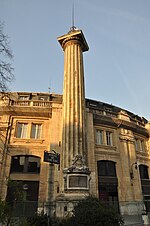
The Medici Column ( fr. Colonne Médicis ) - architectural and historical monument in the center of Paris , in the region of Le Al ; all that remains of the estate of Queen Catherine de Medici standing here; astronomical observatory, which she erected for astrologer Ruggieri who came with her from Florence . Since 1862 it is protected by the French state as a historical monument .
| Column | |
| Colon de Medici | |
|---|---|
| Colonne medicis | |
 | |
| A country | |
| Location | |
| Architect | |
After the death of Catherine, her palace was sold in 1601 to Catherine of Bourbon , sister of Henry IV , then Karl of Soissons . The palace, since Soissons , was sold to the bankrupt heirs of Charles and destroyed in 1748 ; Louis Petit de Bachaumont was able to redeem only the column.
When built in 1763-1767. City Bread Rows (in 1889, their round building was rebuilt into the City Commercial Exchange ), the column was placed in the wall, and it lost its appearance.
Architecture
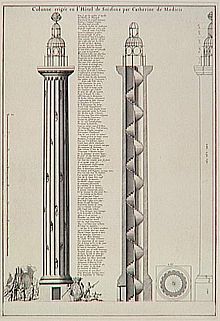
The height of 31 m, is made in the form of a Doric column. Inside there is a staircase of 147 steps leading to the globe, which served as an observatory, where Catherine de Medici retired with her astronomers and where the direct entrance was made from the queen's apartments.
When building the Bread Rows at the foot of the column, a fountain was arranged ( Fr. Fontaine de la Halle aux Blés ), and a meridian was drawn at the very pole: at any time of the year it correctly showed the hour of the day. The invention belonged to Father Pinaré (Pinaré), canon of the abbey of St.. Genevieve .
The dome after the restoration of the XIX century was iron ; now absent.
See also
- Soissons Palace
- Cosimo rugieri
Notes
- ↑ 1 2 base Mérimée - ministère de la Culture , 1978.
Literature
- Nikolay Sergeevich Vsevolozhsky (1772-1857) - Journey through southern Russia, the Crimea and Odessa to Constantinople, Asia Minor, northern Africa, Malta, Sicily, Italy, southern France and Paris in 1836-1837. Volume 2