Wenceslas III Adam Teschinsky ( Polish Wacław III Adam cieszyński ) Wenceslas III Adam Tseschinsky ( December 1524 - November 4, 1579 ) - Prince Tseschinsky (1528-1579), the youngest (second) son of Prince Wenceslas II Teschinsky and Anna Brandenburg. Representative of the Cieszyn line of the Silesian Piasts .
| Vaclav III Adam Tseshinsky | |||||||
|---|---|---|---|---|---|---|---|
| Wacław III Adam cieszyński | |||||||
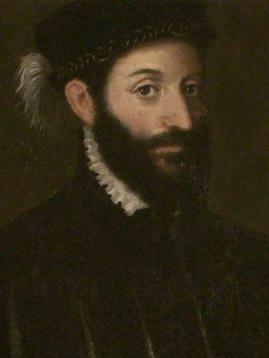 Vaclav III Adam Tseshinsky | |||||||
 | |||||||
| Predecessor | Casimir II Cieszinski | ||||||
| Successor | Adam Vaclav Cieszinsky | ||||||
| Birth | December 1524 Teshin principality | ||||||
| Death | November 4, 1579 Teshin principality | ||||||
| Burial place | Cieszyn | ||||||
| Kind | Silesian Piasts | ||||||
| Father | Vaclav II Cieszinski | ||||||
| Mother | Anna Brandenburg | ||||||
| Spouse | Maria from Pernstein Catherine Sidonia Saxe-Lauenbug | ||||||
| Children | from first marriage : Friedrich Casimir Maria Sidonia Anna Sibylla Adam Wenceslas  Jan Albrecht | ||||||
| Religion | Catholicism , then Lutheranism | ||||||
| Autograph | |||||||
Content
- 1 Biography
- 2 family
- 3 Sources
- 4 References
Biography
Vaclav Adam was born in December 1524 , a month after the death of his father, Prince Vaclav II Cieszinski . Initially, from 1524 to 1528, he was under the care of his grandfather, Prince Casimir II Tseshinsky .
In December 1528, after the death of his grandfather, Prince Teshinsky Casimir II , four-year-old Vaclav III Adam was declared the new prince Tseshinsky . In 1528-1539 , the regency principality was his mother Anna Brandenburg (1487-1539), and then the Czech tycoon Jan of Pershine (1487-1548), the Zemsky hetman of Moravia. During the regency, the young prince spent a lot of time at the imperial court in Vienna , where he was educated. Vaclav Adam Tseshinsky renounced Catholicism and accepted the Lutheran faith , which he adhered to for the rest of his life.
At the time of the death of his mother, Anna Hohenzollern, in February 1539, Vaclav III Adam was already 15 years old, which, according to the then traditions, was of his majority. Despite this, the Cieszyn principality continued to be ruled by a second regent, the Czech tycoon and count Kladsky Jan from Pernstein . Only on May 9, 1545, he renounced power in the principality in favor of Vaclav Adam. Thus, in May 1545, the 20-year-old Prince Vaclav III Adam began to rule independently in his principality, transferring the Czech cities of Frýdek-Místek and Friedlán nad Ostravicí to the former regent Jan from Pernstein .
In 1548, the Czech tycoon Jan IV of Pernstein , the former guardian of Vaclav Adam and the regent of the Cieszyn Principality , died. After the death of his father-in-law, Prince Vaclav Adam Tseshinsky bought the Czech cities of Fridek-Mistek and Friedlant nad Ostravice from his sons Yaroslav, Vratislav and Wojciech. But this acquisition was short-lived, since soon Prince Wenceslas Adam pledged these cities to Jan from Czechowice.
One of the most important events during the reign of Prince Wenceslas III Adam Tseshinsky was the Reformation , which from 1525 began to penetrate the territory of his principality. Even at the beginning of his independent reign, the prince announced claims to the estates of Dominicans and Franciscans. In 1560, Vaclav Adam Tseshinsky expelled the Benedictines from Orlov . Roman Catholic churches and monasteries were turned into Lutheran churches or destroyed. The majority of the nobility and population of the principality, without resistance, adopted a new faith.
The new situation was also adopted by the sovereigns of the princes of Silesia: the Habsburgs . Vaclav III transferred part of the property confiscated from Catholic orders in favor of the city hospital in Cieszyn , where the poor were also treated. Interestingly, the prince himself in his youth studied medicine, he himself was engaged in caring for patients, which acquired special significance during the plague epidemic in 1570 .
On June 24, 1573, Prince Wenceslas III Adam Tseszynski issued the so-called land law of the Principality of Cieszinski (Zřízení zemské Knížecství Těšínského), which represented a set of legal rules for all residents of the principality. Initially, this law was adopted with great care, but then it was adopted by all subjects. In addition to this land law, Prince Vaclav Adam in 1568 issued the so-called church order (Řád církevní), which regulated the liturgical life of the Lutheran church.
In his foreign policy, Silesian Prince Wenceslas III Adam Teszinsky was guided by the Austrian house of the Habsburgs . In 1563, Presburg was present at the erection of the Hungarian royal throne of Maximilian II . In 1565, Vaclav Adam Teshinsky was in Vienna , where he was present at the burial of the German Emperor Ferdinand I.
In connection with the increasing Turkish threat in 1573, Prince Vaclav Adam Tseshinsky ordered the construction of several defensive ramparts in the vicinity of Yablonkov.
During his lifetime, Prince Wenceslas III Adam Teshinsky appointed his elder son Friedrich Casimir as his co-ruler, transferring the cities of Frishtat and Skoczow to him in 1560, and Bielsko-Biala in 1565 . However, Friedrich Casimir Teshinsky died during the life of his father in 1571 . Vaclav III Adam was forced to sell many territories from his principality, in particular the cities of Bielsko-Biala , Frydek-Mistek and Frishtat.
In 1573, Vaclav III Adam unsuccessfully put forward his candidacy for the Polish royal throne after the suppression of the Jagiellonian dynasty .
On November 4, 1579, Prince Wenceslas III Adam died of apoplexy after a long and debilitating illness. He was buried in a former Dominican church in Cieszyn .
The successor of Wenceslas III Adam was the eldest of the living sons of the Duke from his second marriage, the five-year-old Adam Wenceslas .
Family
On February 10, 1540, Prince Wenceslas III Adam Cieszinski first married Mary of Pernstein (February 24, 1524–19 November 1566), the daughter of his guardian, Czech tycoon Jan of Pernstein (1487-1548). This marriage was decided by Prince Casimir II . The engagement took place on September 8, 1528, three months after the death of Casimir II . Vaclav Adam received 12,000 Hungarian zlotys from his father-in-law Jan of Pernstein as a dowry. Children from their first marriage:
- Sofia (1540-1541)
- Frederick Casimir (1541/1542 - 1571), Prince of Silesia-Cieszyn;
- Anna (1543-1564);
On November 25, 1567, in Cieszyn, Prince Vaclav Adam remarried to Catherine Sidonia of Saxe-Lauenburg (c. 1550-1594 ), the youngest daughter of Franz I , Duke of Saxe-Lauenbugsky (1510-1581) and Sibylla of Saxony (1515-1592). Children from the second marriage:
- Daughter (d. 1569);
- Christian Augustus (1570-1571);
- Maria Sidonia (1572-1587), wife from 1587 of Frederick IV (1552-1596), prince of Silesian-Legnica;
- Anna Sibylla (1573 - after 1601);
- Adam Wenceslas (1574-1617), Prince of Silesia-Cieszyn;
- Jan Albrecht (1578 - until 1579).
Sources
- Landwehr v. Pragenau M., Geschichte der Stadt Teschen, Würzburg 1976, s. 5-6, 19, 25, 27, 29-30, 33, 35, 40, 43, 45, 50, 126.
- Rudolf Žáček: Dějiny Slezska v datech. Nakladatelství Libri, Praha 2004, ISBN 80-7277-172-8 , S. 133, 139 f., 145, 410, 450 f.
- Idzi Panic: Poczet Piastów i Piastówien cieszyńskich. Biuro Promocji i Informacji, Cieszyn 2002, ISBN 83-917095-4-X .