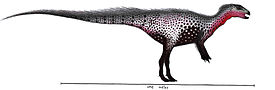
Gideonmantellia amosanjuanae (lat.) Is a species of herbivorous poultry- dinosaur dinosaurs belonging to the Euornithopoda group and living at the beginning of the Cretaceous in modern Spain .
| † Gideonmantellia amosanjuanae |
 |
| Scientific classification |
|---|
| No rank : | Bilateral symmetrical |
| Infraclass : | Archosauromorphs |
| No rank : | Archosauriformes |
| Infrastructure : | † Ornithopods |
| Gender: | † Gideonmantellia Ruiz-Omeñaca et al. , 2012 |
| View: | † Gideonmantellia amosanjuanae |
|
| International scientific name |
|---|
Gideonmantellia amosanjuanae
Ruiz-Omeñaca et al. , 2012 |
Geochronology
Barrem century129.4-125.0 Ma | million years | Period | Era | Aeon |
|---|
| 2,588 | Even | | | Ka | F
but
n
e
R
about
s
about
th | | 23.03 | Neogene | | 66.0 | Paleogen | | 145.5 | a piece of chalk | M
e
s
about
s
about
th | | 199.6 | Yura | | 251 | Triassic | | 299 | Permian | P
but
l
e
about
s
about
th | | 359.2 | Carbon | | 416 | Devonian | | 443.7 | Silur | | 488.3 | Ordovician | | 542 | Cambrian | | 4570 | Precambrian |
◄ Nowadays◄ Cretaceous-Paleogene extinction◄ Triassic extinction◄ Mass Permian Extinction◄ Devonian extinction◄ Ordovician-Silurian extinction◄ Cambrian explosion |
|---|
|
The type species Gideonmantellia amosanjuanae was described in 2012 by a group of scientists led by Ignacio Ruiz-Omeniaki. The name of the genus is given in honor of Gideon Mantell . The designation of the species is given in honor of the paleontologist Maria Olga Amo Sanjuán, who also previously conducted research on the remains of this species.
Fossils, the holotype MPG-PBCH, were found in the Camarillas River Formation, which dates back to the beginning of the Barrem (about 130 million years ago). They consist of a partial skeleton without a skull with elements of the spine, pelvis and two hind limbs. These remains belong to an immature animal, as evidenced by the incomplete fusion of part of the vertebra. The sample represents the most complete skeleton of a poultry-dinosaur dinosaur ever found in Spain.
Gideonmantellia amosanjuanae was a small animal, less than a meter in length. The femur 95 mm long indicates that the animal was similar to the size of gypsilophodone , whose height was about 90 cm. Scientists estimate the length of an adult about 2 meters, and weight - 20 kilograms.
In 2001, this species was placed in the family Hypsilophodontidae , but later this family was recognized as an unnatural paraphyletic group. In 2012, the species was assigned to basal euornithopods (Euornithopoda). An accurate cladistic analysis conducted in 2012 showed that the position of the genus Gideonmantellia in the pedigree is higher than that of the genus Hypsilophodon [1] .
| Euornithopoda |
| Orrodromeus makelai |
|
|
|
| Haya griva |
|
|
| Changchunsaurus parvus |
|
| Jeholosaurus shangyuanensis |
|
|
|
|
|
|
| Hypsilophodon foxii |
|
|
| Gideonmantellia amosanjuanae |
|
| Thescelosaurus neglectus |
|
|
| Gasparinisaura cincosaltensis |
|
| Parksosaurus warreni |
|
|
| | Iguanodontia |
| Anabisetia saldiviai |
|
| Talenkauen santacrucensis |
|
|
| Rhabdodontidae |
|
|
|
| Tenontosaurus tilletti |
|
| Tenontosaurus dossi |
|
|
|
|
| Dryosauridae |
|
| Ankylopollexia |
|
|
|
|
|
|
|
|
|
|
|
|
|
|
|
|
|
