The black-bellied disco-speaking frog [2] , or the Israeli decorated frog [3] ( lat. Latonia nigriventer [4] , formerly Discoglossus nigriventer [2] [3] ) is a species from the genus Latonia . It was considered extinct since 1943 and was again discovered in 2011 [5] .
| Black-bellied Disco-Frog |
|
| Scientific classification |
|---|
| No rank : | Bilateral symmetrical |
| Squad: | Tailless Amphibians |
| Suborder : | Archaeobatrachia |
| View: | Black-bellied Disco-Frog |
|
| International scientific name |
|---|
Latonia nigriventer
Mendelssohn & Steinitz , 1943 [1] |
| Area |
|---|

|
| Security status |
|---|
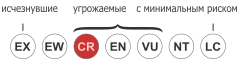
Endangered SpeciesIUCN 3.1 Critically Endangered : 6715 |
|
It was known for several individuals caught in 1940 on the eastern shore of Lake Hula in northern Israel . After 1943, it was no longer detected and was considered to have disappeared due to the drainage of the swamps surrounding the lake. It was assumed that this species existed in swamps in neighboring Syria .
In 2011, a male black-bellied disc-speaking frog was caught by an inspector of the National Reserve in Hula ( Galilee ); two years later, as a result of targeted searches, a female specimen was caught.
Content
This frog was originally assigned to the genus Discoglossus , however, the study of the genetic and morphological features of the species after its discovery in 2011 led to the identification of the genus Latonia [4] , other representatives of which died out at least 15,000 years ago [6] [7] . Based on the molecular clock method, it was estimated that the last common ancestor of the genus Latonia and its sister Discoglossus lived about 32 million years ago [4] . In this regard, Latonia nigriventer is recognized as a living fossil [8] .
Currently (the beginning of 2018), the number of frogs is estimated at two hundred individuals, some of which are kept in captivity, some in the natural reservoirs of the Hula Valley and the Golan Heights; There is also an unconfirmed assumption about the possible existence of individuals in southern Lebanon. However, this is not enough for the species to cease to be considered critically vulnerable. The IUCN International Union for Conservation of Nature and Natural Resources and its Israeli branch continue to classify the black-bellied disco-speaking frog as a species "on the verge of extinction."