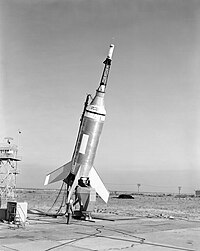
Mercury-Little Joe-1 (LJ-1) - failed launch on August 21, 1959 of the Little Joe-1 launch vehicle as part of the Mercury program from the LA-1 launch pad on Wallops Island in Virginia . It was an attempt at a suborbital flight by NASA .
| Little Joe 1 | |
|---|---|
 | |
| General information | |
| Organization | |
| Ship flight data | |
| Ship name | Mercury Little Joe-1 (LJ-1) |
| Launch vehicle | Little Joe 1 |
| Launch pad | about. Wallops, Virginia, start. area LA-1 |
| Launch | August 21, 1959 00:00:00 UTC |
| Entry into orbit | Suborbital |
| Ship landing | August 21, 1959 00:00:00 UTC |
| Flight duration | 20 sec |
| Apogee | 0.610 km |
| Weight | kg |
| Crew flight data | |
| Associated Expeditions | |
Content
- 1 start
- 2 Accident Act
- 3 notes
- 4 See also
Start

Little Joe-1 was the failed launch of a small solid - fuel rocket Little Joe-1 , which was developed to test the emergency rescue system (CAC) of the ship and the landing scheme of the manned spacecraft "Mercury". The rocket was 15 meters high and 2 meters in diameter, weighed about 20 tons, and ended with a superstructure of 6.5 m (the ship itself and the SAS tower). The Little Joe booster rocket consisted of four solid-fuel rockets packaged under one fairing and four stabilizers . It could develop a thrust of 1100 kN and raise the maximum payload of 1788 kg (of which 460 kg were weighed by CAC - a truss tower and engines).
On August 21, 1959, Little Joe-1 was getting ready for launch. Suddenly, half an hour before the scheduled launch, the SAS engines worked and removed the Mercury spacecraft from the launch pad. The spacecraft reached a height of 610 meters and landed at a distance of approximately 800 meters. The flight time was 20 seconds [1] .
Accident Act
According to the accident act of September 18, 1959, the unexpected response of the emergency rescue system was caused by transients in the electrical circuit or sudden grounding. The analysis showed that CAC triggered due to engine failure, a signal should have arrived, it could have formed due to the destruction of the copper plate (busbar [2] ) of the battery, which could lead to a short circuit. Batteries in the USA were sent from England, uncharged and shorted. When charging the batteries before the start, when the power became sufficient, a short circuit occurred, strange commands passed, which brought into operation the standard program for the situation “main engine failure”. Sensors identified the height as "insufficient" and issued a command to explode pyro-bolts to shoot the capsule and started the CAC engine. Subsequently, the engines were automatically reset, and already insufficient power in the batteries prevented the team from shooting the tower and ejecting a parachute, a rapid drop occurred. The capsule and tower crashed into the sea [3] .
Notes
- ↑ Project Mercury unmanned Missions: LJ-1 Archived on May 27, 2012.
- ↑ en: Busbar
- ↑ http://ntrs.nasa.gov/archive/nasa/casi.ntrs.nasa.gov
See also
- Gemini