Sura ( Chuvash. Săr , Gornomar. Shur , Erz. Sura Lei ) [2] - a large river , the right tributary of the Volga . It flows through the Ulyanovsk , Penza and Nizhny Novgorod regions, Mordovia , Mari El and Chuvashia .
| Sura | |
|---|---|
 Surah in Alatyr region Surah in Alatyr region | |
| Characteristic | |
| Length | 841 km |
| Pool | 67 500 km² |
| Water consumption | 260 m³ / s (at the mouth) |
| Watercourse | |
| Source | |
| • Location | with. Sura Peaks |
| • Coordinates | |
| Mouth | Cheboksary reservoir |
| • Location | v. Vasilsursk |
| • Coordinates | |
| Location | |
| Water system | Cheboksary reservoir → Volga → Caspian Sea |
| A country |
|
| Regions | Ulyanovsk Region , Nizhny Novgorod Region , Penza Region , Mordovia , Chuvashia |
| HWR code | |

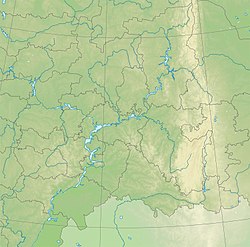


The length of the river is 841 km, the catchment area is 67.5 thousand km² [2] . The average flow rate at the mouth is 260 m³ / s [3] .
It originates on the Volga Upland in the Ulyanovsk Region near the village of Sursky Peaks and flows first to the west, then mainly to the north. In the lower reaches, floatable and navigable. Used for industrial water supply. The largest city on the Sura is Penza . The cities of Sursk , Alatyr , Yadrin , Shumerlya are also located on the Sura, at the mouth - the pier Vasilsursk , the village of Kurmysh . Until the 16th century , the eastern border of the Moscow principality passed along the Sura.
Content
Toponymy
- Sura - a winding river and its channel, often presents sharp turns. In the Mountain Mari language, “ shur ” also means “ horn ” (animal horn) [4] . Etymology probably comes from this word.
- Another version:
In Mordovians the river is called Sura , sometimes Suro , in the language of the mountain Mari Shur , to compare with the Udmurt shur "river", Chuvash shor , Shur "swamp", Komi shor "stream". All this suggests the formation of the Sura hydronym from the term "river" in the extinct Finno-Ugric language of the Volga region.
- Geographical names of the world: Toponymic dictionary. - M: AST. Pospelov E.M. 2001
- Third version:
There is a Mordovian legend about the origin of the name: “In ancient times, many peoples moved from place to place. When the Mordovians came here, some people already lived on the Volga. Mordva came to the Volga, but those who lived there did not let her go down the river. Mordva returned back, but from above, from the Volga; I went back and forth, looking for where to live. I came to a place where another river flows to the Volga from the south. The old people together began to consult: what to do, where to go next? One of the oldest people said: “This river, like a finger, shows where to go. We need to go on this river and live there. " He obeyed and went up this river, there were no other peoples then, no one lived. And the place was good for hunting, there were a lot of forests. So they stayed to live here. And the river began to be called Sur - it, like a finger, showed them where to live. Mordovian Sur - “ finger ” ”(“ Oral and Poetic Creativity of the Mordovian People ”, volume H. - Saransk, 1983, p. 230)
- Antiquities of the Penza region in the mirror of toponymy [5]
- Fourth version:
... in the Tatar language there is the word " sora " (that's what the local Tatars call the Sura), which means the gray color inherent in the Sura water.
- Nizhny Novgorod Tatars: ethnic roots and historical fates [6]
Feature
The food is mixed, with a predominance of snow. High water in April - May. It freezes in November - December, opens at the end of March - April. [3] After the construction of the Sur reservoir, the river has a regulated flow.
History
In the XVI century, the Sura River was a boundary watercourse. The diplomat and traveler S. Herberstein , who visited Russia in 1517 and 1526, wrote: “The Sura River shares the possessions of the tsars of Moscow and Kazan, it flows from the south and, turning east, flows into the Volga twenty-eight miles below Novgorod. At the confluence of the Volga and the Sura, on one of the shores, Sovereign Vasily erected a fortress and named after his name Vasilievgorod (Basilowgorod) ” [7] . With the construction of this fortress, the Russians practically took control of the entire river.
In 1557, who arrived with a detachment on the Sura during the campaign of Ivan the Terrible to Kazan , Prince A. M. Kurbsky called it “a great river, where there were a lot of fish” [8] . In the XVII century, fortress cities were built on the Sura and its tributaries: Saransk (in 1641), Penza (in 1663), etc. Probably the first mention of the ichthyofauna of the Sura was information about the city of Penza in the Heraldry Office in 1728. : “And this city was built by the Penza and Surah rivers ... And in the designated rivers and those rivers and lakes there are fish: pike, tench, burbot, catfish, ide, roach, zander, bream, perch, crucian carp” [8] .
The first research work in the Sura basin was carried out by the expedition of P.S. Pallas in 1768. Her route passed through the Nizhny Novgorod and Penza provinces .
Climate
The pool is located in a temperate continental climate, which is characterized by cold winters and moderately hot summers. The territory is under the influence of air masses of temperate latitudes carried by the prevailing westerly winds. The average temperature of the hottest month, July is 18-19 ° С; the coldest, January - −11- −12 ° С. The average annual temperature is about 4 ° C, humidity - 75%. Snow cover is established on average in the 15-20th of November and lasts 150-160 days [9] .
Flora and fauna
The current species composition of the fish population of the Sura basin is 50 taxa , of which 37 are aquatic species, 13 are introduced species, and no migratory species are currently recorded. Most of the species are found in the channel of the Sura (42) and in large tributaries (34). In most of the water bodies and streams of the Sura basin, only 7 species of fish are found: pike, Verkhovka, common char, silver carp, roach and perch. The occurrence of carp in many rivers is due to its release from pond farms. Only 5 species were noted exclusively in the channel of the Sura: tyulka , eel , bluefin , bersh . Only in the ponds and reservoir are 3 species noted: grass carp , buffalo and colorful silver carp . However, many introducers “run away” from the farms, which determines their appearance in river beds. In 2008, GosNIORH employees in the lower reaches of the Sura (28 km of the ship's course upstream) noted a round goby . Of the 37 species listed in the regional Red Books , 29 species inhabit and / or inhabit the waters of the Sura basin [2] .
From mammals are found: common beaver, muskrat, mink. Sometimes wild boars come to the watering hole from the surrounding forests.
Amphibians : pond and lake frog, toads are rare.
Reptiles : so ordinary.
Insects : beauty dragonflies and many other species, pond pond.
Mollusks : toothless, perilous, pond. Crayfish are found.
In the Sura valley on the territory of Alatyr district (9025 ha), the main part of the Prisursky reserve is located.
Ichthyofauna
At the end of the 19th century, in the counties of Alatyr , Kurmysh , and Ardatovsky in the Simbirsk province , catches were recorded: perch , pike perch , bream , chub , sterlet , ide , common carp , crucian carp , pike , roach , burbot , beluga tench , tench , sturgeon , herring , catfish and podust [10] .
The origins of the Sura are rather poor in the composition of the ichthyofauna and include 9 species of fish: river minnow, top, pike, perch, burbot, common sculpin, baleen, Siberian and ordinary tweezers. In recent years, due to the environment-transforming activity of the beaver, the hydraulic regime of the Supreme Sura has changed significantly. A typical “brook” rheophilic fauna is replaced by a limnophilic one. If before, more than 90% of all catches were river minnow, now the highest numbers are reached by the mustachioed char, perch and top [2] .
On the site from the village of Yavleika to the village of Chaadayevka, the ichthyofauna still has a pronounced rheophilic “character”, and limphophilous species are still of low abundance. Among the rheophiles, the fish population is represented by: chub, dace, foxhunter, podost, bleak, Volga gudgeon. Quite a high number of roach, perch, pike [2] .
In the section from Chaadayevka to the village of Koldais , it bears more pronounced limnophilic features. Among the species with a high abundance, we can distinguish roach, bleak, perch, bream. According to the data of A. V. Yankin, about 28 live here, and taking into account the fish population of the elder women - 31 species [11] . In many ways, such a high diversity of the ichthyofauna of the site is explained by the backwater influence of the dam of the Sur reservoir [2] .
The upper section is the least diverse, the pre-mouth section is the largest. Currently, the number of species in the upper reaches of the Sura is 33, the average is 29, the lower is 35. The most numerous and widespread in the considered section of the river bed are bleak and roach, and the rarest are loach, common carp, sterlet and bersh. In total, 41 species of fish belonging to 14 families were recorded in the riverbed [2] :
- Eudontomyzon mariae
- Acipenser ruthenus
- Clubspeonella cultriventris
- Esox lucius
- Anguilla anguilla
- Abramis brama
- Ballerus sapa
- Ballerus ballerus
- Alburnoides rossicus
- Alburnus alburnus
- Aspius aspius
- Blicca bjoerkna
- Carassius carassius
- Carassius gibelio
- Chondrostoma variabile
- Cyprinus carpio
- Gobio volgensis
- Leucaspius delineatus
- Squalius cephalus
- Leuciscus idus
- Leuciscus leuciscus
- Pelecus cultratus
- Phoxinus phoxinus
- Rhodeus amarus
- Romanogobio albipinnatus
- Rutilus rutilus
- Scardinius erythrophthalmus
- Tinca tinca
- Barbatula barbatula
- Cobitis melanoleuca
- Cobitis taenia
- Misgurnus fossilis
- Silurus glanis
- Lota lota
- Gymnocephalus cernuus
- Perca fluviatilis
- Sander lucioperca
- Sander volgensis
- Neogobius melanostomus
- Perccottus glenii
- Cottus gobio
The wellhead and the lower reaches of the Sura are used for fishing [2] .
Tributaries of the Surah
Left tributaries
- Truev
- Suzumka
- Cadada
- Koldais
- Vezhnyanga
- Uza
- Penza
- Penny
- Sheldois
- Koloyark
- Shuksha
- Kutlya
- Peletma
- Vyas
- Repeating
- Intent
- Sinyash
- Nerlake
- Big Ksha
- Chermely
- Pin
- Lasha
- Cheberchinka
- Industrial
- Big Sarka
- Small Sarka
- Wet
- Alatyr
- Phenomenon [12]
- Ichiksa
- Elhovka
- Me
- Kisha
- Medyana
- Drunk
- Kurmyshka
- Urga
- Belavka
- Symyanka
- Fire
- Cast iron
Right tributaries
- Hour
- Kachimka
- Broomstick
- Shkudimka
- Teshnyar
- Catmiss
- Yulovka
- Ishimka
- Shnaevo
- Medovka
- Vyadya
- Ivanyrs
- Quince
- Inza
- Argash
- Tala
- Belovodye
- Barysh
- Shave
- Sledgehammer
- Abyss
- Lula
- Atratka
- Picshara
- Lantern
- Kirya
- Algashka
- The thought
- Kumashka
- Kumazhan
- Skipping
- Howl
Gallery
Sura at the confluence of the Volga. Vasilsursk.
Surah in Penza.
Sura at the village of Kachelai
See also
- Sursky line of defense
Notes
- ↑ Surface Water Resources of the USSR: Hydrological Understanding. T. 10. Upper Volga region / ed. V.P. Shaban. - L .: Gidrometeoizdat, 1966 .-- 528 p.
- ↑ 1 2 3 4 5 6 7 8 Ruchin A. B., Artaev O. N., Klevakin A. A. et al. Fish population of the Sura River basin: species diversity, populations, distribution, protection . - Saransk: Mordov. University, 2016 .-- 272 p. - ISBN 978-5-7103-3217-7 .
- ↑ 1 2 Sura (river) // Great Soviet Encyclopedia : [in 30 vol.] / Ch. ed. A.M. Prokhorov . - 3rd ed. - M .: Soviet Encyclopedia, 1969-1978.
- ↑ The Big Mari-Russian Dictionary (1990-2005): Mari Yilme Muter = Dictionary of the Mari Language in 10 volumes. Yoshkar-Ola: Mari Book Publishing House, 1990-2005 (Unavailable link) . Date of treatment December 2, 2014. Archived December 9, 2014.
- ↑ M.S. Poluboyarov. The antiquities of the Penza region in the mirror of toponymy: Moscow, 2010
- ↑ Orlov A.M. Nizhny Novgorod Tatars: ethnic roots and historical destinies. Nizhny Novgorod, 2001
- ↑ Sigismund Herberstein. Notes on Muscovy, in 2 vols. / A.L. Khoroshkevich , trans. A.I. Maleina, A.V. Nazarenko. - M .: Monuments of historical thought, 2008.
- ↑ 1 2 V. Lebedev. Upper Sura in the 16–18 centuries. // Penza. From the history of the region. Essays on local lore. - 1993. - Vol. 4. - S. 64–71.
- ↑ Geographic Atlas of the Republic of Mordovia / A.A. Yamashkin, S.M. Vdovin, N.P. Makarkin et al. - Saransk: Mordov. University, 2012 .-- 204 p.
- ↑ Fishing in Russia in 1900: Based on materials received from the owners, correspondents of the Department of Rural Economy and Agricultural Statistics and from institutions involved in fishing affairs. - S. Petersburg, 1901 .-- 122 s.
- ↑ Yankin A.V., Yanov D.G., Ilyin V. Yu. Features of the ichthyofauna of the upper reaches of the Sura River. - Proceedings of the PSPU. Natural Sciences. - 2006. - Vol. 15). - S. 89–91.
- ↑ Map sheet N-38-46-Aa - FSUE GOSGISCENTER
Literature
- Sura // Dictionary of modern geographical names / Rus. geo about . Mosk. Centre; Under the total. ed. Acad. V.M. Kotlyakova . Institute of Geography RAS . - Yekaterinburg: U-Factoria, 2006.