The Battle of Liss is a naval battle during the Austrian-Italian War of 1866. Held on July 20, 1866 near the island of Lissa (now the island of Vis ) in the Adriatic Sea between the Italian fleet under the command of Admiral Carlo di Persano and the Austrian fleet under the command of Rear Admiral Wilhelm von Tegethoff . The first ever naval battle of armored squadrons.
| Battle of Liss | |||
|---|---|---|---|
| Main conflict: Austro-Prussian-Italian war | |||
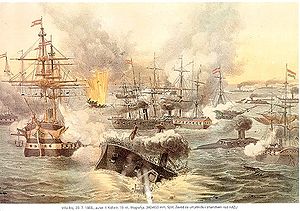 Painting F. Collarz | |||
| date of | July 20, 1866 | ||
| A place | Adriatic Sea , near the island of Lissa , modern Croatia | ||
| Total | convincing victory of Austria | ||
| Opponents | |||
| |||
| Commanders | |||
| |||
| Forces of the parties | |||
| |||
| Losses | |||
| |||


Content
- 1 The situation at the beginning of the battle
- 2 The balance of power
- 3 Building fleets
- 4 At the tip of the main blow
- 5 General battle of armadillos
- 6 The end of the battle and its results
- 7 Implications for Naval Tactics
- 8 Notes
- 9 Literature
The situation at the beginning of the battle
The start of the war was made unprepared by the naval forces of both states opposing each other on the Adriatic. However, the Austrians were in a worse situation: their two strongest battleships were not completed, they did not have artillery ordered in Prussia, which itself declared war on Austria. Nevertheless, the energetic Rear Admiral Tegethoff , appointed commander of the Austrian squadron on the eve of the war, took urgent measures to bring the fleet in full readiness. The new battleships were equipped with a temporary mast and armed with smooth-bore guns removed from old ships (the main hope lay on the ram ); ships without armor were sheathed with thick boards or lined with steel chains and rails on the sides. The Austrian fleet organized exercises every day, regularly held staff meetings to develop the best battle tactics. With the declaration of war, Tegethoff moved to active action off the Italian coast, looking for a decisive battle with the enemy.
On the contrary, the Italian fleet was noticeably superior in strength to the Austrians passively. Admiral Persano refused to go to sea, making excuses for the unavailability of ships and crews, but did not take any measures to prepare the fleet. Finally, under pressure from the Italian government, which, due to the decline in popularity among the population, urgently needed to win , Persano was forced to conduct a limited offensive operation. On July 17, the Italian fleet left its base in Ancona and headed for the coast of Dalmatia. On the morning of July 18, Italian ships appeared at the Austrian fortress on the island of Lissa . Before the telegraph cable was cut, Lissa managed to send a message to Tegethoff asking for help. The admiral replied to the besieged garrison with a telegram: "Hold on until the fleet comes to you!" On July 18 and 19, the Italian squadron bombarded the fortifications of Lissa, but did not succeed. A number of ships were damaged, and one of the battleships ( Formidabile ) was disabled. The Italians used up a significant part of the ammunition and coal. Meanwhile, on July 19, the Austrian fleet left its main base in the Field to help Lissa.
The weather on the morning of July 20 was unstable. The Austrian patrol ship saw the Italians as early as 6:40 in the morning, but then an oncoming storm hid the enemy from sight. There were doubts that strong excitement would generally allow the battle to take place. Then, however, the sea calmed down, and Tegethoff ordered the squadron to “close up!” And “Full speed!” His fleet, lined up in battle formations, rushed at the enemy at a speed of 8 or even 10 knots. Persano squadron at this time was busy preparing for landing on Lissa; light gray Italian ships were scattered around the besieged island. At 9 a.m., Italians saw the black ships of the Austrians approaching from the north-west.
The balance of power
The main forces of the Italian fleet were 12 battleships, including the two largest 5700-ton “Re d'Italia” (flagship Persano) and “Re di Portogallo”, 4300-ton “Maria Pia”, “Castelfidardo”, “San Martino” and Ancona, 4,000-ton Principe di Carignano and Affondator (the latest tower monitor ), 2,700-ton Terribil and Formidabile, 2,000-ton armored gunboats Palestro and Varese. Armadillos were built in France, the USA (“Re d'Italia” and “Re di Portogallo”) and England (“Affondator”). Most of the battleships were armed from 16 (Terribl) to 30 (Re d'Italia) with medium-caliber English rifled guns. In addition, two heavy guns were in “Re d'Italia”, “Re di Portogallo” and “Affondator”, the latter they were the only ones. On armored gunboats, weapons were also limited to two heavy guns. In addition to the battleships, the Italians had 11 more unarmored wooden ships - 6 screw frigates with 6 rifled and 30 smoothbore guns, 4 wheeled corvettes, several transports and messenger ships.
The battle core of the Austrian squadron was 7 battleships: 5100-ton “Archduke Ferdinand Max” (Tegethoff flagship) and “Habsburg”, 3600-ton “Kaiser Maximilian”, “Prince Eugen” and “Don Juan”; 3000-ton Drahe and Salamander. Armadillos (except for two large ones) were armed with 16-18 medium-caliber rifled guns, as well as 10-16 smoothbore guns. The Ferdinand Max and the Habsburg weapons were limited to 18 smoothbore guns. The strongest unarmored vessel of the Austrians was the Kaiser 5200-ton wooden screw-ship battleship, armed with 90 smooth-bore guns. In addition, the Austrians had five screw frigates (3-4 rifled and 20-40 smoothbore guns), a screw corvette, seven gunboats and several unarmed sentry and messenger ships. All ships were built at Austrian shipyards.
In total against 34 ships with 695 guns that were at Persano, Tegethoff had 27 ships with 525 guns. The total salvo weight of the Austrian squadron was 23.5 thousand pounds, and the Italian - 53.2 thousand. "The Italians nominally had almost twice as many armadillos and 50% more guns. Their superiority was both in number and in the size of the ships. Regarding rifled guns, the only weapon that can effectively operate in the battle of armadillos, they had significant superiority: 276 guns versus 121 enemy guns, and this advantage was increased by the greater power of the Italian guns, which could shoot shells four times heavier than the Austrian ones [1] . It should also be borne in mind that the Italian armadillos were not only heavily armed, but, in most cases, larger and faster than the Austrian. However, on the side of Tegethoff was the best preparation and organization of his fleet.
Building Fleets
The Austrian commander divided his squadron into three detachments ("divisions"). The battleships were under the direct command of Tegethoff. Unarmored wooden ships - the Kaiser screw battleship, five frigates and a corvette formed the 2nd “division” under the command of Commodore Anton von Peetz. The 3rd detachment under the command of Captain Eberles consisted of 7 gunboats. Knowing the superiority of the Italians in artillery, Admiral Tegethoff relied on the rams of his battleships, for which it was necessary to decisively attack the Italian fleet, imposing close combat on him.
The Austrian commander chose a groundbreaking construction for his time. Three squads of his squadron moved in the form of successive wedges (see diagram). Tegethoff, holding the flag on the head of the first wedge of Ferdinand Max, led a detachment of armadillos. They had to break through the enemy system, operating artillery at the closest distance and using rams. Armadillos were followed by a wedge from a battleship and frigates, with numerous artillery from smooth-bore guns, but without any armor; they had to complete the rout of the enemy. Finally, the last gunboats were intended to support their main forces with fire. Such a construction made it possible to cover unprotected ships with armored vehicles, to concentrate maximum forces in a limited space and to combine ramming tactics with the preservation of the ability to fire onboard guns.
After receiving a message about the appearance of the enemy, Persano began to transmit many signals, many of which were not dismantled on other ships. Vice Admiral Giovanni Battista Albini , who commanded a detachment of unarmored frigates and corvettes, ignoring Persano's order, stepped aside and did not participate in the battle. The battleships “Terribile” and “Varese” did not have time to join the squadron, “Formidabile” raised a signal that it was not capable of combat and began to retreat. The rest of the Italian battleships, however, slowly lined up the bearing . The battleships made up three detachments: the vanguard under the command of Rear Admiral Giovanni Vacca - "Principe di Carignano", "Castelfidardo" and "Ancona"; Admiral Persano’s main squad is Re d'Italia (flagship), San Martino, and Palestro; rearguard under the command of Captain Augusto Ribotti - “Re di Portogallo” and “Maria Pia”. The newly arrived “Affondator” was not included in any of the units.
After the squadron was built by the bearing system, Persano unexpectedly gave the command: "Build in the wake system." Wake columns were familiar to the old sailing fleet and with the advent of steam armored ships became obsolete. However, if the Italians, using the advantage in speed, would have avoided the ramming attack of the Austrians, then, thanks to the wake formation, they could better use their superiority in artillery (as the Japanese did in the Battle of Yalu in 1894). However, the Italian squadron actually stood still, allowing the Austrians to strike. The reason for this was Admiral Persano’s unexpected decision to move the flag from Re d'Italia to the Affondator, which was out of line. The main and closing detachments of the battleships slowed down to give the Re d'Italia the opportunity to launch boats. However, the vanguard ships that did not notice the signal continued to move forward, widening the gap between themselves and the rest of the squadron. To top it all, Persano did not signal the commanders of their transition to the Affondator, and the Italians continued to wait for orders from Re d'Italia, and not from the new flagship. Thus, during the battle, the Italian armored squadron, stretching 13 miles north of Lissa, was essentially without control.
On the cutting edge
At 11 a.m., the Austrian fleet met with violent fire cut through an Italian column between the vanguard and the main squadron. The shelling did not bring any harm to the Austrians, Italian shells flew past the target, however, the Austrians were not able to ram a single Italian ship during the first attack. The Italian vanguard of Rear Admiral Wacky tried, having gained speed, bypassed the Austrian armored wedge from the east and hit the enemy’s weak wooden ships. However, the Austrian gunboats evaded the attack, dragging behind them three battleships Wacky, who, thus, were withdrawn from the main battle for some time.
Meanwhile, Tegethoff deployed seven of his armadillos and attacked three armadillos of the main Italian squad. Thus, despite the general superiority of the Italians, in the decisive place of the battle, the Austrians managed to create more than twice the advantage of the ships. The battle turned into a random dump, where opponents often lost each other in the thick smoke of shots. The main goal of the Austrians was "Re d'Italia", which was continuously attacked immediately by two or three enemy ships. When he came to the aid of “Re d'Italia”, the small Italian “Palestro” was set on fire by the concentrated military salvo of the Austrian “Drache” and left the battle. The Draha got as well, its commander died, the main mast fell, a fire broke out on the deck, due to damage to the steam engine, the Austrian battleship was forced to abandon the pursuit of the burning Palestro, which was soon obscured by the returning battleships Wacky.
Tegethoff on his Ferdinand Max twice tried to ram the Re d'Italia, but the blows turned out to be sliding and did not penetrate the skin. More fortunate "Kaiser Maximilian." The Austrian armadillo himself suffered from Italian shells that damaged his pipe and mast, but he rammed the steering wheel at Re d'Italia with a ramming strike, so that the Italian ship could only be controlled by a machine. The commander of the “Re d'Italia” Faa di Bruno tried to make his way to the suitable battleship Ancon from the vanguard of Vacca, but then some Austrian battleship blocked his path. Captain di Bruni, instead of ramming, reversed and thereby doomed his ship to death. To the left of Re d'Italia was Tegethoff's flagship.
Distinguishing a huge gray mass in front of him through powder smoke, the Austrian admiral immediately gave the command: "Full speed ahead!" Archduke Ferdinand Max hit Re d'Italia right in the middle of the hull, breaking through armor and wood paneling, and immediately reversed, tearing a ram from a 16 square meter hole. The Italian battleship tilted to the right, then to the left, and began to quickly go into the water with its nose forward. Captain di Bruno shot himself, other Italians fired from the sinking ship against the Austrians to the last. At 11 hours 20 minutes, “Re d'Italia" sank. Ferdinand Max tried to help the Italians floating in the water, but then was attacked by the San Martino and was forced to retreat in order to re-enter the battle.
General Battle of the Armadillos
The detachment of the Austrian unarmored ships of Anton von Peetz according to the original plan was to fight with Italian frigates and corvettes. However, the vice-admiral Albine, who commanded them, declined to participate in the battle, and the von Pets detachment encountered Italian armadillos hurrying to the aid of Re d'Italia, as well as the fast-moving Affondore. First, von Pets on the Kaiser battleship made the Affondator, on board which the Italian commander himself was on board, threatened to collide, and then hastened to the aid of two Austrian frigates, who were shot by Italian armadillos. Soon, the wooden Kaiser was among four enemy armored ships coming up from opposite sides, successfully firing at them with its numerous artillery.
Opposing the large Italian battleship “Re di Portogallo”, the Austrian wooden ship boldly went into the ram of a much stronger ship, shocked him with the strike of the stem, but could not sink, and he lost his pipe and masts and was badly damaged by the fire that the Italians fired on it almost point blank. The crippled Kaiser, together with the frigates, headed towards Lissa, and the fast-moving Affondore tried to intercept him. The old heavily damaged wooden battleship could no longer evade the attack, but at the crucial moment, Admiral Persano abandoned the ram and the Kaiser took refuge safely in the harbor.
Then the “Re di Portogallo”, “Maria Pia” and “Varese” joined the battle with the Austrian battleships. “Re di Portogallo” pressed “Don Juan”, but “Kaiser Maximilian” came to the rescue. Admiral Persano’s “Affondator” tried to ram the “Prince Eugen”, but again missed. Tegethoff also unsuccessfully attacked an unidentified Italian ship that passed between the flagship Ferdinand Max and Eugen. Throughout the battle, Tegethoff controlled the battle, standing on the open deck of his ship, while Persano never left the armored cabin of the Affondator. During the hot shootout, Italian armadillos fired a lot more shots than the Austrians (4 thousand versus 1.5 thousand), but they themselves suffered much more, possibly from the incendiary nuclei used by the Austrians. At the Maria Pia, the fire nearly reached the crevice camera. At San Martino, which collided with Maria Pia, a strong leak formed, fires broke out three times. There was also a big fire on the Ancon, and a bomb exploded on the battery deck, flying through an open gun port. At the “Re di Portogallo”, with its ram, the “Kaiser” part of the armor plates was torn down.
The end of the battle and its outcome
At 12 o’clock the squadrons dispersed, swapping places. Now Tegethoff was at Lissa, and Persano was to the north of him. Tegethoff prepared to continue the battle, lining his ships in a wake column and covering them with wooden vessels. Persano, collecting the remaining armadillos, cruised in the distance.
The Italian fleet was still stronger than the Austrian, but the morale of the Italians was broken. At 14.30 the long-burning Palestro exploded - the fire reached the ammunition brought to the deck. The death of the second Italian battleship occurred in front of both fleets. Tegethoff gave the order: "Chasing the enemy!". The Austrians were rebuilt in three columns, but their slow-moving armadillos had no chance of catching up with the Italians, and Tegethoff, seeing that the enemy did not want to engage in battle, canceled his order. At 10 pm Persano withdrew his fleet to Ancona. Following this, Tegethoff went with his squadron to the base in Polu.
The Austrians won a complete victory in the battle of Liss. They solved the operational task before them, helping the besieged island fortress, and inflicted much more damage to the enemy than they themselves suffered. The Italians lost two armadillos and more than 600 people killed and drowned, while the Austrians did not lose a single ship and only 38 people died. The victory over the strongest enemy fleet, however, was for the Austrians only moral value. The outcome of the Austrian-Italian war was determined by the defeat of Austria on land from Italy's ally - Prussia. Before Admiral Vacca, appointed the new commander of the Italian fleet instead of the shot Persano, went to sea to gain revenge on Tegethoff, a truce was concluded (July 26).
The Italian Admiral Persano , located on the armored ram “ Affondator ”, twice had the opportunity to ram a wooden two-decker ship “Kaiser” but every time at a critical moment his nerves cheated on him. There is evidence of several more attempts to ram, but each time the target ship managed to dodge. So, although the ram’s reputation is based on the battle of Liss, the effect of a single successful strike was in all respects too exaggerated compared to many unsuccessful ramming attacks, which were attributed to confusion due to the gun smoke of the Austrian ships.
Implications for Naval Tactics
For almost the next three decades, the battle of Liss was seen as an example of an exemplary naval battle. The powerlessness of artillery against the ship’s armor manifested in the battle was absolutized. Ram was now considered as the main weapon of combat ships. The tactics of ramming at close range began to be considered the defining tactics, which turned squadron battles into a dump of individual ships. In shipbuilding, everything, including the location of artillery, began to obey the ram.
In Russia, the development of ramming tactics was carried out by Vice Admiral G.I. Butakov .
Notes
Literature
- Wikimedia Commons has media related to the Battle of Liss
- Wilson H. Armadillos in battle. Chapter 10. The Battle of Liss
- Stenzel A. History of wars at sea. Part 4. Ch. 4. The Austro-Italian War of 1866
- Petrov. MA A. Overview of the main campaigns and battles of the steam fleet. in connection with the evolution of naval art Chapter 4. The Battle of Liss.
- Maxim Ferapontov. The Austro-Italian War of 1866. The Battle of Liss (Rus.) // Arsenal Collection . - M. , 2015. - No. 7 . - S. 38-52 .