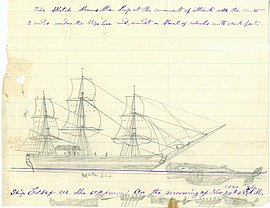
The crash of the Essex is an incident that happened to the American whaling ship Essex, whose captain was George Pollard, Jr. In 1820, in the South Pacific, the vessel was attacked by a sperm whale and sank, and the crew of the ship, thousands of miles from the coast, was forced to seek salvation in three whaleboats . The incident inspired Herman Melville to write the novel " Moby Dick " in 1851.
Content
Ship and crew
Crew "Essex" |
Captain George Pollard Jr. First mate Owen chase Second mate Matthew Joy Boat steering Thomas chappel Steward William Bond Sailors Owen coffin * landed in Ecuador in September 1820 cabin boy Thomas nickerson |
The Essex was an old Boston-based whaler type of ship, but many of its trips were profitable, so the ship acquired the nickname “lucky.” The captain was George Pollard Jr., Owen Chase served as the first assistant, who held this post in the previous successful campaign. George Pollard, in his 29 years, was the youngest captain in whaling. Owen Chase was 23 years old, and the youngest member of the crew was Junga Thomas Nickerson, who was only 14 years old.
The vessel shortly before the last voyage was completely refitted. With a displacement of 238 tons and a length of 87 feet (27 m) [1], the ship was not considered fit for whaling. The Essex was equipped with four separate whaleboats , each of which was approximately 28 feet (8.5 m) long. The design of the boats was unreliable, but it provided a high speed of movement [2] .
Swimming
On August 12, 1819, Essex left the port of registry, Nantucket, and set off to the west coast of South America for two and a half years. Two days after the ship sailed, the ship fell into a squall , during which the ends of the beams almost fell on the water (which means the ship was tilting at more than 45 °). Bramsel was torn, and three whaleboats badly damaged. The captain decided to continue sailing without repairing and repairing the damage received. In January 1820, Essex rounded Cape Horn . The passage of this place took as long as five weeks, which was extremely long even for that time. This fact and the events of the recent squall led to talk among the sailors about the bad omen. However, all this was forgotten when, in the summer, the Essex began a long hunt in the South Pacific, moving north along the west coast of the mainland [2] .
While at the fishing site, whose resources were almost exhausted, Essex met another whaling ship, whose crew told about a new open area for fishing, known as Sea Land. The place is located at 5-10 degrees south. sh. and 105–125 degrees h. in the south of the Pacific Ocean, approximately 2500 nautical miles (4600 km) to the south and west. At the beginning of the development of the Pacific fishery, the removal of a new area from the land seemed huge, and numerous islands in that region were rumored to be inhabited by cannibals. To replenish supplies for the upcoming long journey, the Essex sailed to the island of Charles Galapagos Island Group .
Due to the need to patch serious leaks, the ship was forced to anchor on October 8 at Hood Island . During the seven days of parking, the crew caught 300 turtles, replenishing their supplies with supplies on the ship. Then the ship went to the island of Charles, where on October 22 the sailors extracted another 60 turtles [К 1] . While the crew was hunting, Thomas Chappell, the boatmaster, decided to start a fire in the forest in order to play a trick on the other sailors. However, it was just at this time that the peak of the drought fell, and soon the fire went out of control, quickly surrounding the hunters. The sailors were forced to flee through the flames. When they reached the Essex, almost the entire island was already engulfed in flames. The crew was upset by the incident, and Captain Pollard announced that he would severely punish the arsonist. Fearful of flogging, Chappel did not dare to make a confession for a long time. Meanwhile, the island continued to burn the next day, when the ship left it. After a whole day of sailing, the fire was still visible on the horizon from the ship. Many years later, when Thomas Nickerson (who served on Essex as a cabin boy) returned to the island, he found only a black wasteland: "neither trees, nor shrubs, nor grass has appeared since." It is believed that the fire contributed to the disappearance of Florentine turtles and mockingbirds there [3] .
Whale Attack
The crew of the ship, located thousands of miles from the coast of South America, gradually increased the tension, especially between the officers - Pollard and Chase. The whaleboats returned empty for several days, and on November 16, Chase's boat was "broken ... literally to pieces" when the whale began to float, being directly under the bottom of the whaleboat. However, at 8 am on November 20, 1820, the crew of the ship saw a fountain in the sea and, at the three surviving whaleboats, began the pursuit of the sperm whale [2] .
On the leeward side of the Essex, Chase's boat harpooned the whale, but it struck the whaleboat in which the stream was formed. People had to cut the harpoon cable and go to the ship for urgent repairs. Meanwhile, two miles from the Essex's windward side, the people in the boats of Captain Pollard and the second mate harpooned another whale, and now he dragged the whaleboats away from the ship. While Chase was repairing a damaged whaleboat, the crew observed a whale — a sperm whale, which was much larger than usual (presumably about 26 m in length). The behavior of the whale was rather strange. He lay motionless on the surface of the water head to the ship, and then began to move toward the ship, picking up speed with small diving movements. The whale rammed the Essex and went under it, tipping the ship. Then the sperm whale surfaced on the starboard side and positioned along the vessel, head to the bow, and tail to the stern. Apparently, the whale was stunned. Chase was ready to harpoon him, but in time he realized that the tail of the sperm whale was only a few inches from the steering wheel . Thus, having received the blow of the harpoon, the whale can easily destroy the steering wheel. Fearing to be on an unmanaged ship thousands of miles from the coast, Chase abandoned his intentions. By that time, Keith had come to his senses and now sailed a few hundred yards ahead of the ship, turning his head to it [4] .
I turned around and saw him at about a hundred births (about 500 m) right in front of us, swimming with his usual speed doubled (about 24 knots , or 44 km / h), and it seemed with a ten-fold hatred and thirst for revenge in his eyes. His destructive tail left around him on all sides of the breakers. The head was half raised above the water, and so he came to us, hitting the ship again.
- Owen Chase
The whale broke the bow of the ship like an egg-shell, throwing the 238-ton ship back. Finally, the sperm whale pulled his head from the punched body and disappeared from sight. Essex quickly began to roll on its nose. Chase and the rest of the sailors tried desperately to install the rigging on the only whaleboat, while the steward rushed down to collect all the navigational aids that he could find [К 2] .
The boat of the captain was the first that approached us. He stopped her, but could not utter a single word, so was suppressed. "My God, Mr. Chase, what happened?" I replied: "We were rammed by a whale."
- Owen Chase
This was the first known case of a whale attack on a whaling ship [2] .
Fight for salvation
The ship sank 2,000 nautical miles (3,700 km) west of the coast of South America. Twenty sailors remained in three small whaleboats with food and fresh water only for two days. The nearest known islands, the Marquesas , were more than 1,200 miles (2,222.4 km) to the west. Captain Pollard decided to sail to them, but the team led by Owen Chase believed that the islands could be inhabited by cannibals, and voted to try to reach South America. The boats could not sail against the trade winds , and they had to first go 1000 miles (1,852 km) to the south before they could use the western winds and turn to the coast of the mainland, which would have been 3,000 miles away from the crashed.
Among the provisions rescued from the ship, there was a small supply of biscuits , 5 live turtles and 700 liters of water [5] . Most of the food was in the sea water, so they had to eat them in the first place, which further increased thirst. People ate salted food for two weeks, resorting to rinsing their mouths with sea water and drinking their own urine. Whaleboats, not intended for long-distance and long-term voyages (besides, roughly repaired earlier), constantly leaked, which was a very serious problem for the crew. Once the people of one of the boats were forced to tilt their whaleboat so that the opposite side and a hole in it came out of the water, allowing the crew of the second whale to eliminate the leak. The boats reached the uninhabited island Henderson literally at the time when in a few hours people would die of thirst. Now this island is British territory, one of the islands of Pitcairn . If they landed directly on Pitcairn Island, which was only 104 miles (192 km) in the south-west, they would get help: the island was inhabited and the last surviving participants in the Bounty insurgency lived there. On the island of Henderson, sailors from the Essex discovered a small key source of fresh water. The food ration of the crew consisted of birds, eggs and crabs. However, after a week, the island’s resources were largely exhausted. On December 26, the survivors concluded that if there was a delay in this place, famine would soon come. However, three men - William Wright, Seth Weeks and Thomas Chappell decided to stay. The rest of the crew of the Essex resumed sailing on New Year's Eve in order to reach Easter Island . Within three days, the stocks of crabs and birds taken for swimming were exhausted. Of the food left only a small amount of bread saved from the ship. On January 4, the sailors estimated that they were too far from Easter Island to be able to reach it. It was decided to follow the island of Mas-a-Tierra , which lies at a distance of 1818 miles (3367 km) to the east, and 419 miles (776 km) west of the coast of South America. One by one, the people in the boats began to die [6] .
Chase Boat
Matthew Joy died on January 10, and the next day the boat with Owen Chase, Richard Peterson, Isaac Cole, Benjamin Lawrence and Thomas Nickerson separated from the rest during a strong squall. Peterson died on January 18th. Like Joey, he was sewn into his own clothes and buried at sea. Isaac Cole died on February 8, but his body was left in the boat. In the conditions of shortage of provisions, after discussion, it was decided to resort to cannibalism for the sake of survival. By February 15, the three remaining men had run out of food again, but on February 18 they were spotted and rescued by the British whaling ship Indian, 90 days after the death of Essex [2] .
Pollard and Hendrix Boats
In the Hendrix Dinner boat, food supplies ran out on January 14, and Pollard’s supplies came to an end a week later. Lawson Thomas died on January 20 and it was decided to eat his body. Charles Shother died 3 days later, Isaiah Shepard - 27, and Samuel Reed - January 28. All the bodies were eaten. January 28, the two boats were separated. The third boat, in which Hendrix’s Lunch, Joseph West and William Bond, were never seen again. It is believed that they died at sea [2] .
On February 1, the food ended again and the situation in Captain Pollard’s boat became critical. Then it was decided to draw lots to be sacrificed in order to save the rest of the crew. A short straw, ironically, went to Owen Coffin, the 17-year-old cousin of the captain, whom he once swore to protect. Owen replied that he would accept his fate in order to save the others. The crew again pulled the straws to determine who would have to play the role of executioner. She went to Owen's friend - Charles Ramsdell. Ramsdell shot Coffin with a captain's pistol, and his remains were eaten by Pollard, Barzilla Ray and Charles Ramsdell. February 11, Ray died, which saved people from having to repeat the terrible procedure. In the remainder of the voyage, Pollard and Ramsdell gnawed the bones of Coffin and Ray. Nearly reaching the limit of visibility of the South American coast, they were rescued by the whaling ship "Dauphine" on February 23, 1821 [2] .
Salvation and reunion
Pollard, Chase, Ramsdell, Lawrence and Nickerson were reunited in the port city of Valparaiso , where they informed the authorities about their three comrades who remained on Henderson Island. A ship was sent to the island, which took them on board on April 5, 1821. Three men were alive, although they were close to starvation.
All eight of the rescued people again went to sea a few months after the rescue [2] . Herman Melville later suggested that all sailors would have survived if they had initially accepted Captain Pollard's offer to sail west.
Implications
Captain George Pollard Jr. returned to sea in early 1822 as captain of the Two Brothers whaling ship. After a shipwreck at French-Frigat Scholes during a storm off the Hawaiian Islands on his first voyage (Pollard again had to use a bot, he and the rest of the crew were picked up by a passing ship five days later [5] . The wreck was found in 2011 [ 7] ), he boarded a merchant ship, which also soon crashed in the same area. George Pollard was to take the place of the captain on the Yonah, but the shipowner did not dare to entrust him with another ship, and Pollard was forced to resign. He became the night watchman in the city of Nantucket . Every November 20, he locked himself in his room and commemorated the people of Essex [6] .
Senior Assistant Owen Chase returned to Nantucket on June 11, 1821, to track down his 14-month-old daughter, whom he had never even seen before. Four months later, he finished writing a book about the events that took place, entitled “The Story of the Most Unusual and Terrible Shipwreck that Happened to the Whaling Ship Essex” ( eng. Narrative of the Whale-Ship Essex ). Later this book will inspire the writer Herman Melville to write the novel " Moby Dick ." In December, Chase again set sail in the position of senior assistant on the Florida whaling ship, and then went to sea as captain of the Winslow ship until he built his own ship, Charles Carroll. Chase went to sea for another 19 years, returning to land only for short periods of time every 2-3 years. And each time he became the father of the child. His first two wives died when Chase was at sea. He divorced his third wife when he discovered that she had given birth 16 months after he last saw her. However, he subsequently raised her child as his own. In September 1840, two months after the completion of the divorce procedure, he married the fourth and last time, having left the whaling industry [6] . Memories of terrible days spent at sea on the whaleboat chased Owen Chase. He suffered from severe headaches and nightmares. At the end of his life, Chase acquired the habit of hiding food in the attic of his house in Nantucket, standing on Orange Street [8] .
Junga's Thomas Nickerson became captain of the merchant fleet, and then wrote the book The Loss of the Ship Essex, sunk by a whale, and crew tests in open boats ( Engl. The Loss of the Ship " in Open Boats ). The book was not published until 1984, when it was published by the Nantucket Historical Association ( Nantucket Historical Association ). Nickerson wrote it at the end of life, and until 1960 its existence was not known. In 1980, the book fell into the hands of a Nantucket whaling expert, Eduard Stackpol, who appreciated its importance.
Charles Ramsdell before retirement became the captain of the whaling ship "General Jackson." Benjamin Lawrence before his resignation was the captain of the ships "Dromo" and "Charon", and after retirement became a farmer. William Wright also returned to whaling and drowned during a hurricane in the West Indies . Seth Wicks led a secluded Cape Cod lifestyle. Thomas Chappel is believed to have become a missionary preacher [2] .
Многие из оставшихся в живых рано или поздно написали свои отчёты о катастрофе, некоторые из которых различаются деталями о поведении тех или иных спасшихся людей.
Memory
Рассказы о катастрофе достигли молодого в то время Германа Мелвилла . Во время службы на китобойном судне «Акушнет» он встретил сына Оуэна Чейза, служившего в то время на другом китобойном корабле. Случайная встреча произошла менее чем в 100 милях (185,2 км) от места затопления «Эссекса». Чейз подарил Мелвиллу отчёт своего отца, и тот читал книгу в море, вдохновляясь идеей о том, что кит может быть способен на причинение такого бедствия. Мелвилл позже встретился с капитаном Поллардом, записав о нём в дубликате повествования Чейза следующее: « встретил капитана Полларда в Нантакете. Для большинства островитян он никто. На мой взгляд, это один из самых необычных людей, которых я когда-либо встречал ». Герман Мелвилл написал роман « Моби Дик, или Белый кит ». Источником вдохновения для книги послужила первая часть истории «Эссекса», заканчивающаяся его затоплением.
Книга Натаниэля Филбрика «В сердце моря: Трагедия китобойного судна „Эссекс“» удостоилась Национальной книжной премии Америки в номинации работ по морской истории. В книге показана история «Эссекса», в том числе и взгляд с точек зрений Никерсона и Чейза. В 2013 году на канале BBC One был показан телефильм «Кит». В 2015 году вышел фильм « В сердце моря », в котором одну из главных ролей исполнил Крис Хемсворт [9] .
История «Эссекса» ежедневно пересказывается сотрудниками Музея китобойного промысла Нантакета.
История «Эссекса» послужила источником вдохновения для популярной песни группы « Mountain » — «Nantucket Sleighride». Также назван и альбом 1971 года, куда включена эта песня.
История «Эссекса» была использована в 2009 году компанией « Би-би-си » в документальном шестисерийном фильме « Тайны Тихого океана ». Эпизод был третьим по счёту и носил название «Бескрайняя синева». В нём среди прочего говорилось о сложности выживания людей в открытом океане.
История «Эссекса» упоминается в большом числе художественных произведений XIX—XXI вв.
Немецкая Funeral Doom Metal группа Ahab посвятила катастрофе «Эссекса» и судьбе капитана Полларда свой второй альбом The Divinity of Oceans.
Comments
- ↑ Весом от 100 до 800 фунтов (от 45 до 360 кг). Черепах оставляли живыми, так как они способны прожить около года без пищи и воды. Моряки убивали их по мере необходимости. Мясо черепах считается вкусным и очень питательным.
- ↑ По одним источникам, капитан приказал снять с судна такелаж и таким образом убрал крен корабля. Судно оставалось на плаву вплоть до сокрытия его от взгляда за горизонтом. По другим источникам, когда подошли лодки, люди успели лишь помочь вынести провизию. По третьим источникам, лодки прибыли уже после затопления судна.
Notes
- ↑ Philbrick, 2001 , p. 241.
- ↑ 1 2 3 4 5 6 7 8 9 BBC, The Wreck of the Whaleship Essex .
- ↑ Nickerson, Account of the Ship Essex Sinking, 1819-1821 .
- ↑ Karp, The Essex Disaster, April — May 1983 .
- ↑ 1 2 Дмитриев, Самый знаменитый кит .
- ↑ 1 2 3 Leslie E., Seagrave S., 1998 , p. 251-253.
- ↑ Patel, Top 10 Discoveries of 2011 .
- ↑ Philbrick, 2001 , p. 244.
- ↑ Пономарев, Охотник станет жертвой .
Literature
Books
- Chase O. Narrative of the Most Extraordinary and Distressing Shipwreck of the Whale-Ship Essex . — N. Y. : WB Gilley, 1821. OCLC 12217894
- Heffernan T. Stove by a whale: Owen Chase and the Essex . — Middletown: Wesleyan University Press, 1990. — 288 p.
- Leslie E., Seagrave S. Desperate Journeys, Abandoned Souls: True Stories of Castaways and Other Survivors. — Houghton Mifflin Harcourt, 1998. — ISBN 978-0-395-91150-1 .
- Nickerson T. The Loss of the Ship Essex Sunk by a Whale and the Ordeal of the Crew in Open Boats. — Nantucket: Nantucket Historical Society, 1984. OCLC 11613950
- Philbrick N. In the Heart of the Sea: The Tragedy of the Whaleship Essex. — New York: Penguin Books, 2001. — ISBN 0-14-100182-8 . OCLC 46949818
Статьи
- Дмитриев Г. Самый знаменитый кит // Водный транспорт.
- Karp W. The Essex Disaster // American Heritage. — April — May 1983.
Публикации в интернете
- Пономарев Р. Охотник станет жертвой . kinomania.ru. Дата обращения 12 августа 2012. Архивировано 2 октября 2012 года.
- Шеффер В. Мобильный дикий кашалот… . tmru.bizland.com. Дата обращения 12 августа 2012. Архивировано 2 октября 2012 года.
- Nickerson T. Account of the Ship Essex Sinking, 1819-1821. (англ.) . galapagos.to. Дата обращения 12 августа 2012. Архивировано 2 октября 2012 года.
- Patel S. Top 10 Discoveries of 2011 - Atlantic Whaler Found in Pacific - French Frigate Shoals, Hawaii - Archaeology Magazine (англ.) . archaeology.org. Дата обращения 12 августа 2012. Архивировано 2 октября 2012 года.
- Американское китобойное судно «Эссекс» было несколько раз протаранено гигантским китом . vokrugsveta.ru. Дата обращения 12 августа 2012. Архивировано 2 октября 2012 года.
- The Wreck of the Whaleship Essex (англ.) . bbc.co.uk. Дата обращения 12 августа 2012. Архивировано 2 октября 2012 года.
- 'Moby Dick' captain's ship found (English) . bbc.co.uk. The appeal date was August 12, 2012. Archived October 2, 2012.
- PBS - The Voyage of the Odyssey - Class from the Sea - Ocean History - Whaleship Essex (Eng.) . pbs.org. The appeal date was August 12, 2012. Archived October 2, 2012.
- Into the Deep: America, Whaling & the World - American Experience (Eng.) . pbs.org. The appeal date was August 12, 2012. Archived October 2, 2012.