Charles Hatchett ( January 2, 1765 , London - March 10, 1847 , Chelsea ) - British chemist and mineralogist. In 1801, he discovered the chemical element niobium .
| Charles Hatchett | |
|---|---|
| English Charles Hatchett | |
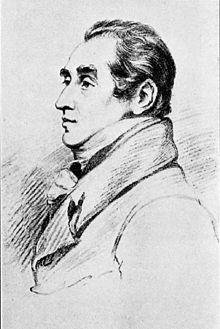 Charles Hatchett | |
| Date of Birth | |
| Place of Birth | London , UK |
| Date of death | |
| A place of death | |
| A country | |
| Scientific field | chemistry |
| Place of work | |
| Known as | discovery of the niobium element |
| Awards and prizes | member of the Royal Society of London Copley Medal ( 1798 ) |
Biography
Charles Hatchett was born into the family of a well-known carriage manufacturer. However, at first he did not go by the profession of his father, since childhood having an interest in mineralogy and chemistry. In 1801, commissioned by the British Museum in London, he conducted an analysis of the Columbite mineral. Hatchett called the new element Columbia. On November 26, he reported on his discovery to the Royal Society [4] [5] . This name is still preserved in the English-speaking space. Hatchett's discovery was confirmed later, after his death. Henry Rose in 1844 rediscovered the element. Since he was not aware of Hatchett's work, he called the element niobium.
In 1797, Hatchett became a member of the Royal Society of London . The last years of his life, Charles Hatchett devoted the family business of carriage production and left chemistry. He also became a famous collector of old musical manuscripts and musical instruments.
In 1798 he was awarded the Copley Medal . In honor of him, a prize was established by the Institute of Materials, Minerals and Mining ("IOM3", London), which since 1979 has been awarded to authors of the best publications in the field of science and technology of niobium and its alloys.
He died on March 10, 1847, was buried in St. Lawrence Church ( Slough , Buckinghamshire county). There is also the grave of William Herschel .
Notes
- ↑ Encyclopædia Britannica
- ↑ SNAC - 2010.
- ↑ Oxford Dictionary of National Biography / C. Matthew - Oxford : OUP , 2004.
- ↑ Charles Hatchett. An Analysis of a Mineral Substance from North America, Containing a Metal Hitherto Unknown (Eng.) // Philosophical Transactions of the Royal Society of London : journal. - 1802. - Vol. 92 . - P. 49-66 . - DOI : 10.1098 / rstl . 1802.0005 .
- ↑ Charles Hatchett. Eigenschaften und chemisches Verhalten des von Charlesw Hatchett entdeckten neuen Metalls, Columbium (German) // Annalen der Physik : magazin. - 1802. - Bd. 11 , Nr. 5 . - S. 120-122 . - DOI : 10.1002 / andp.18020110507 .