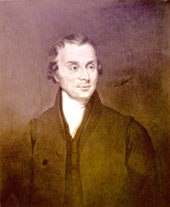
Luke Howard ( Eng. Luke Howard ; November 28, 1772 - March 21, 1864 ) is a British chemist-pharmacist and amateur meteorologist with wide interests in the field of science. Known as the creator of the currently used nomenclature of clouds [1] .
| Luke Howard | |
|---|---|
| English Luke howard | |
 | |
| Date of Birth | November 28, 1772 |
| Place of Birth | London |
| Date of death | March 21, 1864 (91 years old) |
| Place of death | London |
| A country |  Great Britain Great Britain |
| Scientific field | |
| Known as | cloud nomenclature author |
| Awards and prizes | member of the Royal Society of London |
Content
Biography
Luke Howard was born in 1772 in London. His father, Robert Howard, was a manufacturer and supplier of argand lamps [2] . He received his primary education at a Quaker school in Burford ( Eng. Burford ), Oxfordshire [3] . He was an assistant pharmacist in Stockport , after which he opened his own pharmacy in London [4] . He subsequently founded the pharmaceutical company Howard & Sons.
From childhood, Howard was interested in weather phenomena, primarily clouds [5] . Apparently, this interest arose under the influence of the events of 1783, when the sky over England was swept by an unusual haze caused by powerful eruptions of the Laki volcanoes in Iceland and Asama in Japan [5] . From that time until the end of his life, Howard constantly observed the sky and weather conditions in London and kept a diary of his observations for 30 years [5] .
Raised by the Quakers, Howard remained a deeply religious man all his life, keenly feeling his duty towards his neighbors. He was a member of the abolitionism movement, was a member of the Society Against Capital Punishment and Society Against Cruelty to Animals , and was also a founding member of the African Institution (an organization that supported former slaves) [6] .
Since 1796, Luke Howard was married to Mariabella Eliot [2] . They had eight children, one of whom - John Eliot Howard - subsequently became a famous chemist.
Contribution to science
Howard's main contribution to science is the cloud nomenclature system, which he proposed in 1802, speaking to the Askesian society of which he was a member. Until the beginning of the XIX century, clouds did not try to classify, considering them too volatile and ephemeral [7] . In 1802, independently of each other, Jean-Baptiste Lamarck and Luke Howard proposed their cloud classification systems. However, the terminology of Lamarck was not included in scientific use, since he created it in French [5] . Howard, being guided by the nomenclature of the animal and plant world developed by Linnaeus , used the Latin language in his classification. It was Howard who gave the clouds their generally accepted names, highlighting three main types: “cumulus” ( cumulus ), “stratus” ( layered ), “cirrus” ( cirrus ) [3] . Combinations of the main types made it possible to characterize four more types of clouds: “cirro-cumulus”, “cirro-stratus”, “cumulostratus”, “cumulo-cirro-stratus”, or “nimbus” [3] .
In 1803, Howard published his Essay on the Modifications of Clouds . He is also the author of the following books: The Climate of London , 1818, Seven lectures on meteorology , 1837, The Seasons in Britain for 18 Years ( A cycle of eighteen years in the seasons of Britain , 1842) and Barometrographia ( Barometrographia , 1847). He was the first scientist to pay attention to the specifics of the urban climate [8] .
In 1821, Luke Howard, despite the lack of special education, was elected a member of the Royal Society of London , and in 1850 joined the Royal Meteorological Society ( 9) .
During the 19th century, scientists from different countries improved, refined and supplemented Howard's classification. In Russia, it has been used in observatories for observing clouds since the 1830s [10] .
Recognition and Memory
Despite the fact that Luke Howard is called the “father of meteorology” [9] and “the godfather of the clouds” [5] , his name is known only to specialists. However, even during the life of the scientist, Goethe admired his classification of clouds, who dedicated a cycle of poems to Howard, each of which was a poetic illustration of one of the types of clouds described by Howard [11] . Goethe even wrote an enthusiastic letter to the young scientist, which he initially considered a hoax.
The studies of Howard were inspired by British poets and artists: Percy Bysshe Shelley , author of the famous poem The Cloud (Cloud), John Constable , who repeatedly depicted clouds in his paintings, and John Ruskin , who was guided by Howard's classification in the study of landscape painters [12 ] . William Turner and Caspar David Friedrich were also familiar with his works, drawing attention to the watercolor sketches of clouds made by Howard himself [5] .
In the 21st century, French writer Stefan Odega gave Luke Howard an important place among the characters in his novel Cloud Theory ( La Théorie des nuages , 2005).
Currently, a memorial plaque has been installed on Luke Howard’s house in London [5] .
Notes
- ↑ Howard, Luke // Brockhaus and Efron Encyclopedic Dictionary : in 86 volumes (82 volumes and 4 additional). - SPb. , 1890-1907.
- ↑ 1 2 Family Archived March 15, 2016 on Wayback Machine
- ↑ 1 2 3 RMetS .
- ↑ Luke Howard - a man with his head in the clouds?
- ↑ 1 2 3 4 5 6 7 The Man Who Named the Clouds, 1999 .
- ↑ ... such an excellent man Archived December 21, 2016 on Wayback Machine
- ↑ Thornes, 1999 , p. 34
- ↑ The Climate of London .
- ↑ 1 2 Tottenham Clouds .
- ↑ Andreev A.O., Dukalskaya M.V., Golovina E.G. Clouds: origin, classification, recognition. - St. Petersburg, ed. Russian State Medical University. - 2007. - P.29
- ↑ Maria Popova. The Invention of Clouds: Goethe's Poems for the Skies
- ↑ Thornes, 1999 , p. 187.
Bibliography
- Luke Howard. Essay on the Modifications of Clouds . - Cambridge University Press, 2011 .-- 70 p. - ISBN 9781108037686 .
- Luke Howard. The Climate of London . - IAUC.
Literature
- Hamblyn, Richard. The Invention of Clouds: How an Amateur Meteorologist Forged the Language of the Skies. - London: Picador, 2001 .-- ISBN 978-0-330-39195-5 .
- Thornes, John.E. John Constable's Skies . - The University of Birmingham Press, 1999. - ISBN 1-902459-02-4 .
- Oxford Dictionary of National Biography
Links
- Tottenham Clouds (a site dedicated to Luke Howard ) . Date of treatment October 24, 2015.
- Luke Howard and Cloud Names ( link unavailable) . Royal Meteorological Society. Date of treatment October 24, 2015. Archived October 19, 2015.
- Keith.C. Heidorn. Luke Howard: The Man Who Named The Clouds (English) (1999). Date of treatment October 24, 2015.
- Luke Howard (bio and bibliography) Date of treatment October 24, 2015.
- Richard Hamblyn. How did clouds get their names? (video) TED-Ed. Date of treatment January 21, 2016.