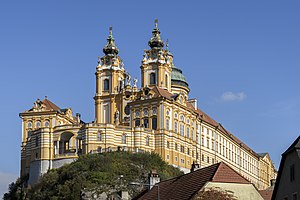
The Benedictine monastery in Melk ( German: Stift Melk ) is located in Lower Austria near the town of Melk on the rocky right bank of the Danube in the Wachau Valley. The baroque ensemble of the monastery, created in 1702 - 1746 by the famous Austrian architect Jakob Prandtauer ( German : Jakob Prandtauer ), was included in the UNESCO World Heritage List in 2000 . The monastery has a gymnasium founded before 1140 , one of the oldest schools in Austria.
| Monastery | |
| Monastery in Melk | |
|---|---|
| Stift Melk (up to the 19th century, it was also called Stift Mölk) | |
 | |
| A country |  Austria Austria |
| City | Melk , Lower Austria |
| Denomination | Catholicism |
| Diocese | |
| Architectural style | |
| Architect | Jakob prandtauer |
| Founder | |
| Established | XI century |
| Website | |
Content
- 1 History
- 1.1 Early period
- 1.2 Late Middle Ages and Melk Monastic Reform
- 1.3 Decline and rebirth in the 16th and 17th centuries
- 1.4 Baroque monastery construction
- 1.5 Ideas of the Age of Enlightenment and Josephism
- 1.6 Monastery in the XIX century. Memorial to Russian soldiers in Melk
- 1.7 The development of the monastery in the XX century and at the beginning of the XXI century
- 2 Monastery complex architecture
- 2.1 Entrance to the monastery, eastern facade
- 2.2 Large monastery park and monastery restaurant
- 2.3 Hall of St. Benedict and the Courtyard of the Prelates
- 2.4 The Imperial Staircase, Imperial Outbuilding and Museum
- 2.4.1 The Imperial Staircase and the Imperial Outbuilding
- 2.4.2 Museum
- 2.5 Marble Hall
- 2.6 Outdoor Terrace
- 2.7 Library
- 3 Monastery Church
- 3.1 Construction
- 3.2 Western facade and towers
- 3.3 Bells
- 3.4 Church interior
- 3.5 Organ
- 3.6 Gymnasium
- 4 Monastery in Melk in literature
- 5 notes
- 6 References
History
Early Period
From the beginning of the XI century, Melk was the center of power of the ruling in Austria in the years 976 - 1246 of the Margraves and Dukes of the Babenbergs . Here was the main tomb of the Babenbergs, and on October 13, 1014, the relics of St. Coloman . The manuscripts from the monastery library indicate that even under the Margrave of Austria, Leopold I Melk was a kind of palatinate contained in the presbytery , i.e. a waypoint (palace / castle), where traveling persons of the ruling dynasty and, more rarely, the highest church officials stopped .
With the expansion of Margrave, Austria in the north and east and the emergence of new centers Melk gradually lost its significance, but still remained the burial place of the Babenbergs. During the struggle for investiture (the most significant conflict between the Catholic Church and secular power in medieval Europe ), Margrave Leopold II granted asylum in Melk to Bishop Altmann Passausky , who was expelled from Passau in 1085 for allegiance to the pope. Presumably, it was Altmann Passausky who had a significant influence on Leopold II in his decision to build a monastery in Melk on a rock towering above the Danube. And already on March 21, 1089 , Benedictine monks from Lambach , headed by Abbot Zigibold, moved to the newly built monastery. [one]
In 1122 , the so-called " eczema " was granted to the monastery in Melk - exemption from submission to the episcopate Passau, and the monastery became directly subordinate to the pope .
The monastery had its own scriptorium where scribes worked. It is very likely that in the 12th century they included a cleric (or perhaps a monk or a converse ) and satirist poet Heinrich von Melk ( German Heinrich von Melk ), a representative of the early New High German period of German language development.
Some manuscripts written by Abbot Walther ( 1224 - 1227 ) ( German : Abt Walther ) have survived, some of them contain colored miniatures . The manuscripts of 1160 indicate that the monastery actively operated its own school.
On August 14, 1297, church buildings and outbuildings of the monastery were destroyed by a severe fire. The library perished in the fire, and with it most of the manuscripts and historical sources.
Late Middle Ages and Melk Monastic Reform
The fire in the monastery turned it into almost ruins. Through the efforts of Abbot Ulrich II ( 1306 - 1324 ), only the most necessary was restored. The events of the fourteenth century did not allow the monastery to develop quietly: the plague , crop failures and the Great Western schism in the Roman Church, which lasted from 1378 to 1417 , undermined the discipline of the monastery and adversely affected the economic activities of the monastery.
Some glimpse brought with him the time of the reign of Duke Rudolph IV . In 1362, the duke ordered and presented the monastery with a very expensive, artfully decorated cross as a frame for a particularly revered relic : particles from the cross on which Jesus Christ was crucified - it was brought to Melk by Margrave Adalbert around 1040 . Today, the Melk Cross ( German das Melker Kreuz ) is the main shrine of the monastery in Melk. [2] In addition, the duke rebuilt and decorated the tomb of St. Coloman.
At the beginning of the 15th century, the Melka Monastery, like many other monasteries of this time, got stuck in debt, the monks clashed among themselves, discipline was greatly shaken. At the Council of Constance, it was decided to reform the Benedictine monasteries, and the monastery in Melk was to become the starting point of this reform. The abbot of the Benedictine monastery in Italy, ( German : Nikolaus Seyringer), a former rector of the University of Vienna , was sent to the Melka Monastery to monitor the progress of the reform, and in 1418 he became abbot of the Melk monastery.
Zeuringer managed to restore strict monastic discipline in Melk. served as the beginning of a wide reform of the church sphere. Monks from other monasteries came to Melk to study the experience of reform. Members of the Melk Convention were appointed abbots to other monasteries. Thus, Melk became the center of reform that swept Austria, and then the whole of southern Germany, affecting the Black Forest region.
In the subsequent period, the monastery, in close collaboration with the University of Vienna, became one of the centers of culture. A number of famous representatives of spiritual history came out from the walls of the monastery, such as , , [3] , [4] , ). Theological, monastic and scientific works were created or corresponded in scriptoriums. Two thirds of the surviving Melk manuscripts belong to this period.
However, economically, things were not going well: the monastery continued to struggle with economic difficulties. The country was shocked by the Hussite wars and conflicts of Frederick III with the nobility. The monastery was faced with the financial demands of the overlords and was drawn into conflicts. In 1482, the Hungarian king Matthias I declared war on Austria, which ended with the victory of Hungary: in 1485, Matthias I took possession of Vienna , which became his new residence. In 1483, Abbot Augustin von Obernalb was forced to resign, and Wolfgang Schaffenrath, the favorite of Frederick III, became abbot in Melk instead.
Decline and Renaissance in the 16th and 17th Centuries
At the beginning of the XVI century, the Ottoman wars brought new expenses, which undermined the economic foundations of the monastery. The possessions of the monastery near Vienna were devastated and depreciated.
At the same time, many residents of nearby settlements, as well as the owners of neighboring fortresses supported the Reformation . The number of people wishing to join the Catholic monastery in Melk fell sharply. In 1566, less than ten people were inhabitants of the monastery. The monastery was on the verge of complete closure.
In 1564, the new abbot Urban Pentaz arrived in Melk (until 1587 ), from which the revival of the monastery began. At first, he had to overcome conflicts with secular officials , who were important to maintain their power over the monastery. Charges were even brought against him. In the end, he managed not only to free himself from these accusations, but also to obtain official approval from Rome as abbot. He was able to restore the monastery’s economy again and made sure that many young men from southern Germany again entered the monastery. The case of the abbot was continued by his followers Caspar Hofmann (1587–1623) and Rainer von Landau (1623–1673). The monastery finally paid off its debts and even bought out the mortgaged property, despite the high taxes caused by the Thirty Years' War and the constant threats from the Ottoman Empire . The church and monastery were renovated and restored, partially rebuilt or rebuilt. The influence of secular power was weakening more and more, and then it was finally overcome. As in previous times, the monastery community flourished again, and the monks from Melk again began to be often invited by the abbots to other monasteries. At the end of the 17th century , the financial basis was laid for the later construction of a new Baroque monastery.
At the same time, the monastery became the regional center of the counter-reformation . By agreement with the episcopate in Passau, the monastery appointed its monks to all church posts in nearby parishes in order to prevent the spread of Lutheran ideas .
Together with the economic upsurge, the literary and scientific activities of the monastery revived. At that time, Johann Tritemius ( German Johannes Zeller, Latin Ioannes Tritemius) and the author of the Melk Chronicle Anselm Schramb ( German Anselm Schramb ) lived in Melk, wrote and wrote their works. The Melk monastery school was expanded, reorganized on the basis of 6-year-old Jesuit gymnasiums: students first completed a four-year course at the monastery school, and then were transferred to a Jesuit college (college) in Vienna for two years to complete their studies.
Baroque Monastery Construction
On November 18, 1700, the thirty-year-old Bertold Dietmayr [5] was elected abbot, who immediately set a goal to increase the religious, spiritual and political significance of the monastery. To achieve this, the abbot intended by rebuilding the monastery in the Baroque style. He invited famous experts.
The project was developed by architect Jakob Prandtauer ( German : Jakob Prandtauer ), who led the construction for 34 years, until his death, which followed in September 1726 , and then this mission was taken over by his nephew Joseph Munggenast ( German Joseph Munggenast ).
In 1701, restoration of the sacristy and the collapse of the monastery church, which threatened with collapse , began, but almost immediately after the start of work, they decided to build a new church. The first stone in its foundation was laid in 1702 . But then it was decided to build a new monastery complex. The plan of horizontal projection of the monastery from 1711 (German Klosterriss ) has survived to our days.
The Viennese engineer, theater architect and designer Antonio Beduzzi (also spelled Antonio Beducci ) ( it . Antonio Beduzzi or Peduzzi ) was invited to the post of internal building architect. Stucco work since 1716 led by Johann Pöckh ( German : Johann Pöckh ). At the same time, the artist Johann-Michael Rottmayr painted ceiling murals . Other famous artists, both local and invited from afar, also participated in the construction and decoration. So, the frescoes in the library and in the Marble Hall were created by the Austrian painter Paul Troger , Christian David from Vienna (German Christian David ) was responsible for the decorative gilding .
By 1736, the construction of both the monastery church and the monastery itself was essentially completed. However, in 1738 the monastery was swept by a new strong fire, which destroyed almost all the roofs, both towers and some ceremonial halls. Bertold Dietmire immediately ordered restoration work, but he did not live to see it finish (he died in 1739 ). It was possible to complete the restoration only under his successors, despite financial and political obstacles, and in 1746 a new monastery church was finally consecrated in the monastery.
The heyday of the monastery’s scientific and musical life was also in the eighteenth century. Two Benedictine monks, predecessors of the Age of Enlightenment , brothers Bernhard Pets and Jerome Pets (the first one is a historian, philologist and librarian, the second is a philologist and historian), made an indispensable contribution to the study of the history of Austria; their works are of lasting importance. Musicians such as the composer and pianist, Joseph Haydn’s pupil Robert Kimmerling ( Robert Kimmerling (inaccessible link) ), his pupil priest Marian Paradeiser , who taught at the monastery gymnasium until the end of his days, as well as the church composer attracted great attention and respect. and music theorist, parish priest Maximilian Stadler. Until 1793 , Johann Georg Albrechtsberger was the organist in the monastery in Melk, who later received the post of bandmaster of the Cathedral of St. Stephen's in Vienna.
Ideas of the Age of Enlightenment and Josephism
During the reign of Emperor Joseph II , who carried out liberal reforms in Austria in the spirit of the Age of Enlightenment , the monastery in Melk experienced a number of changes. Following the ideas of enlightened absolutism , Joseph II carried out reforms that completely subordinated the Catholic Church to the state, regulating its activities in literally everything except issues related to dogma. These reforms were to serve the interests of the welfare state. According to his ideas, many church institutions, such as monasteries, did not perform social functions, and therefore they were massively closed due to their uselessness to civil society.
By imperial decree , the teaching of theology was canceled in Melk in 1783 . All clergymen had to study only at the Vienna General (or General) Seminary (Wiener Generalseminar) (Joseph II established twelve state theological general / general seminaries , including in Vienna) in the spirit of the Enlightenment. Those who returned to Melk after graduating from Vienna seminary should have promoted and disseminated new ideas.
Numerous government regulations limited the independence of the monastery in Melk. He was responsible for appointments for vacancies in new parishes organized according to the State Order on Clergy, paid for the expenses of church courtyards in which parish priests lived, and schools. Due to the great importance of the monastery’s activities for the state, school education and counseling, it was possible to avoid its closure. However, in 1785 , after the death of Abbot Urban Hauer, Emperor Joseph II banned the election of a new abbot. Instead, the leadership of the monastery in Melk was entrusted to the state commandant abbot ( lat . Abbas in commendam ) (see command ).
These orders were canceled after the death of Joseph II in 1790 . Isidore Payrhuber , who served as commandant abbot since 1788 , was selected to return to the post of monastery abbot.
The monastery in the XIX century. Memorial to Russian Soldiers in Melk
Before the monastery could get rid of state pressure, the bishop of the new episcopate in the city of Sankt Pölten began to intervene in his life. In 1787, on his initiative, the monastery gymnasium was transferred to St. Pölten, and only in 1804 it was again returned to Melk.
During a fire on December 14, 1805, which broke out in the fortified northern tower of the monastery, about 200 or 300 soldiers of the Russian Imperial Army captured in the Battle of Austerlitz were killed in the fire. Russian soldiers were buried in a mass grave halfway between Melk and the village of Vinden. At first, a simple wooden cross was installed on the grave, but in 1891, Emperor Alexander III ordered the construction of a black marble memorial, around which trees were planted. In 1945, the memorial was restored by the military forces of the Soviet occupation zone on the orders of the political department of the 20th Rifle Corps, while a fence with an arched opening was installed. Today, the memorial is located directly on the federal highway B 1 (Wiener Straße) and is the object of protection of historical monuments . [6]
During the Napoleonic Wars, the monastery was imposed new heavy taxes while maintaining the financial burden imposed by decrees of Joseph II. The monastery was able to pay off the debt only after the reign of Napoleon Bonaparte , under the abbot Marian Zwinger (Marian Zwinger, 1819 - 1837 ).
After the revolution of 1848 , the monastery lost ownership of the land. However, he was paid monetary compensation. Part of these funds went to the overhaul of the monastery buildings, and the remaining funds were acquired estate in Margite (a city in modern Romania ).
At the end of the 19th century, under the abbot and politician ( 1875 - 1909 ), the monastery regained its former influence in the region. The Wachau Valley owes the monastery a characteristic planting of fruit trees along country roads. In the city of Melke, the monastery organized a kindergarten and presented the city with several land plots, on which a quarter built up with villas subsequently arose. Karl-Abt-Strasse street adjacent to the quarter is named after Abbot Alexander Karl.
The development of the monastery in the 20th century and at the beginning of the 21st century
At the beginning of the 20th century , modern sewerage and water supply systems were built in the monastery, electricity was provided, and major repairs of buildings were carried out. All these works were successfully completed, despite the First World War . However, financial difficulties forced the monastery to part with many cultural values, mainly in 1919 , when the monastery lost a significant part of its financial assets due to inflation . In particular, in 1926, Gutenberg's Bible was sold to Yale University .
After the Anschluss of Austria in 1938 , the Nazis closed the monastery’s gymnasium, and many of the monastery’s buildings were confiscated and transferred to the state high school. There were fears that the Nazis would completely close the monastery, but neither during the Second World War , nor during the occupation of Austria by the Allied forces, the monastery was almost not affected, except for the destruction of the vineyards.
In 1960, the facade of the monastery was restored again.
In 1989, the 900th anniversary of the monastery in Melk was celebrated, in connection with which an exhibition was opened in the monastery, open until 1990 . During these two years, the exhibition was able to visit about 1.1 million people. By the opening of the exhibition, the building through which the entrance to the monastery and the Courtyard of the Prelates were restored.
Already on the eve of the anniversary celebrations, it became obvious that further restoration of the monastery was necessary. The Cartesian monastery of Kartause in Gaming ( de: Kartause Gaming ), which belonged to the monastery in Melk, had to be sold due to the impossibility of financing the work on its restoration in addition to the costs of restoration work in Melk.
In 1990, work was carried out to strengthen the supporting structures in the library, in the hall of St. Koloman and in the northern part of the monastery. In 1991 - 1995, the northern side of the monastery, the eastern facade, the southern facade, etc. were restored.
Since the income from the traditional monastic industry - agriculture and forestry - was not enough to cover these expenses, nor the current operation of the monastery, tourism has recently become another source of income. The monastery was opened for tourists after restoration, and now about 500 thousand visitors come here annually. To date, revenue from excursions is a significant part of the complex’s income. Of course, the infrastructure necessary for tourists was also created: a large modern parking for cars, a bicycle parking with lockable cells for storing things, which allows many cyclists to visit the monastery during trips along bicycle routes along the Danube, a restaurant, a monastery garden with an updated landscape park design. Guided tours of the monastery complex and garden are organized.
Melk Monastery is depicted on the reverse side of the 501 shilling banknote of 1951 (which went out of circulation after the introduction of the euro ).
Monastery Complex Architecture
The monastery in Melk is striking in its scale: in Austria it is the largest monastery ensemble, built in the Baroque style. The area occupied by the monastery is 17.5 thousand m², the length of the southern wing, where the luxurious Marble Hall is located, is more than 240 m, the total length of the main axis is 320 m [7] .
Entrance to the monastery, eastern facade
As a rule, visitors enter the Melk monastery through a portico in the eastern part of the monastery fence. On the sides of the portico, built in 1718 , there are so-called bastions (fortress towers): the southern one is the fortification building of 1650, while the northern tower was ordered to be built by the architect Jacob Prandtauer, the author of the project for the new monastery complex, for reasons of symmetry. To the right and to the left of the gate in 1716 there are statues of Margrave Saint Leopold III, patron of Austria and Vienna, and St. Coloman, their author is the Viennese court sculptor . He created a composition with angels, crowning the pediment of the portico.
After passing through the portico, visitors find themselves in the Gatekeepers' Court ( Austrian Torwartlhof ), on the left side of which there is a reception area and ticket offices. On the right is one of the two Babenberg towers , the remains of the ancient fortifications of the monastery.
Directly in front of visitors, they see a magnificent oriental facade that looks more like a palace of a monastery building. In the old days, from the small balcony that is located above the large arch of the main entrance, the abbots traditionally welcomed guests. The columns to the right and left of the entrance are crowned at the balcony level with statues of the holy apostles Peter and Paul , patrons of the monastery church. The motto shines on the pediment: Absit gloriari nisi in cruce ( But for me there will be no other praise, unless the cross of our Lord Jesus , Gal. 6:14). This motto is not just words from the Epistle to the Galatians of the Holy Apostle Paul, but a reminder of the relic of the monastery: the Melk cross, an enlarged copy of which adorns the completion of the pediment.
Grand Monastery Park and Monastery Restaurant
Near the portico is the entrance to a large monastery park. It was defeated in 1746 - 1747 on behalf of Abbot Thomas Power according to the design of the Vienna architect and artist Franz Sebastian Rosenstingl and still retains the features of the original layout. The park is one of the most significant park and architectural ensembles in Austria and is protected as a cultural monument.
The park has a garden pavilion in the Baroque style, built in 1747 - 1748 according to the project of Franz Munggenast. The halls of the pavilion were painted in 1763 - 1764 by Johann Baptist Wenzel Bergl with frescoes on exotic motifs. Today in the garden pavilion there is a cafe and concerts are held.
The monastery park is divided into several zones, among which it is worth mentioning first of all the Paradise Garden (German: Paradiesgärtlein ), as well as the Baroque water reservoir, lined with 250-year-old linden trees.
Opposite the gate is the entrance to another part of the park, where there is a monastery restaurant and a baroque garden and park ensemble ( not to be confused with a large monastery park ).
Hall of St. Benedict and the Court of the Prelates
Passing through the arch of the main entrance under the balcony, visitors find themselves in a bright two-story hall - St. Benedict . The saint is depicted on the ceiling fresco of the hall. The original image created by Franz Rosenstingl was updated by the Austrian portrait painter and historical paintings by Friedrich Schilcher in 1852 . From the hall of St. Benedict has a view of the Prelate Courtyard ( German Prälatenhof ) - 84 mx 42 m. It has a trapezoidal shape, which enhances the overall spatial impression of the Prelate Courtyard square, oriented to the dome of the monastery church.
The articulation of the facades of buildings framing the Courtyard of the Prelates is simple and calm in harmony. The baroque frescoes of Franz Rosenstingl on the central gables depicted the four main virtues (according to Plato ): moderation (on the north side), wisdom (on the west side), courage (south side), justice (in the east). In the mid- 19th century, they were replaced by frescoes by the Austrian painter Friedrich Schilcher . But they, too, could not be restored during a major restoration in the 1980s. Therefore, they were replaced by the works of contemporary artists Peter Bischof (Peter Bischof) and Helmut Krumpel (Helmut Krumpel) [8] .
In the center of the Prelate's Courtyard there is the fountain of St. Coloman , created in 1687 and standing in the Prelate's Courtyard until 1722 , when Abbot Bertold Dietmair presented it to the city of Melk for installation on the market square - the central square of the city. At the beginning of the 19th century, the fountain was bought from the Waldhausen monastery and has since been again in the Prelate's Courtyard.
Imperial Staircase, Imperial Outbuilding and Museum
The Imperial Staircase and the Imperial Wing
The gates located in the left rear (southeast) corner of the Prelate Courtyard overlook the imperial main staircase leading to the imperial outbuilding - that part of the monastery building in which the chambers of the imperial family were located. The luxurious imperial staircase, adorned with columns of white limestone, does not seem wide enough below, but extends upward, where it is richly decorated with stucco and two allegorical sculptures of the virtues of Constantia (constancy) and Fortitudo (courage). The ceiling fresco depicts boys playing with eagles, who point to the imperial double-headed eagle . This testifies not only to the secular nature of the imperial wing, but also to the political role played by the monastery in the state system of Austria. Emperor Charles VI , whose motto is "Constantia et fortitudine " ( lat . "With constancy and courage" ) adorns a large gilded plaster medallion , always emphasized his special commitment to the monastery and its abbot Bertold Dietmayr.
The imperial gallery along the emperor’s chambers on the second floor is 196 meters long and runs along almost the entire southern side of the building. On the walls hang portraits of all Austrian rulers from the dynasties of the Babenberg and Habsburgs , equipped with brief biographical information. Most of the old portraits were painted in 1759 by the monastery painter Franz Josef Kremer , a representative of the picturesque school of Paul Troger.
The rooms intended for the imperial family were on the left side of the gallery. Later, furniture from the imperial chambers was transferred to the Lauenburger Schloss castle, the original stucco decorations were preserved in only two rooms.
Museum
Today in the former imperial chambers the museum of the monastery is located. The exposition of each of the halls is dedicated to one or two of the following topics:
- Saint Benedict and the foundation of the Order of St. Benedict.
- Babenberg Dynasty, St. Koloman and the foundation of the monastery in Melk.
- The heyday and decline in the history of the monastery and the church.
- Romanesque and Gothic architecture : Romanesque crucifix made of linden tree (late XII century ) (previously located in the Ruprechtskirche church in Vienna).
- Life in the Baroque era.
- Abbot Bertold Dietmayr and the restructuring of the monastery in the Baroque style: the exposition presents paraments (altar vestments) and abbey wands.
- Enlightened absolutism and Josephism. The exposition, in particular, exhibited leather robes and the so-called economical reusable coffin , used in the reign of Joseph II.
- The emerging man and the tasks of the monastery.
- Melk Altar created by Jörg Bray the Elder ( 1502 ). On eight boards on both sides are scenes from the life of Jesus Christ and the passion of Christ .
- The economy of the monastery. The history of the construction of the monastery.
- The baroque ensemble of the monastery and its decoration. The exposition presents a model of the entire monastery complex.
Marble Hall
The marble hall, adjacent to the imperial chambers, was originally conceived as a festive and banquet hall for receptions of social guests, especially for the imperial court. The hall could be heated through a cast-iron grate embedded in the floor in the center of the hall. Door panels and thresholds are made of real Salzburg marble , the wall decoration imitates natural stone (plastering using the scalol technique). The purpose of the hall is indicated by Latin inscriptions above the doors of the Charter of St. Benedict ( lat . Regula Benedicti ): Hospites tamquam Christus suscipiantur (“You must meet the guests as Christ himself”) and Et omnibus congruus honor exhibeatur (“And everyone should be given the appropriate honors”).
On the ceiling fresco (Paul Troger, 1731 ) in the center is Athena Pallas , who controls a winged chariot drawn by lions, and to her left is Heracles , who kills the three-headed dog Cerberus with a club. Sometimes this plot is interpreted as an embodiment of the ideal of Habsburg domination: a balanced relationship of reasonable moderation (Athena Pallas) and the use of necessary force (Hercules).
Эту потолочную фреску обрамляет роскошная интерьерная живопись , творение итальянского художника- фрескиста Гаэтано Фанти .
Открытая терраса
Архитектурным завершением здания с западной стороны служит просторная открытая терраса на втором этаже, которая соединяет Мраморный зал с библиотекой. С террасы открывается прекрасная панорама: речной ландшафт на западе, горы на северо-западе и город Мельк, расположенный у подножия монастыря с севера.
Терраса позволяет обозревать и внутреннюю территорию монастыря: весь западный фасад монастырской церкви и обе башни.
Библиотека
В бенедиктинских монастырях библиотека всегда является вторым по значимости помещением после монастырской церкви.
Монастырская библиотека в Мельке разделена на два главных зала, которые расписаны потолочными фресками, созданными Паулем Трогером в 1731 — 1732 годах . Изображение на фреске большого зала - полная противоположность фреске Мраморного зала. Это аллегория христианской веры: женщина, которая держит книгу за семью печатями , Агнца Апокалипсиса и щит с изображением Святого Духа в виде голубя, в окружении фигур ангелов и аллегорических воплощений четырёх главных добродетелей: мудрости, справедливости, мужества и умеренности. А интерьерная живопись , как и в Мраморном зале, выполнена Гаэтано Фанти .
Зал производит величественное и гармоничное впечатление благодаря панелям темного дерева, украшенным интарсиями , и соответствующим им по цветовой гамме золотисто-коричневым корешкам книг.
Так как в библиотечном зале весьма темно, то в книжных стеллажах были предусмотрены потайные двери, которые позволяли читающим выйти в светлые помещения. На верхнем этаже устроены два читальных зала, куда публика не допускается. Они украшены фресками Иоганна Бергля .
В фондах библиотеки находятся 1888 рукописей, самые ранние из которых датируются IX веком, среди них - рукописная копия Вергилия X - XI веков. Только в 1997 году был обнаружен фрагмент рукописного списка « Песни о Нибелунгах» , который датируется XIII веком . Кроме того, здесь хранятся 750 инкунабул — книг, напечатанных до 1500 года [9] . Всего в библиотеке около 100 тыс. единиц. Например, недавно были выставлены два экземпляра написанной на латинском языке Х. Шеделем « Нюрнбергской хроники » - инкунабулы 1493 года издания, содержащей иллюстрированную хронику библейской истории от сотворения мира . Печатником «Нюрнбергской хроники» был Антон Кобергер — крёстный отец Альбрехта Дюрера (одного из величайших мастеров западноевропейского Ренессанса ).
В 2009 году в библиотеке действовала выставка, посвящённая Международному году астрономии . На ней были представлены рукописи, книги и исторические инструменты из собрания монастыря. Параллельно здесь же прошла выставка книг из монастырской библиотеки, организованная Европейской южной обсерваторией и посвящённая истории астрономии. [10]
Монастырская церковь
Небесные покровители монастырской церкви - святые апостолы Петр и Павел , хотя защитником и покровителем всего монастыря является св. Коломан и в церкви находится рака с его мощами. Монастырская церковь - символ города Мелька и долины Вахау . Она считается одной из самых красивых барочных церквей в Австрии .
Design
Монастырская церковь представляет собой огромный зальный храм под бочарным сводом , с нишами-часовнями и эмпорами .
Западный фасад и башни
На фасаде церкви можно видеть изваяния небесных покровителей церкви, св. апостолов Петра и Павла, а над порталом - статуи архангела Михаила (слева) и ангела-хранителя (справа). На фронтоне между двумя башнями установлено монументальное скульптурное изображение воскресшего Иисуса Христа со стоящими по сторонам двумя ангелами.
Башни были построены заново после пожара 1738 года по проекту Йозефа Мунггенаста, причем он несколько изменил оригинальный проект Якоба Прандтауера. Эти восстановленные башни уже носят черты стиля рококо .
Колокола
В монастырской церкви пять колоколов. Колокольный звон основан на трезвучиях , что типично для барокко, последовательность звучания f 0 –h 0 –d 1 –f 1 –a 1 . Колокол Весперин (Vesperin) весит 7 840 кг, что делает его самым большим колоколом в Нижней Австрии . После пожара 1738 года аббат Бертольд Дитмайр заключил с венским колокольных дел мастером Андреасом Кляйном договор о литье новых колоколов. В 1739 году были установлены балки для подвешивания колоколов и отлиты новые колокола.
Большой колокол звучит при совершении таинства Евхаристии во время понтификальной торжественной мессы . К вечерне накануне католических торжеств и перед понтификальной торжественной мессой звучат все колокола.
По пятницам в 15 часов, когда умер на кресте распятый Христос, звучит 2-й колокол. Во время ежедневного чтения католической молитвы «Ангел Господень» ( лат . Angelus Domini ) утром, в полдень и вечером звонят в 3-й колокол. По воскресным дням 3-й, 4-й и 5-й колокола призывают на богослужение. В маленький хоровой колокол звонят каждое утро, созывая на ежедневное утреннее богослужение.
| № колокола | Названия колоколов | Диаметр (мм) | Масса (кг) | Face value (нота, на которую по умолчанию настроен колокол) (16-е) | Tower |
|---|---|---|---|---|---|
| 1st | Петр и Павел (Весперин) | 2360 | 7840 | f 0 −4 | north |
| 2-й | Троица (Колокол страха) | 1780 | 4300 | h 0 ±0 | южная |
| 3-й | Семь скорбей Марии (Колокол Аве Мария ) | 1520 | 2450 | d 1 −6 | южная |
| 4-й | Коломан | 1180 | 1235 | f 1 +6 | южная |
| 5-й | Бенедикт | 960 | 575 | a 1 +6 | южная |
| 6-й | Хоровой колокол | 650 | 170 | dis 2 +4 | на малой храмовой башне |
Интерьер церкви
Пышное убранство интерьера , богато украшенного сусальным золотом , лепниной и мрамором, выдержано в золотых, охровых, оранжевых, зелёных и серых тонах. Основные проекты и идеи по созданию интерьера принадлежат архитектору Антонио Бедуччи ( ит . Antonio Beduzzi или Peduzzi ). Его указания были реализованы местными художниками.
Центральная тема главного алтаря – прощание друг с другом св. апостолов Петра и Павла . По преданию, они содержались в Мамертинской тюрьме древнего Рима и были казнены в один и тот же день. Огромный золотой венец над ними – символ того, что их мученичество было победой христианства . Справа и слева от апостолов стоят фигуры ветхозаветных пророков . Над всеми восседает на троне Бог Отец под распятием, которое тоже является символом победы христианского вероучения.
Этот мотив церкви воинствующей и побеждающей продолжается в аллегориях на великолепных фресках потолка пресвитерия , выполненных Йоханном-Михаэлем Роттмайром . Ему же принадлежат потолочные фрески в нефе , созданные им по проектам Бедуччи. Они изображают „ Via Triumphalis “ св. Бенедикта. Роспись в фонаре купола – маленькой куполообразной надстройке с декоративными аркадами – принадлежит кисти Роттмайра (1716-1717) и изображает Небесный Иерусалим с Богом Отцом, Христом и Святым Духом. Вокруг них – апостолы, Дева Мария и сонм особо значимых для монастыря в Мельке святых.
Оба алтаря в трансептах (поперечных нефах) расположены симметрично по отношению друг к другу. Они созданы по проектам Бедуччи и посвящены двум главным святым монастыря: св. Коломану и св. Бенедикту. В левом боковом алтаре находится рака с мощами св. Коломана. Чтобы соблюсти симметрию, в правом алтаре, посвящённом св. Бенедикту, установили кенотаф – надгробный памятник в месте, которое не содержит останков покойного. Скульптурная группа в этом алтаре изображает смерть св. Бенедикта в кругу его братьев-монахов. Алтарная скульптура св. Коломана показывает его молящимся.
Часовни боковых алтарей в нефе храма тоже созданы по проектам Бедуччи. Их фрески изображают сцены из жизни святого, которому посвящен алтарь. На северной стороне (в порядке с запада на восток): св. Николай (алтарная картина кисти Паулия Трогера, 1746), архангел Михаил (алтарная картина кисти Й.-М. Роттмайра, 1723), три волхва (в Эпифанском алтаре на алтарной картине Й.-М. Роттмайра, 1723); на южной стороне: св. Себастьян (алтарная картина Пауля Трогера, 1746), св. Иоанн Креститель (на алтарной картине на сюжет крещения Иисуса Христа, художник Й.-М. Роттмайр, 1727), в третьем южном боковом алтаре (алтарь св. Леопольда) – алтарная картина маслом на оловянной пластине, представляющая историю мелькского монастыря от Леопольда I до Леопольда III . В алтарях архангела Михаила и св. Иоанна Крестителя стоят раки с мощами христианских мучеников из катакомб древнего Рима.
Позолоченная кафедра – творение Петера Видерина , скульптора из Санкт-Пёльтена , по проекту Галли-Бибиена . Группа фигур на аба-вуа , потолочном навесе над кафедрой, изображает триумф церкви над еретическими учениями . Боковые элементы деревянных барочных скамей для молящихся украшены резьбой, представляющей собой акантовый орнамент .
Орган
О большом органе венского органного мастера Готтфрида Зоннхольца мы можем судить только по рисунку, изображающему так называемый проспект (термин, обозначающий фасадную часть органа); это единственный документ, сохранившийся со времени его установки в 1731 - 1732 годах, потому что сам орган был утрачен в 1929 году при реконструкции. В 1970 году Грегор Храдецки, органный мастер из Кремса-на-Дунае , изготовил новый орган с пневматической трактурой , имеющий 3 553 трубы, 45 регистров для трёх мануалов и педальную клавиатуру. В 2005 году органостроительная фирма «Александр Шуке» отреставрировала инструмент. Работами руководил Бернхардт Альтхаус, который, в частности, распорядился заменить открытый флейтовый регистр на Montre 8'. В результате удалось добиться новой интонировки труб. Кроме того, в органе теперь используется электронный секвенцер.
Помимо этого главного органа в монастыре есть и другие инструменты, изготовленные такими органными мастерами, как нидерландский мастер Рейл, австрийцы Храдецки, Ридл и Улльманн.
Гимназия
Основная статья: Гимназия в монастыре Мелька
Школа в монастыре действует, начиная с XII века . В настоящее время она имеет статус гимназии.
После Второй мировой войны количество учеников, проживавших в интернате, постоянно сокращалось, так как современное транспортное сообщение позволяет учениками проживать в своих семьях. Поэтому бывший интернат стал сегодня гимназией с углублённым изучением греческого и французского языков и реальной гимназией высшей ступени [11] , где углублённо преподаются игра на музыкальных инструментах, изобразительное искусство, математика и естественнонаучные дисциплины.
С 1966 года осуществляется программа школьного обмена с бенедиктинской школой St. John's Preparatory School в Миннесоте . В 2012 году в гимназии обучались 924 ученика. На сегодняшний день директором гимназии является Антон Эдер. В мае 2008 года завершился двухлетний ремонт всей школы, включая строительство нового спортивного зала.
В школьной зоне монастыря находится зал св. Коломана с потолочной фреской Пауля Трогера , на которой представлена история монастыря в Мельке. В зале св. Коломана регулярно проходят концерты, например в рамках организуемых монастырём Международных дней барокко. В обычные дни посторонние в этот зал не допускаются.
Монастырь в Мельке в литературе
Монастырь в Мельке в литературе
Монастырь в Мельке упоминается в романе Умберто Эко « Имя розы » как место, где была найдена рукопись романа. Адсон, от лица которого ведется повествование, - монах мелькского монастыря. Действие же романа происходит в каком-то другом монастыре. Монастырская библиотека в Мельке легла в основу описания библиотеки в романе.
Notes
- ↑ [stiftmelk.at, abgerufen am 26. März 2017. Die Gründung des Benediktinerklosters in Melk.] .
- ↑ Kolomanimonstranz (англ.) . Stift Melk. Дата обращения 7 мая 2017.
- ↑ Martinus de Senging . Digitale Repertorium "Geschichtsquellen des deutschen Mittelalters".
- ↑ Wolfgangus de Styra . Digitale Repertorium "Geschichtsquellen des deutschen Mittelalters".
- ↑ Элиша Зинде. Выше Вены . Коммерсантъ (25.03.2013).
- ↑ фотография памятника русским солдатам в Мельке .
- ↑ Путеводитель по Австрии, Вокруг Света, 2005, с. 151
- ↑ Das kulturelle Geschehen .
- ↑ Путеводитель по Австрии, Вокруг Света, 2005, с. 152
- ↑ „Die Himmel rühmen die Herrlichkeit Gottes“ (Psalm 19,2) . 1000 Jahre Astronomiegeschichte aus der Stiftsbibliothek Melk (нем.) . StiftMelk.at . Дата обращения 17 мая 2017.
- ↑ Bundesministerium für Bildung. Пути образования в Австрии. 2016/17. На русском яз. .