Clever Geek Handbook
📜 ⬆️ ⬇️

Cellularity

Cellularity ( Suslin number ) is a topological characteristic of a topological spaceX {\ displaystyle X} X determined by the maximum number of open pairwise disjoint sets fromX {\ displaystyle X} X . It is a cardinal invariant and is denoted byc(X) {\ displaystyle c (X)} {\ displaystyle c (X)} .

As with many general topological invariants, finite cellularity is not of interest; it is considered that it is no less than countable (i.e.ℵ0 {\ displaystyle \ aleph _ {0}} \ aleph_0 )

Heredity

Not a hereditary invariant , i.e. a subspaceU⊆X {\ displaystyle U \ subseteq X} {\displaystyle U\subseteq X} may have greater cellularity thanc(X) {\ displaystyle c (X)} {\displaystyle c(X)} . For example, a point is enough0 {\ displaystyle 0} {\displaystyle 0} in the segment[0,one] {\ displaystyle [0,1]} [0,1] multiply an uncountable number of times, then the subspace of multiplied zeros will have greater cellularity than the segment, that is, moreℵ0 {\ displaystyle \ aleph _ {0}} \aleph_0 , i.eℵ0=c(X)<hc(X)=c {\ displaystyle \ aleph _ {0} = c (X) <hc (X) = {\ mathfrak {c}}} {\displaystyle \aleph _{0}=c(X)<hc(X)={\mathfrak {c}}} . Another example of non-inheritance of cellularity is the Nemytsky plane .

Relationship with other invariants

The cellularity of space does not exceed its density (which, in turn, does not exceed weight ):c(X)⩽d(X)⩽w(X) {\ displaystyle c (X) \ leqslant d (X) \ leqslant w (X)} {\displaystyle c(X)\leqslant d(X)\leqslant w(X)} . Also, cellularity does not exceed the spread (which also does not exceed the weight):c(X)⩽hc(X)⩽w(X) {\ displaystyle c (X) \ leqslant hc (X) \ leqslant w (X)} {\displaystyle c(X)\leqslant hc(X)\leqslant w(X)} .

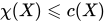
For linearly ordered spaces, their character does not exceed cellularity:χ(X)⩽c(X) {\ displaystyle \ chi (X) \ leqslant c (X)} {\displaystyle \chi (X)\leqslant c(X)} . In addition, for linearly ordered spaces, cellularity coincides with the spread and the Lindelöf hereditary number :c(X)=hc(X)=hl(X) {\ displaystyle c (X) = hc (X) = hl (X)} {\displaystyle c(X)=hc(X)=hl(X)} .

Do not exceed the cellularity of the topological spaceX {\ displaystyle X} X its Lindelöf number and extent (in turn, not exceeding the Lindelöf number):e(X)⩽l(X)⩽c(X) {\ displaystyle e (X) \ leqslant l (X) \ leqslant c (X)} {\displaystyle e(X)\leqslant l(X)\leqslant c(X)} .

Examples

For the real lineR {\ displaystyle \ mathbb {R}} \mathbb {R} :c(R)=ℵ0 {\ displaystyle c (\ mathbb {R}) = \ aleph _ {0}} {\displaystyle c(\mathbb {R} )=\aleph _{0}} . For natural and integer numbers:c(Z)=c(N)=ℵ0 {\ displaystyle c (\ mathbb {Z}) = c (\ mathbb {N}) = \ aleph _ {0}} {\displaystyle c(\mathbb {Z} )=c(\mathbb {N} )=\aleph _{0}} .

For discrete power spaceτ {\ displaystyle \ tau} \tau :c(Dτ)=τ {\ displaystyle c (D _ {\ tau}) = \ tau} {\displaystyle c(D_{\tau })=\tau } .

For a hedgehog pricklyτ {\ displaystyle \ tau} \tau :c(J(τ) ) = τ {\ displaystyle c (J (\ tau)) = \ tau} {\displaystyle c(J(\tau ))=\tau } . (Whenτ⩾ℵ0 {\ displaystyle \ tau \ geqslant \ aleph _ {0}} {\displaystyle \tau \geqslant \aleph _{0}} (it’s enough to take an open set in each “needle” that does not go beyond the “needle”).

In general for subspaceU {\ displaystyle U}   from Euclidean spaceRn {\ displaystyle \ mathbb {R} ^ {n}}   :c(U)⩽ℵ0 {\ displaystyle c (U) \ leqslant \ aleph _ {0}}   .

Literature

  • Engelking, Ryszard. General topology. - M .: Mir , 1986 .-- S. 103.333. - 752 s.
Source - https://ru.wikipedia.org/w/index.php?title= Cellularity&oldid = 64483271


More articles:

  • James Thompson (race car driver)
  • Bara (farm)
  • Van der Paul, Annelise
  • Wakeman Oliver
  • Hatching Instinct
  • Korichu
  • Holidays of the USSR
  • Constitutional Court of the Republic of Bashkortostan
  • Saveliev, Ivan Feoktistovich
  • Yazykovo (manor)

All articles

Clever Geek | 2019