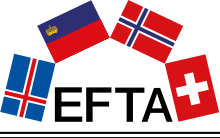
The European Free Trade Association (EFTA) was created in 1960 with the aim of creating a free trade zone , the original members were Great Britain , Denmark , Norway , Sweden , Austria , Switzerland and Portugal . Finland became an associate member in 1961 (in 1986 became a full member), and Iceland became part of the EFTA in 1970 . Liechtenstein joined in 1991 (tentatively, Switzerland represented its interests in the EFTA). Great Britain (1973), Denmark (1973), Portugal (1986), Finland (1995), Austria (1995), and Sweden (1995) left the EFTA and became EU members. Today, only Iceland , Norway , Switzerland and Liechtenstein remain members of the EFTA.
| European Free Trade Association | |
|---|---|
| fr. Association européenne de libre-échange (AELE) him. Europäische Freihandelsassoziation fig. Frisverslunarsamtök evrópu ital. Associazione europea di libero scambio romance. Associaziun europeica da commerzi liber Norwegian Det europeiske frihandelsforbund | |
 | |
 | |
| association members members of the European Union | |
| Membership |  Iceland Iceland Liechtenstein Liechtenstein Norway Norway Switzerland Switzerland |
| Headquarters | Geneva |
| Type of organization | Trading block |
| Base | |
| Established | 1960 |
| efta.int | |
Content
History of Education
The rivalry of Great Britain with France and the Federal Republic of Germany at the turn of the 1950s and 1960s made its entry into the European Economic Community (EEC) impossible. The creation of the second integration association in a sense reflected this rivalry.
The European Free Trade Association (EFTA) was created on May 3, 1960 as an alternative for European states that could not or did not want to join the European Economic Community (now the European Union ) and considered the plans to create a European common market too ambitious.
The EFTA Convention was signed on January 4, 1960 in Stockholm by seven states: the United Kingdom , Denmark , Norway , Sweden , Austria , Switzerland and Portugal .
The Stockholm Convention was subsequently replaced by the Vaduz Convention. This Convention provided for the liberalization of trade among member states of the association by 1970 by reducing customs duties and curtailing quantitative restrictions.
The EFTA was limited to more modest tasks than the EEC. Under the Stockholm Convention, the EFTA customs policy applied only to manufactured goods. The EFTA countries did not introduce a single tariff for products imported from third countries, and maintained national customs duties, thus implementing an independent trade policy.
EFTA Institutes
The European Free Trade Association is governed by the EFTA Council. The Council meets twice a month at the level of ministers or permanent representatives. In its activities, it relies on a number of committees: customs experts, trade experts, an economic committee, an advisory committee (representatives of entrepreneurs and trade unions, up to five people from each member state), a parliamentary committee, a budget committee, and other expert groups that are convened from time to time consider special issues. The Council monitors the implementation of the Convention on the Establishment of the EFTA, and makes recommendations to the governments of the participating countries.
The Secretariat, led by the Secretary General, provides support to the Council, committees and expert groups. Six departments of the secretariat are responsible for trade, economics, integration, the press and information, etc. The EFTA secretariat is located in Geneva (Switzerland).
In connection with the 1992 Agreement on the European Economic Area , two more EFTA organizations were established: the EFTA Supervisory Authority and the EFTA Court. The headquarters of the EFTA Supervisory Authority is located in Brussels (as is the headquarters of the European Commission), while the EFTA Court is located in Luxembourg (as is the Court of the European Union ).
All the governing bodies of the Association, in contrast to the EEC bodies, perform primarily advisory functions.
EFTA Development
By the beginning of the 1970s, the process of creating a free trade zone was completed at EFTA. She became the most famous and significant of all the already established free trade associations. There have been tendencies for this organization to develop into more developed forms of integration, in particular in the economic union, but these trends have not been realized. Although the plans to create a free trade association in Europe were implemented, this integration process in the EFTA countries did not have the same beneficial effect on the economy as in the competing European economic community.
Great Britain and other EFTA countries faced a dilemma: either to strengthen the EFTA, or to seek accession to the EEC. The UK has benefited from the need for common tariffs for EFTA members by importing goods from the Commonwealth of Nations and selling them to other EFTA members. Due to the rapid development of the EEC and the decision to focus on Europe, and not on the United States and the Commonwealth nations, such as Australia, Canada and New Zealand, as a trading partner, the UK asked for membership in the EEC in 1961 . However, as a result of the negative position of France, these negotiations ended in failure in January 1963 , which led to the intensification of the EFTA. By January 1, 1967, all customs duties and quantitative restrictions on trade in industrial goods between the participating countries (except Portugal ) were eliminated. A year later, customs duties between EFTA and Finland were eliminated.
The withdrawal of Great Britain and Denmark from the EFTA in 1972 markedly weakened this organization and forced the remaining participants to seek ways to resolve economic relations with the EEC, which is the main trading partner of the Association member countries. As a result of difficult negotiations, all the EFTA members, as well as Finland, concluded free trade agreements on industrial goods with the EEC, which entered into force in 1973 . Based on them, a mutual reduction of customs duties was carried out, which were completely abolished on July 1, 1977 . As a result, a free trade zone was formed in Western Europe, which included the EU and EFTA countries. In 1984, the EEC and EFTA concluded an agreement on the creation of a single economic space and on the expansion of cooperation in such areas as economic, monetary and industrial policy, R&D, ecology, fisheries, transport, and ferrous metallurgy. One after another, the EFTA countries began to leave the EFTA and join the EU. Portugal left EFTA in 1986 , Austria , Sweden and Finland joined the European Union in 1995 and thus ceased to be members of the EFTA. By that time, in May 1992, EFTA and the EU had concluded an agreement on the Common Economic Space (free movement of people, goods, services, capital).
The remaining EFTA members ( Iceland , Norway , Switzerland and Liechtenstein ) continued to monitor the full implementation of the Stockholm Agreement. EFTA member states have concluded free trade agreements with countries in Central and Eastern Europe, including Bulgaria , Poland , Romania , Slovakia and the Czech Republic . Similar declarations were signed with the Baltic states. In 2010, Ukraine signed a free trade agreement with EFTA. The agreements relate to trade in manufactured goods and agricultural products. Their goal is to support reforms in this part of Europe by stimulating trade ties.
See also
- Central European Free Trade Association
- European Economic Area